 Birch Bay Window
 Blaine's Exterior Challenges Are Different From Inland Whatcom County
Homes in Blaine sit close to Semiahmoo Bay, Drayton Harbor, and the open water of the Strait of Georgia, which puts them in a different exposure category than a house fifteen minutes inland. Salt-laden air moves off the water and settles on every exterior surface, driving rain comes in sideways during winter storms, and the same marine humidity that keeps lawns green year-round also keeps roofs, siding, and shaded decking damp long enough for moss and algae to take hold. None of this means a home in Blaine is doomed to constant repairs, but it does mean the materials and installation details that work fine forty miles inland can fall short here.
We work on homes across Birch Bay and the surrounding Whatcom County coastline, and the pattern in Blaine is consistent: window seals that fail early, north-facing roof slopes that green up faster than the rest of the roof, siding that shows staining or soft spots at the lowest courses, and deck framing that stays wet under the boards long after the surface looks dry. This page covers what we actually see on Blaine homes and how we approach windows, roofing, siding, and decks for this specific stretch of coastline.
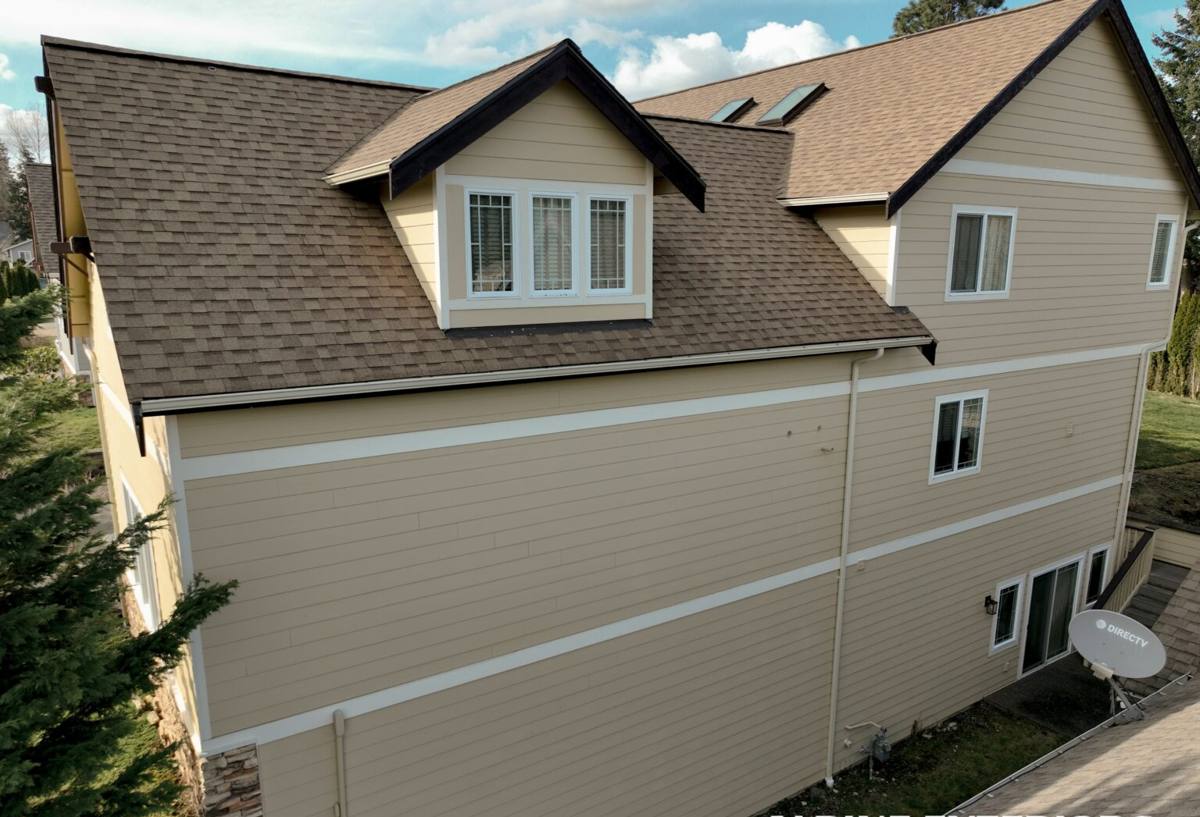
What Salt Air, Rain, and Moss Actually Do to a House
Salt Air and Metal Components
Salt in the air accelerates corrosion on anything metal — window hardware, roofing fasteners, flashing, gutter screws, and deck brackets. It's slow and easy to ignore until a window won't latch smoothly or a fastener head rusts through and starts staining the siding beneath it. Homes closer to the water see this faster than homes set back a few blocks.
Driving Rain and Wind-Driven Moisture
Storms coming off the Strait don't just rain down, they push rain sideways and upward under laps, trim, and flashing that would shed water fine in a calmer climate. This is where installation detail matters more than product quality — a good window installed with poor flashing will leak in Blaine even though it would perform fine somewhere less exposed.
Moss, Algae, and Persistent Dampness
Shaded, north-facing roof and siding surfaces stay damp for days after a storm, and that's exactly what moss and algae need to establish. Left alone, moss holds moisture against roofing material and can work under shingle edges over time. It's a maintenance issue more than an emergency, but it's one that's easy to let slide until it isn't.
Windows Built for This Exposure
Window failures in coastal Whatcom County usually show up as one of three things: fogging between panes (a failed seal), hardware that's stiff or corroded, or drafts around the frame from flashing that was never properly integrated with the wall's water-resistive barrier. We install and flash windows with the assumption that wind-driven rain will hit them directly, not just fall on them.
Frame Material Tradeoffs for Coastal Homes
| Frame Material | Salt Air / Moisture Behavior | Maintenance |
|---|---|---|
| Vinyl | Won't corrode or rot; performance depends heavily on seal and weld quality | Low — occasional cleaning |
| Fiberglass | Very stable dimensionally in wet/dry cycling, resists moisture well | Low |
| Wood or wood-clad | Attractive but requires diligent finish maintenance near salt air | Higher — periodic refinishing |
| Aluminum | Strong but conducts cold and can corrode faster near salt water without coatings | Moderate |
We don't push one material for every home — a shaded, water-facing wall in Blaine calls for different priorities than a sheltered south wall. We'll walk your specific exposure with you rather than recommend the same package for every house.
Glazing and Seal Considerations
Dual-pane, low-E glass with a well-sealed insulated glass unit is standard for this climate — it helps with both energy performance and condensation control on cold, humid days. The seal itself is the part that fails first in a marine environment, which is why we pay close attention to manufacturer warranty terms on the sealed unit specifically, not just the frame.
Roofing That Handles Moss and Wind-Driven Rain
Roof issues in Blaine tend to start at the details, not the field of the roof: valleys, flashing around chimneys and vents, and the edges where wind can lift material during a storm. We pay particular attention to underlayment quality and flashing integration, since a roof that looks fine from the ground can still be letting water in at a poorly sealed penetration.
Moss control is an ongoing conversation, not a one-time fix. Roof orientation, tree cover, and how much sun a slope gets all affect how fast moss returns after cleaning. We can talk through realistic maintenance intervals for your roof's specific exposure rather than promising a permanent solution that doesn't exist in this climate.
Signs a Blaine Roof Needs Attention
- Moss or dark algae streaking on north-facing or shaded slopes
- Granules collecting in gutters after storms
- Soft spots or staining on interior ceilings near exterior walls
- Flashing that looks lifted, rusted, or gapped around chimneys and vents
- Shingles curling or lifting at the edges after wind events
Siding Choices for Salt Air Durability
Siding on the water-facing side of a Blaine home takes more abuse than siding on the leeward side — it's common to see uneven weathering, staining, or early paint failure on the wall that faces the water compared to the rest of the house. Fiber cement and quality vinyl both hold up well against salt air when installed with proper flashing and clearance at the bottom edge, where standing moisture does the most damage over time.
We're careful about ground clearance and drainage behind siding in this climate. A siding product can be excellent and still fail early if it's installed tight against grade or without a way for incidental moisture to escape from behind the panels — that's a workmanship issue, not a product issue, and it's one of the most common causes of early siding failure we see on coastal homes.
Decks That Hold Up to a Marine Climate
Decks in Blaine deal with two separate problems: the visible surface, which gets sun, rain, and salt air, and the framing underneath, which stays damp longer than most homeowners realize because airflow is often blocked by skirting, landscaping, or low clearance to grade. We build and repair decks with attention to under-structure ventilation and proper flashing where the deck ledger meets the house, since that connection point is one of the most common sources of hidden rot.
Composite decking has become popular here because it doesn't need refinishing, but it's not maintenance-free — mildew and algae can still develop on the surface in shaded, damp spots, and it needs periodic cleaning like any other exterior surface. Wood decking can look great and last a long time in this climate, but only with a realistic refinishing schedule that most homeowners underestimate when they first choose it.
Why a Local Crew Matters for This Coastline
A crew that works Whatcom County's coastline regularly knows which details actually matter here: how far to hold siding off grade near the water, how aggressively to flash a window on a wall that takes direct wind-driven rain, and which roof slopes in a given neighborhood tend to hold moss longest. That's knowledge that comes from working on homes in this specific area repeatedly, not from a general specification sheet. It also means we're a short drive away if something needs a follow-up look after a storm, not a crew that has to travel in from out of the area.
A Simple Maintenance Checklist for Blaine Homeowners
- Clean gutters and downspouts at least twice a year, more often under trees
- Rinse or treat moss on shaded roof slopes before it spreads across the field
- Check window hardware and weep holes for smooth operation and clear drainage
- Inspect the bottom courses of siding for staining, softness, or gaps
- Confirm deck framing and ledger flashing have airflow and aren't trapping moisture
- Walk the exterior after major windstorms to check for lifted flashing or shingles
Getting Started
If you're dealing with a specific issue — a window that's fogged or drafty, a roof slope that's greening up faster than the rest, siding that's showing wear on the water-facing side, or a deck that needs a closer look at the framing — we're glad to come take a look. We offer free, no-pressure estimates for homeowners in Blaine and the rest of Birch Bay and Whatcom County, and we'll give you an honest read on what's actually needed versus what can wait. Use the form below to get in touch and we'll schedule a time to walk your property.