 Birch Bay Window
 Siding Built for Cottonwood Beach's Shoreline Exposure
Cottonwood Beach sits close enough to the water that its homes take a different kind of weathering than houses a few miles inland. Wind comes off the bay carrying salt, storms roll through with rain that hits siding sideways instead of straight down, and the long gray stretch between fall and spring keeps exterior surfaces damp for weeks at a time. Siding here isn't just cosmetic — it's the first line of defense against three things working on it at once: salt, wind-driven moisture, and moss.
A lot of siding failures we get called out to inspect in this area aren't dramatic. They're slow. A corner trim board that's been wicking moisture for two winters. Caulk joints that gave up years before the siding itself did. Green film creeping up a shaded north wall that never fully dries between rains. None of it happens overnight, and none of it is unique to old houses — it happens to newer siding installed without this coastline in mind.
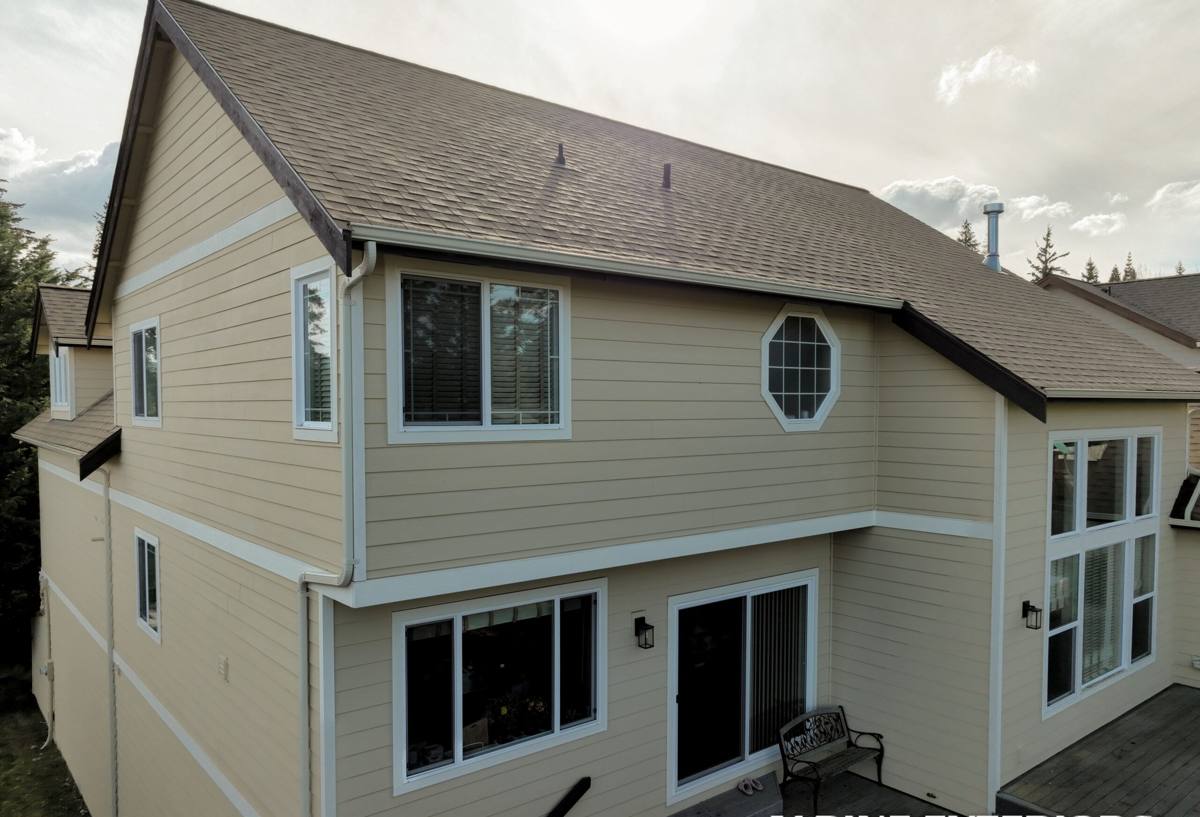
What Salt Air, Driving Rain, and Moss Actually Do to Siding
Salt Air
Airborne salt is corrosive to exposed metal fasteners, flashing, and trim, and it accelerates the breakdown of paint and coatings that aren't formulated to hold up against it. Over time, salt exposure also makes porous or absorbent siding materials hold moisture longer than they would a few miles inland, which sets up everything else on this list.
Driving Rain
Storms off the water rarely arrive as straight-down rain. Wind pushes it sideways and upward into laps, seams, and anywhere two building materials meet — window trim, corner boards, utility penetrations. Siding that's only detailed to shed water falling straight down will eventually let water in around Cottonwood Beach.
Moss Season
Whatcom County's mild, wet stretch from fall through spring means siding surfaces — especially on shaded or north-facing walls — can stay damp for days between rain events. That's exactly the condition moss and algae need to take hold. Once organic growth establishes on a wall, it holds even more moisture against the surface underneath it, which compounds the problem instead of just being cosmetic.
Why Fiber Cement Fits This Stretch of Coastline
Fiber cement holds up to this combination better than most alternatives for a few concrete reasons. It's dimensionally stable, so it doesn't swell, warp, or cup the way wood-based products can when they take on repeated moisture cycles. It's non-combustible. And because it isn't an organic material the way wood or wood-composite siding is, it doesn't give moss and algae the same food source to grow on — a factory-applied finish that sheds water cleanly matters even more here.
That said, fiber cement isn't magic on its own. It's a system — siding, flashing, house wrap, fasteners, caulking, and the gap behind the panel that lets any water that does get in actually drain and dry out. Install that system correctly and it's one of the most durable claddings available for a coastal Whatcom County property. Install it wrong — face-nailed too tight, caulked in the wrong places, no drainage gap — and you can still get moisture problems behind a material that's otherwise doing its job.
Why We Install James Hardie — and Only James Hardie
We don't install vinyl, LP SmartSide, primed spruce or cedar siding, or other fiber cement brands. That's a standard we hold across every job, not just here. It comes down to three things: the finish, the engineering, and the warranty.
James Hardie's ColorPlus finish is baked on at the factory under controlled conditions, not brushed or sprayed on-site or touched up in the field the way most trim and some competing products are. In a salt-air environment, factory-cured finishes consistently outlast field-applied paint, which is usually the first thing to fail on lower-quality installs. Hardie also engineers specific product lines for different climate conditions — including moisture-heavy regions like the Pacific Northwest — rather than selling one generic board everywhere. And Hardie's warranty structure is transferable and backed by a large, established manufacturer, which matters to a homeowner who might sell the house in ten or fifteen years.
Other fiber cement brands aren't scams, and vinyl and engineered wood products have their place in the market. We just don't think they hold up to this specific combination of salt, wind-driven rain, and sustained damp seasons as reliably as Hardie does, and we'd rather stand behind one product system we trust completely than offer several we have mixed confidence in.
What a Correct Installation Involves
Drainage Behind the Panel
A rainscreen gap between the siding and the house wrap lets any water that gets behind the panel drain and the wall assembly dry out, instead of trapping moisture against the sheathing. Skipping this is one of the most common corner-cutting mistakes on coastal jobs.
Flashing at Every Penetration
Windows, doors, hose bibs, vents, and any other break in the siding need proper flashing detail so wind-driven rain can't work its way in around the edges. This is where most water intrusion problems actually start, not through the field of the siding itself.
Fastening to Spec
Hardie specifies fastener placement, spacing, and how tight panels should be nailed — too tight and the panel can't expand and contract normally, which leads to cracking over time. Corrosion-resistant fasteners matter more here than in a drier inland location.
Caulking Only Where It Belongs
Caulk has a role at specific joints, but it's not a substitute for proper flashing and it isn't meant to seal every seam. Over-caulking can actually trap moisture in places it needs to drain from.
Our Process, Start to Finish
- On-site assessment. We look at your current siding, wall assembly, trim condition, and any specific exposure issues tied to your lot — sun, shade, prevailing wind direction, tree cover.
- Scope and product selection. We walk through Hardie panel and plank options, colors, and trim details that fit the house and the site conditions.
- Tear-off and inspection. Once old siding comes off, we inspect the sheathing and house wrap underneath for hidden moisture damage before anything new goes on.
- House wrap and rainscreen. We install or repair the water-resistive barrier and set up proper drainage space before any siding goes up.
- Flashing and trim. Every window, door, and penetration gets detailed before the field siding closes around it.
- Siding installation. Panels and boards go up to Hardie's fastening and clearance specifications.
- Final finish and walkthrough. Caulking, touch-up, and a walkthrough so you know what was done and why.
What Affects the Cost of a Cottonwood Beach Siding Job
| Factor | Why It Matters | Typical Impact |
|---|---|---|
| Condition of existing wall sheathing | Hidden rot or moisture damage found during tear-off has to be repaired before new siding goes on | Can raise cost if found; unknown until tear-off |
| House shape and trim detail | More corners, dormers, and window/door penetrations mean more flashing and cutting labor | Higher for complex facades |
| Panel vs. lap plank profile | Different Hardie profiles have different material and labor requirements | Moderate variation |
| Color and finish selection | Factory ColorPlus finishes vs. field-painted options carry different material costs | Moderate variation |
| Site access | Shoreline lots with limited access or steep grades can slow staging and material handling | Can raise labor cost |
We give a firm number after the on-site assessment, not before — anyone quoting a full siding job over the phone without seeing the house is guessing.
What to Ask Before You Hire a Siding Contractor
- Are you licensed and insured to do exterior work in Washington, and can you show current proof?
- Are your installers factory-trained on the specific product you're installing?
- Will you include a rainscreen/drainage gap, or just nail siding directly over the existing wrap?
- How do you handle flashing at windows, doors, and other penetrations?
- What does the manufacturer's warranty cover, and is it transferable if you sell the house?
- Will you inspect the sheathing underneath the old siding before installing new material?
- Can you provide a written scope of work, not just a price?
Why Local Experience in Cottonwood Beach Matters
A crew that already works this stretch of the Whatcom County coast has already seen which walls take the worst of the wind and rain, which lots hold moss longer because of shade or tree cover, and how salt exposure plays out over a few winters on a real installation rather than in a manufacturer's spec sheet. That's not something you get from a crew that mostly works inland and treats a shoreline job the same as any other. It shows up in the small decisions — where extra flashing goes, how tight the fastening is, which walls get watched more closely — that don't show up on a quote but do show up in how the siding performs five and ten years out.
If you're weighing a siding replacement or repair in Cottonwood Beach, we're happy to come take a look and walk you through what your house actually needs — no pressure, no obligation. The estimate form below is the easiest way to get that conversation started.