 Birch Bay Window
 When a Lynden home's siding has gone past the point of patching, the job stops being maintenance and becomes a full replacement — old cladding off, sheathing checked, and a new weather-resistant system built back up the wall correctly. That's a different scope of work than a repair, and it comes with a different set of risks if it's rushed. Lynden sits inland from the immediate coastline, but it's still well within reach of the marine weather that shapes exterior work across northern Whatcom County: salt-bearing air moving in off the water, rain that comes in sideways more often than straight down, and a moss season that can run most of the year on shaded walls. A full replacement is the point where those conditions either get properly addressed for the next few decades, or get sealed back up behind new siding to keep causing problems.
This page covers what a correct siding replacement looks like specifically for Lynden homes — the signs that a house has crossed from repairable into replace-it territory, what the tear-off and rebuild actually involve, and why we install exclusively James Hardie fiber cement once the old material comes off.
Why Full Replacement, Not Repair, Sometimes Becomes the Right Call
Most siding problems start small — a cracked panel here, a soft spot near a downspout there. Repair makes sense while damage is isolated and the material underneath is sound. Replacement becomes the right call once the damage is widespread, once the siding material itself has reached the end of its useful life, or once whatever's happening on the surface points to a bigger problem in the wall assembly behind it. Lynden's mix of open farmland lots and tree-sheltered residential streets means that timeline varies a lot from house to house — a wall that gets full sun and wind dries out fast and can go decades with minor upkeep, while a shaded wall backed up against trees stays damp longer and often shows its age sooner.
Signs It's Time to Stop Patching
- Moss or dark staining that comes back within a season or two of cleaning, especially on north-facing or tree-shaded walls
- Soft, spongy, or crumbling siding in more than one or two isolated spots
- Visible warping, cupping, or delamination across multiple panels, common on older wood-based or engineered wood siding
- Paint that won't hold anymore no matter how well the surface is prepped before repainting
- Rust streaking from fasteners or trim hardware across large sections of a wall
- Musty smells or staining on interior walls that back up to exterior siding, which usually means moisture is already inside the wall
- Siding original to a home built more than 20-25 years ago with no documented replacement
None of these automatically mean every wall on the house needs new siding — sometimes it's one or two exposures that took the brunt of the weather while the rest held up fine. Part of an honest estimate is telling a homeowner when a targeted repair is genuinely enough, not defaulting to a full tear-off because it's the bigger job.
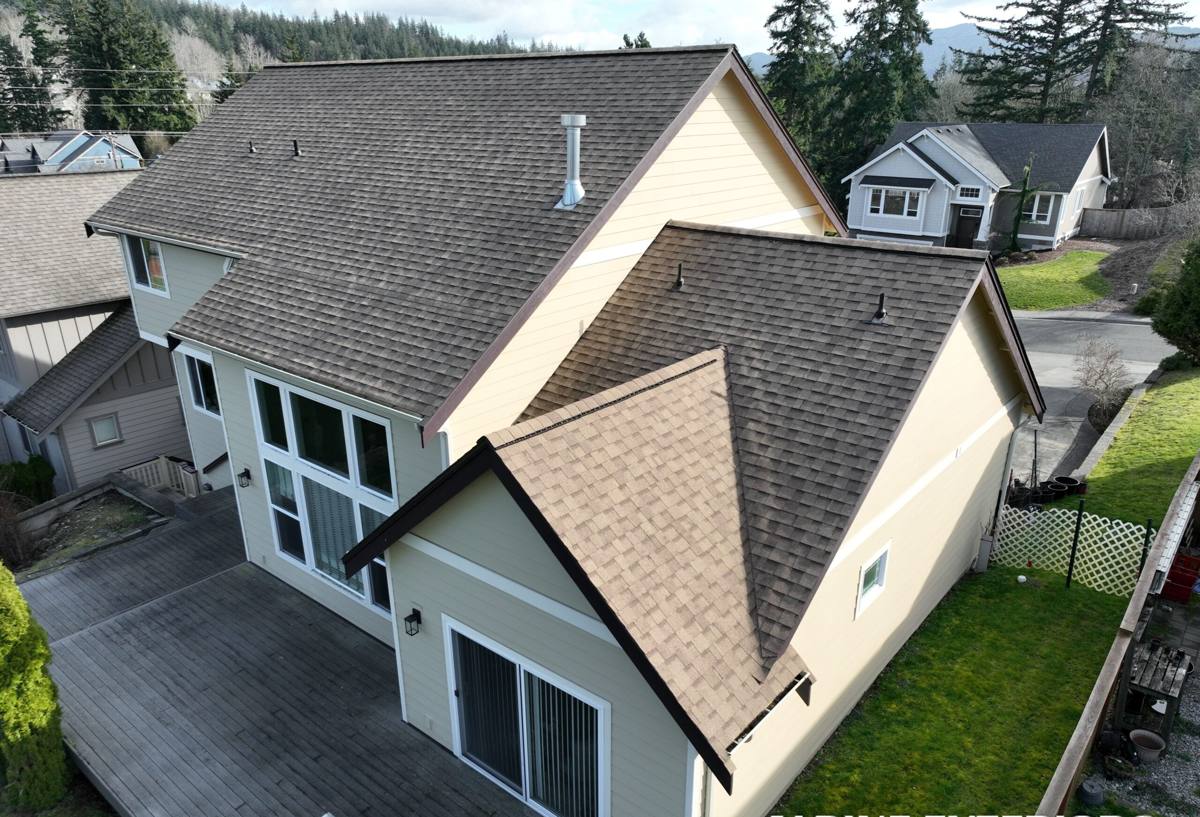
What a Correct Siding Replacement Actually Involves
Tear-Off and Sheathing Inspection
Once the old siding comes off, the sheathing underneath gets a real inspection, not a glance. This is the step that matters most and the one that's easiest to skip if a crew is trying to move fast. Rot, soft spots, or water-damaged sheathing found at this stage need to be cut out and replaced before anything new goes up — covering damaged sheathing with fresh siding just hides a structural problem that keeps getting worse behind the wall, invisible until it fails again years later.
Weather-Resistive Barrier and Flashing
A large share of siding failures in this part of Whatcom County trace back to water getting behind the cladding rather than through it. The house wrap, window and door flashing, and every wall penetration — vents, hose bibs, light fixtures — get sequenced and sealed carefully here, lapped so water is always directed outward and downward, never trapped. This layer is completely hidden once the siding goes up, which is exactly why it deserves the most attention, not the least.
Installation to Manufacturer Spec
James Hardie's transferable warranty depends on the installation following their published specifications — correct fastener type, spacing, and depth; proper clearance above grade, roofline, and decks; specific field-cutting, priming, and caulking practices at cut edges and joints. We treat that spec as the baseline for every job, not as an upgrade option.
Trim, Finish, and Final Walkthrough
Trim gets integrated to match the home's existing lines rather than just butted up against the new siding. Once the job is done, we walk it with the homeowner, cover basic care and maintenance, and confirm the finished work matches what was estimated before calling it complete.
Why We Replace Failing Siding with James Hardie Fiber Cement Only
We used to offer a broader range of siding products. We narrowed to one system after watching what actually held up through repeated wet seasons in this climate versus what looked fine on a spec sheet and struggled on a real wall a few winters in. On every replacement job, we install James Hardie fiber cement — not LP SmartSide, vinyl, Cemplank, Allura, primed spruce, or cedar.
| Product | Common trade-off in Lynden's climate |
|---|---|
| Vinyl siding | Panels can warp or crack under temperature swings; seams and panel gaps give wind-driven rain a path in |
| LP SmartSide / engineered wood | Wood-strand core is more sensitive to moisture at cut edges and fastener points than fiber cement |
| Primed spruce or cedar | Needs ongoing paint and moisture upkeep to avoid rot — a real long-term ownership cost beyond the upfront price |
| Other fiber cement brands | May not offer a climate-specific HZ-style formulation or the same factory-finish warranty depth as James Hardie |
Each of those products has a place in the market, and plenty of homeowners are satisfied with them elsewhere. Our decision is a professional standard, not a judgment on anyone's existing siding: in a climate with this much sustained moisture and salt exposure, we'd rather stand fully behind one system on every replacement than offer a lower-cost option that quietly shifts maintenance risk back onto the homeowner within a few years.
What James Hardie Brings to a Replacement Specifically
- A non-combustible fiber cement core — a real factor for both fire safety and insurance underwriting
- Factory-applied ColorPlus finish, baked on under controlled conditions rather than field-brushed, holding color and adhesion longer under sustained UV and moisture
- The HZ5 product line, engineered for regions with significant moisture exposure and freeze-thaw cycling — a close match for Lynden and the rest of northern Whatcom County
- Dimensional stability that resists the swelling, cupping, and warping engineered wood siding can develop after repeated wetting cycles
- A strong transferable warranty, provided the installation follows Hardie's published specifications
Our Siding Replacement Process, Start to Finish
- On-site assessment — we inspect current siding condition, check for trapped moisture or early sheathing damage, and note how sun, shade, and wind exposure differ across each wall
- Honest scope recommendation — full replacement, partial re-side, or repair, explained with the reasoning, not defaulted to the bigger job
- Written estimate — covering material, labor, sheathing contingency, and a realistic project timeline
- Tear-off and sheathing repair — old siding removed, sheathing inspected, and any rot or damage corrected before new material goes up
- Weather barrier and flashing — house wrap and flashing installed and sequenced around every penetration and opening
- James Hardie installation to spec — fastening, clearances, and joint treatment done to manufacturer specification
- Trim, finish, and final walkthrough — exterior trim matched to the home, then a walkthrough covering care and maintenance
What Moves the Cost of a Full Replacement
Every estimate is specific to the house, but a handful of factors consistently drive the number on a Lynden replacement project.
| Factor | Why it matters |
|---|---|
| Total square footage and stories | More wall area and harder access on multi-story homes both add labor time |
| Sheathing condition once old siding is off | Rot or water damage found during tear-off adds material and labor that can't be priced sight-unseen |
| Trim and detail complexity | Homes with more windows, dormers, or architectural detail take longer to flash and finish correctly |
| Product line and color | James Hardie offers multiple plank profiles, panel styles, and ColorPlus color options at different price points |
| Site access | Tight lot lines, landscaping, or limited staging space can add time to material handling and scaffolding |
We walk through which of these apply to a specific home during the estimate rather than quoting a flat per-square-foot number with no explanation behind it. Sheathing condition in particular is impossible to price accurately until the old siding is actually off the wall, which is why we build a contingency conversation into every proposal instead of surprising a homeowner mid-project.
Why a Crew That Already Works Lynden Matters for This Job
Manufacturer installation guidance is written for average conditions in a moderate climate. Lynden's exposure — inland but still within reach of salt-bearing marine air, wind-driven rain, and a long wet season that keeps shaded walls damp for months at a stretch — doesn't always match that baseline. A crew that has actually torn off and rebuilt siding on homes across this part of Whatcom County knows which parts of the manufacturer's spec are non-negotiable here and which wall orientations on a typical Lynden lot need extra flashing attention even when a generic install guide wouldn't call for it.
That local pattern recognition shows up in decisions that don't come up in a sales pitch — how much lap a flashing course needs on a shaded, tree-lined wall versus an open, sun-exposed one, when a sill or trim detail needs a sloped cap instead of relying on caulk, how sheathing tends to hold up differently on older farmhouse-style homes than on newer builds nearby. Those are the calls that decide whether a replacement is still performing cleanly in twenty years or showing moisture problems again in five.
Questions Worth Asking Before Hiring for a Full Replacement
- Ask whether they inspect and price sheathing repair as part of the process, not as a change-order surprise
- Ask what specific siding product they install and why, not just a price per square foot
- Confirm current Washington contractor licensing and insurance before signing anything
- Ask how they sequence flashing around windows, doors, and other wall penetrations
- Get a written scope of work and a realistic project timeline in writing
- Ask how the manufacturer's warranty and the installation labor are each covered
If your Lynden home's siding has reached the point where patching isn't enough, we're glad to come take a look and give you a straightforward, no-pressure estimate — including an honest read on whether it's a full replacement or something smaller. Use the form below to get a time on the schedule.