 Birch Bay Window
 Why Asphalt Shingle Roofs Take Extra Punishment in Nooksack
Roofs in the Nooksack area of Whatcom County don't fail the way roofs do in drier climates. The damage here is slow and cumulative: salt-laden air drifting in off Birch Bay, long stretches of driving rain pushed sideways by coastal wind, and a moss season that can run most of the year in shaded, north-facing sections of a roof. None of these on their own is dramatic. Together, over a decade or two, they're what separates a shingle roof that makes it to its full service life from one that starts leaking at year twelve.
Salt air is corrosive to exposed metal — nail heads, flashing edges, vent stacks — long before most homeowners notice anything wrong with the shingles themselves. Wind-driven rain finds its way under shingles that were installed with standard nailing patterns instead of the tighter, wind-rated patterns this area calls for. And moss doesn't just sit on the surface looking unsightly; its root structure lifts shingle edges, holds moisture against the roof deck, and accelerates granule loss. A shingle roof built for a drier, calmer climate simply wasn't designed with this combination in mind.
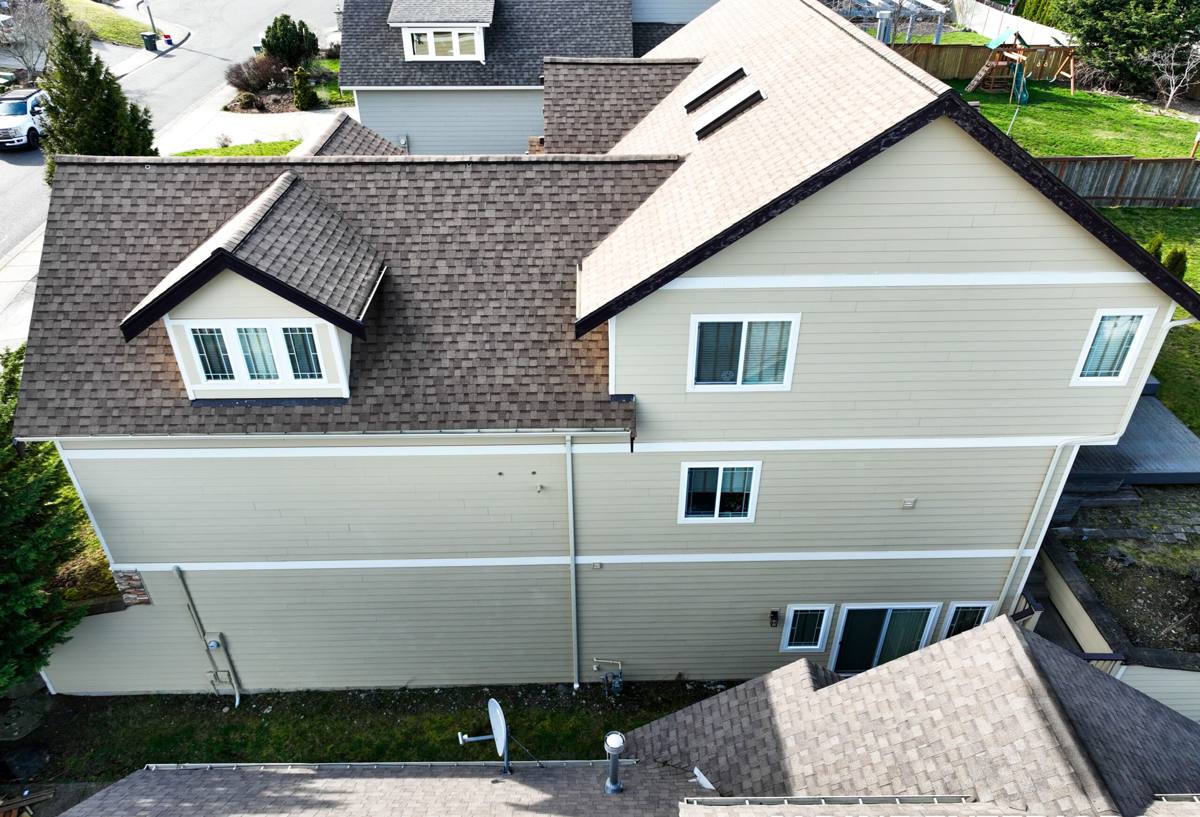
Signs Your Roof Is Telling You Something
Most roofing problems in this area show up gradually, and homeowners often live with early warning signs for a year or two before calling anyone. Worth checking for, especially heading into fall storm season:
- Granules collecting in gutters or at the base of downspouts
- Shingle edges that look curled, cupped, or lifted rather than lying flat
- Dark streaking or green-black staining, particularly on north- and west-facing slopes
- Visible moss mats, even small ones, along ridge lines or in valleys
- Soft or spongy spots underfoot when walking the roof for inspection
- Daylight visible through the attic roof deck, or musty smell in the attic
- Water stains on interior ceilings near exterior walls or chimneys
Any one of these by itself isn't necessarily an emergency. But in combination, or if a roof is already past 15–18 years old, it's worth a proper inspection rather than a guess.
What a Properly Installed Asphalt Shingle Roof Includes
A shingle roof is a system, not a single layer of material. Skipping or shortcutting any one part of that system is usually where premature failures start, and it's rarely visible from the ground.
Underlayment and Ice & Water Barrier
Synthetic underlayment goes down first as the roof's backup water barrier. In this climate, we treat self-adhered ice-and-water membrane as standard — not optional — at eaves, valleys, and around every roof penetration, because those are exactly the spots where wind-driven rain tests a roof hardest.
Ventilation
A roof deck that can't breathe traps moisture underneath the shingles from the inside, which speeds up rot and shingle deterioration regardless of how good the shingles themselves are. Balanced intake and exhaust ventilation matters as much here as the shingle brand does.
Flashing and Fasteners
Flashing around chimneys, skylights, walls, and vent stacks needs to be properly step-flashed and sealed, using corrosion-resistant material given the salt air. Fastener count and placement matter too — proper nailing patterns, not staples, and enough nails per shingle to meet wind-rating requirements rather than the manufacturer's bare minimum.
Matching the Shingle to This Climate
Not every asphalt shingle product is built the same, and the right choice for Nooksack isn't always the cheapest or the most premium-looking option — it's the one whose wind rating and algae resistance actually match local conditions.
| Shingle Type | Typical Lifespan | Wind Rating | Algae Resistance | Best Fit For |
|---|---|---|---|---|
| 3-Tab | 15–20 years | Standard | Only if specified | Budget-conscious reroofs, secondary structures |
| Architectural / Dimensional | 25–30 years | Higher (with proper fastening) | Available, recommend requesting it | Most Nooksack homes |
| Impact-Rated / Premium | 30+ years | Highest | Built-in on most lines | Exposed sites, homes closer to open water |
For most homes in this area, we steer people toward architectural shingles with algae-resistant granules (copper- or zinc-infused) as the practical baseline, not an upsell. On more exposed lots — closer to open water or with less tree cover to break the wind — the jump to a higher wind-rated or impact-rated product is worth discussing.
Our Process, Start to Finish
- Inspection and honest assessment — we look at the whole system: shingles, flashing, ventilation, and the deck underneath, not just the surface.
- Written scope and estimate — materials, tear-off approach, and any deck repair called out clearly before work starts, no surprises added mid-job.
- Full tear-off — we don't install over existing layers; it hides deck problems and voids most manufacturer warranties.
- Deck inspection and repair — any soft, rotted, or delaminated sheathing gets replaced before anything new goes down.
- Underlayment and ice-and-water membrane — installed to the standard described above, not the manufacturer's bare minimum.
- Shingle installation — correct exposure, nailing pattern, and starter/ridge detailing for the wind conditions here.
- Flashing and penetration detailing — chimneys, vents, skylights, and wall transitions sealed and flashed properly.
- Cleanup and magnetic sweep — job site and yard cleared of debris and stray fasteners.
- Final walkthrough — we go over the finished roof and the workmanship warranty with you before calling it done.
Moss, Algae, and Salt Air: Managing the Long-Term Enemy
Moss and algae aren't cosmetic problems in this climate — they're a maintenance issue that, left alone, becomes a moisture issue. A few practical points worth knowing:
Pressure washing shingles is one of the fastest ways to strip granules and shorten a roof's life, and we don't recommend it. Zinc or copper control strips near the ridge let rainwater carry trace metal ions down the roof slope, which suppresses new moss and algae growth over time without harsh chemical treatment. Keeping overhanging branches trimmed back reduces the shade and debris buildup that moss depends on. And because salt air accelerates corrosion of exposed metal fasteners and flashing edges, we favor corrosion-resistant materials on Nooksack roofs specifically — a detail that matters less a few miles further inland.
What Affects the Cost of a Nooksack Reroof
Every roof is different, but the same handful of factors drive most of the price variation we see on jobs in this area:
| Factor | How It Affects Cost |
|---|---|
| Roof size and number of stories | More square footage and steeper access mean more labor and material |
| Roof pitch and complexity | Multiple valleys, dormers, and hips take longer to flash correctly |
| Deck condition | Rotted or delaminated sheathing found during tear-off adds material and labor |
| Shingle tier chosen | 3-tab, architectural, and impact-rated products carry different material costs |
| Layers to remove | Tearing off multiple existing layers adds disposal and labor time |
| Ventilation upgrades | Adding or correcting intake/exhaust venting is a smaller add-on cost with a large payoff |
We'd rather walk your roof and give you real numbers than throw out a broad range that doesn't mean much until someone's actually up there.
Maintenance Checklist for Homeowners
Between professional inspections, a few simple habits go a long way toward getting full life out of a shingle roof in this climate:
- Clean gutters and downspouts at least twice a year, more if you have overhanging trees
- Do a visual check from the ground after major windstorms for missing or lifted shingles
- Trim back branches that shade the roof or drop debris onto it
- Watch for moss starting at ridges and valleys — catch it early rather than letting it spread
- Check attic ventilation isn't blocked by insulation during any attic work
- Schedule a professional inspection every few years, or after any major storm event
Why Hire a Crew That Already Works This Area
A roofing crew that mainly works drier inland climates will often default to standard installation specs — because that's what works where they usually build. A crew that works Whatcom County's coastal communities regularly knows to upgrade fastening patterns for wind exposure, install ice-and-water membrane as standard rather than an add-on, and choose corrosion-resistant flashing and fasteners without being asked. That local familiarity shows up less in the sales pitch and more in how the roof performs during its second or third winter, when the shortcuts a less experienced crew might take usually start to show.
If you're weighing a repair against a full reroof, or just want an honest read on where your current roof stands, we're happy to take a look. Reach out for a free, no-pressure estimate — someone will walk the roof, explain what we find in plain terms, and give you real numbers to work from.