 Birch Bay Window
 Siding Replacement in Bellingham: A Different Job Than a Repair or a Refresh
Siding replacement is its own category of work, separate from patching a damaged section or repainting a wall that still has good bones. A full replacement means the old material comes off, the wall underneath gets a real look, and everything from the house wrap out gets rebuilt as one system. In Bellingham, where salt-tinged marine air off the bay, wind-driven rain, and a moss season that can run most of the year all work on a wall at once, that distinction matters more than it would in a milder climate. A lot of the siding we tear off in this city looks fine from the street right up until the boards come down and the substrate underneath tells a different story.
This page is specifically about full siding replacement for Bellingham homes: when it's the right call instead of a repair, what a correct replacement job actually involves, how we run the project from first walkthrough to final inspection, and why the climate here changes the calculus compared to a drier part of the state. We install James Hardie fiber cement exclusively, and a lot of what follows explains why that's the material we stand behind for a job this consequential.
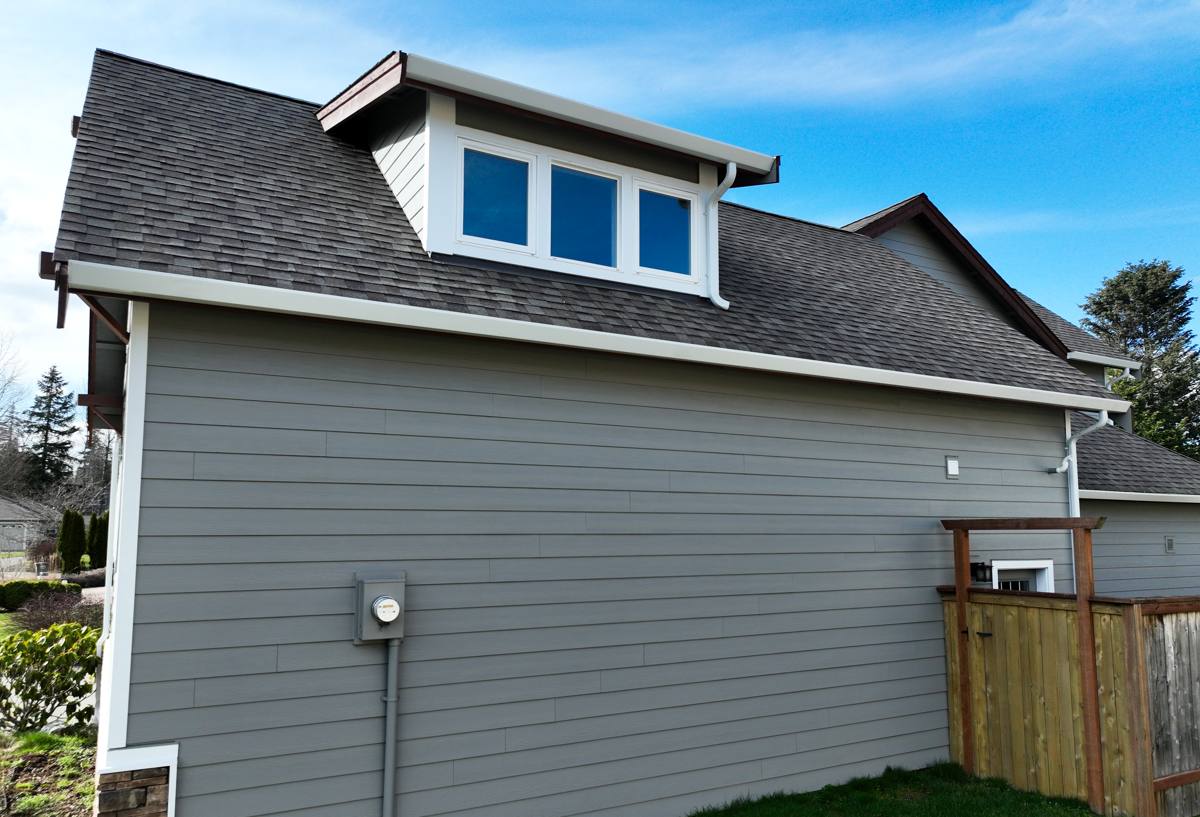
What Bellingham's Climate Does to a Wall Over Time
Salt Air and Bay Exposure
Bellingham sits close enough to the bay and the Salish Sea that most homes get a steady flow of salt-laden air moving through, not just on days with an obvious storm. That exposure is corrosive to fasteners, flashing, and lower-grade finishes over years of slow, quiet wear, and it's rarely the reason a homeowner first notices a problem. By the time it shows up as a visible issue, it's usually been working on the wall assembly for a while.
Wind-Driven Rain
Rain here doesn't fall straight down. Wind off the water pushes it sideways into lap joints, trim seams, and wall penetrations at an angle that a lot of siding systems and installation methods simply aren't built to handle. A wall that would perform fine in a calmer, drier region can fail here specifically because water is being driven in from the side, not dropped from above.
A Long Moss and Mildew Season
Mild year-round temperatures, tree cover, and consistent dampness add up to extended moss and mildew growth, especially on north-facing and shaded walls. Any siding material with even slight porosity, or one that holds moisture against the substrate instead of shedding it, becomes a growth surface over time. It tends to show up first in the places nobody checks regularly: behind shrubs, under eaves, on the shaded side of the house facing a neighbor's property.
Put those three factors together over ten or twenty years and you get the pattern we see constantly on Bellingham tear-offs: siding that held up reasonably well for a decade or so, then started failing quietly behind the surface long before it looked bad enough to prompt a call.
Is It Time for a Replacement, or Does the Wall Just Need Repair?
Not every siding problem in Bellingham means a full tear-off. Isolated impact damage, a section that failed around a single window, or trim that's come loose can often be repaired and matched into existing material without redoing the whole house. Full replacement becomes the right call when the damage is systemic rather than isolated, or when the material itself has reached the end of its practical life. A few signs point toward replacement rather than a patch:
- Moss or dark staining that returns quickly after cleaning across multiple walls, not just one shaded corner
- Soft or spongy siding in more than one location, especially near the base of the wall or around several window and door openings
- Widespread paint failure, bubbling, or warping rather than a single damaged board
- Visible gaps at seams, corners, or trim joints in multiple places, suggesting the whole wall assembly has aged out
- The existing siding is an older wood-based or vinyl product nearing or past its expected service life
- Rising heating bills that point to a wall assembly that's no longer sealing the way it should
- Previous patch repairs that keep reappearing in the same general area
If you're not sure which category your home falls into, that's a reasonable thing to ask us to assess honestly during a walkthrough rather than guess at from the driveway.
Why We Replace With James Hardie Fiber Cement
When a wall is getting torn open anyway, the material that goes back up matters more than it does on a small patch job, because you're setting the performance of that wall for the next several decades. We install James Hardie fiber cement, full stop, and the reasons come from what we've consistently seen on tear-offs and repair calls across this climate:
- Non-combustible core: Fiber cement doesn't feed a fire the way wood-based siding products can, which matters for household safety and can matter for insurance as well.
- Factory-applied ColorPlus finish: The color coat is cured under controlled factory conditions rather than brushed on at the job site, so it resists fading and moisture intrusion far longer than field-applied paint.
- Climate-engineered HZ product lines: Hardie's HZ5 formulation is built for regions with heavy sustained moisture and freeze-thaw cycling, a better fit for coastal Whatcom County than a generic national siding spec.
- Dimensional stability: Fiber cement doesn't swell, cup, or warp the way engineered wood products can after repeated wet-season moisture cycles.
- Strong transferable warranty: Hardie backs its products with one of the more substantial warranty structures in the industry, provided the installation follows spec.
We don't install LP SmartSide, vinyl siding, Cemplank, Allura, primed spruce, or cedar. Those are legitimate products, and other contractors install them competently. But on a job where we're rebuilding a wall from the studs out, we made a professional decision that standing behind one system we trust completely serves our customers better than offering a cheaper alternative that quietly shifts maintenance risk onto them a few years down the road.
What a Correct Replacement Job Actually Involves
Full replacement is the point in a siding project where you get to fix things that a repair never reaches. That's the opportunity, and it's also where a rushed or corner-cut job does the most long-term damage. A correct replacement addresses the whole wall assembly, not just the visible surface:
| Layer | What Happens During Replacement | Why It Matters in Bellingham |
|---|---|---|
| Old siding removal | Full tear-off of existing material down to the sheathing | Exposes hidden moisture damage that's common under decades-old siding in this climate |
| Sheathing and framing | Inspected for rot, soft spots, or insect damage; repaired or replaced as needed | Years of trapped moisture behind failing siding can rot wood before it's ever visible from outside |
| House wrap / weather-resistive barrier | New barrier installed and correctly lapped, top over bottom | The primary line of defense against wind-driven rain working its way behind the siding |
| Flashing | New flashing at windows, doors, and penetrations, integrated with the house wrap | Poor flashing is one of the most common sources of hidden leaks in this region |
| Siding installation | James Hardie panels or planks installed to manufacturer spec for fastening, clearance, and joint lapping | Correct install detail is what lets the material perform the way it's engineered to for decades |
Skipping the middle steps to save time is one of the more common ways a good siding product ends up with a bad reputation. The material didn't fail; the wall assembly around it did, and the siding just took the blame. That's why we treat the layers you never see again once the new siding is up as seriously as the finish coat everyone will actually look at.
Our Siding Replacement Process, Step by Step
Walkthrough and Assessment
We start by looking at the actual condition of your walls, not just the siding surface. That includes checking for soft spots, tracing where staining and moss patterns suggest moisture is getting in, and being honest about whether you're looking at a repair or a full replacement before we ever talk about products or pricing.
Scope and Material Selection
Once we know the scope, we walk through Hardie's product lines, colors, and profiles with you, and we spec the HZ5 formulation appropriate for this climate zone. We also flag anything we expect to find once tear-off starts, like older homes where sheathing repair is a reasonable possibility, so there aren't surprises mid-project.
Tear-Off and Substrate Repair
Old siding comes off the wall completely. Any rot, insect damage, or soft sheathing gets addressed before anything new goes back up. This is the step that gets skipped on corner-cut jobs, and it's the one that determines whether the new siding actually lasts.
House Wrap, Flashing, and Installation
New house wrap goes on correctly lapped, flashing is integrated at every window, door, and penetration, and the Hardie siding is installed to the manufacturer's fastening pattern, clearance, and joint specifications for this climate. Every one of these steps is a system, not a checklist to move through quickly.
Final Walkthrough
We walk the finished job with you, cover what maintenance realistically looks like going forward, and make sure you know what a correctly installed wall looks like if you ever want to check it yourself down the road.
Replacement Cost Factors in Bellingham
| Factor | What It Affects | Why It Matters Here |
|---|---|---|
| Home size and wall complexity | Total material and labor | Bellingham's older hillside homes often have more dormers, trim, and roofline intersections where wind-driven rain can work its way in |
| Substrate condition found at tear-off | Repair costs before new siding goes on | Years of trapped moisture behind failing siding can rot sheathing and framing before it's ever visible from outside |
| Trim and color selection | Material cost and finish longevity | ColorPlus factory finishes outlast field-applied paint against salt air and UV exposure |
| Site access and lot terrain | Labor time and equipment needs | Sloped hillside lots and mature tree cover common in Bellingham neighborhoods can add staging and setup time |
| Disposal and permitting | Project overhead | Full tear-offs generate more debris and typically require permitting through the city or county |
Real numbers depend on the specific house, especially what we find once the old siding comes off, which is why we walk the property before quoting instead of pricing off square footage alone.
Timeline and What to Expect During the Project
A full siding replacement on an average single-family Bellingham home generally runs one to a few weeks, depending on size, trim complexity, and how much substrate repair turns up once tear-off starts. Weather is a real factor here, since a wet stretch can pause exterior work that needs a dry substrate before house wrap and siding go on. We plan around Bellingham's wetter months where we can and build reasonable buffer into the schedule rather than promising a timeline the climate won't actually support. During the project, expect some noise, staging equipment around the house, and sections of exposed wall for short periods between tear-off and new house wrap going up. We keep those exposure windows as short as practical and cover open sections if weather turns before the crew can close them back up.
Why Hire a Crew That Already Works Bellingham
A crew that works this stretch of Whatcom County regularly sees how salt air, wind-driven rain, and moss actually behave on real houses across a full year, not just how a product performs on paper. That shows up in practical decisions on a replacement job: where extra flashing attention pays off, which wall orientations stay wet longest and deserve extra scrutiny at tear-off, and which details are worth the extra time so you're not dealing with a callback two winters later. Bellingham's mix of hillside terrain, bay exposure, and a housing stock that spans mid-century homes to newer construction isn't uniform, and a crew with hands-on replacement experience across that range treats each home individually rather than applying the same approach to every job.
If your Bellingham home needs a full siding replacement, or you're not yet sure whether you're looking at a repair or something bigger, we're glad to take an honest look. Reach out using the form below to schedule a free, no-pressure estimate.