 Birch Bay Window
 California Creek sits in one of the wetter, greener pockets of the Birch Bay area, and that combination — tree cover, low-lying drainage, and close proximity to Puget Sound's salt air — asks more of a home's siding than most manufacturers ever tested for on a lab wall. Homes here don't fail because siding is a bad product category. They fail because the wrong product, or the right product installed the wrong way, was asked to handle Whatcom County's coastal moisture load year after year. This page is about getting fiber cement siding right for this specific area: what the climate actually does to a wall assembly, what correct installation looks like, and why a crew that already works California Creek is worth choosing over one that doesn't.
What California Creek's Climate Actually Does to Siding
Three things define this area's exposure, and they compound each other rather than acting alone.
Salt Air and Marine Moisture
Birch Bay's proximity to the water means airborne salt is a constant, low-grade presence on exterior surfaces. Salt doesn't just corrode fasteners and trim — it holds moisture against a wall longer than plain rainwater would, which keeps siding surfaces damp for more hours per day than an inland home ever experiences.
Driving Rain
Storms off the Strait of Georgia and the Sound tend to arrive with wind behind them, which means rain hits siding at an angle instead of falling straight down. Driving rain finds every gap in flashing, every under-caulked seam, and every point where a fastener wasn't set correctly — water that a calm-weather product might shed just fine gets driven sideways and up under laps.
A Long Moss Season
Tree cover near the creek keeps parts of many lots shaded for much of the day, and shade plus year-round moisture is exactly what moss, algae, and mildew need to take hold. On the wrong siding material, that growth doesn't stay cosmetic — it holds water against the surface and accelerates whatever degradation the material was already prone to.
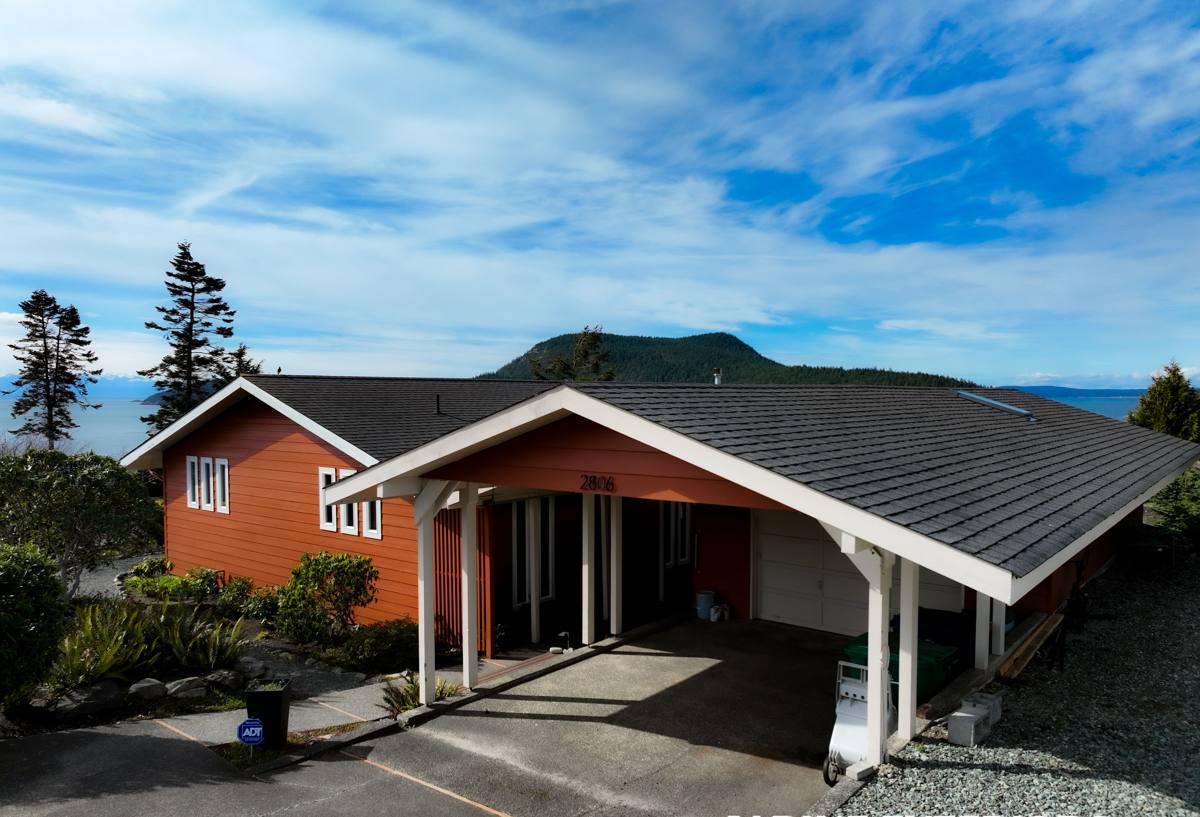
Why We Install James Hardie Fiber Cement Here — and Nothing Else
We install only James Hardie fiber cement siding. Not because every alternative is worthless, but because after years of exterior work in exactly this climate, Hardie is the one product system that consistently holds up to salt, driving rain, and moss without the maintenance burden or moisture risk that other materials carry in this specific setting.
Dimensional Stability
Fiber cement doesn't swell, warp, or delaminate the way wood-based and some engineered wood siding products can when they take on repeated moisture cycling. In a climate where siding rarely gets a long stretch to fully dry out, that stability matters more than it would somewhere arid.
Non-Combustible Composition
James Hardie siding is made primarily from cement, sand, and cellulose fiber, which makes it non-combustible. That's a genuine advantage independent of the moisture story, and it's part of why we standardized on it as our product across every job.
Factory-Applied ColorPlus Finish
Hardie's ColorPlus finish is baked on in a controlled factory environment rather than field-applied after installation. It resists fading and holds up to mildew and moss better than a job-site paint job, and it comes with its own finish warranty separate from the substrate warranty — two layers of manufacturer backing instead of one.
Fiber Cement vs. the Alternatives in This Climate
We get asked why we don't offer vinyl, LP SmartSide, or cedar as options. Here's the honest comparison for a climate like California Creek's specifically — not a general verdict on these products everywhere, but how they perform against salt air, driving rain, and moss.
| Material | Moisture Behavior | Moss/Mildew Resistance | Maintenance in This Climate |
|---|---|---|---|
| James Hardie fiber cement | Dimensionally stable; doesn't swell or rot from repeated wetting | Factory finish resists growth; surface cleans without damage | Low — periodic rinse and inspection |
| Vinyl siding | Can warp or buckle with heat/cold cycling; seams are a moisture entry point | Growth sits on the surface but panels can trap moisture behind them | Low-effort but limited lifespan under coastal wind loads |
| LP SmartSide (engineered wood) | Wood-strand core is more moisture-sensitive at cut edges and seams | Requires diligent caulk and paint maintenance to prevent moisture wicking | Higher — edge sealing and repainting on a schedule |
| Cedar / primed spruce | Natural wood movement; absorbs and releases moisture with weather | Prone to moss and mildew without frequent treatment | Highest — regular refinishing and moss treatment |
None of these are unusable products in general — they just carry trade-offs that show up faster in a salt-air, high-moss environment than they would somewhere drier. That's the professional judgment behind our standardizing on one product line instead of offering all of them.
What Correct Installation Actually Involves
Fiber cement's reputation is only as good as the installation behind it. Most of the siding failures we're called to look at aren't a materials problem — they're a water-management problem built into the wall during installation.
Weather-Resistive Barrier and Drainage Plane
Every wall gets a continuous weather-resistive barrier behind the siding, lapped correctly from the bottom up so water is directed out and down rather than trapped. Where wall assemblies benefit from it, we build in a drainage gap so any moisture that gets behind the siding has somewhere to go instead of sitting against the sheathing.
Flashing at Every Penetration
Windows, doors, hose bibs, light fixtures, and any other wall penetration get properly integrated flashing — not caulk used as a substitute for flashing. Caulk fails; correctly lapped flashing sheds water regardless of what the sealant does over time.
Fastening to Hardie's Specifications
Fiber cement has specific fastener spacing, type, and placement requirements, and this region's exposure calls for following Hardie's high-wind and coastal installation guidance rather than the minimum spec. Under-fastened or improperly placed nails are one of the most common causes of siding call-backs.
Correct Caulking and Joint Treatment
Butt joints, corners, and trim transitions get sealed with a high-quality, paintable sealant rated for exterior use — applied to manufacturer spec, not just wherever a gap looks visible. Over-caulking is as much a problem as under-caulking; it can trap moisture instead of letting a wall breathe as designed.
Our Process on a California Creek Job
The steps don't change much house to house, but the moisture assessment at the front end matters more here than in a drier neighborhood.
- Walk-through and moisture assessment of existing siding, trim, and sheathing to catch hidden rot before it's covered up again
- Detailed estimate covering tear-off, any sheathing repair, and the full Hardie install — no surprise change orders for problems we should have caught up front
- Tear-off and disposal of the existing siding
- Repair or replacement of any compromised sheathing found underneath
- Installation of the weather-resistive barrier and flashing at every penetration
- Fiber cement installation to Hardie's fastening and clearance specifications for this exposure
- Trim, joint sealing, and touch-up of the ColorPlus finish at cut edges
- Final walk-through so you know exactly what was done and what maintenance to expect
Living With Fiber Cement Siding in a Moss-Prone, Salty Climate
Correctly installed Hardie siding is low-maintenance, not no-maintenance. A little seasonal attention keeps it looking and performing the way it should for the long haul.
- Rinse siding periodically to clear salt residue, especially on wind-exposed elevations
- Keep gutters and downspouts clear so overflow doesn't run down the wall face
- Trim back vegetation near the house to reduce shade and improve airflow along shaded walls
- Check caulked joints and trim seams once a year, and re-caulk any that have opened up
- Address any moss or mildew on the surface early with a gentle wash rather than pressure that can damage the finish
- Watch for chipped or scratched areas at corners and touch up the finish before bare substrate is exposed to weather
Cost Factors on California Creek Siding Projects
Every home is different, so we won't quote a number without seeing the house, but these are the variables that move a California Creek estimate up or down.
| Factor | Why It Matters Here |
|---|---|
| Existing sheathing condition | Moisture-related repair under old siding is more common in shaded, damp lots near the creek |
| Home size and wall complexity | More corners, dormers, and trim details mean more flashing and cutting labor |
| Siding profile and accessories | Lap width, trim style, and accent details change material and labor cost |
| Site access | Tree cover and lot layout near the creek can affect staging, scaffolding, and disposal logistics |
| Tear-off vs. new construction | Removing and disposing of old siding adds labor that new-build siding doesn't require |
Why a Crew That Already Works California Creek Matters
A contractor who's worked this specific pocket of Birch Bay already knows which walls tend to hold moisture, how the tree cover along the creek affects drying time after a storm, and which fastening and flashing details actually matter for Whatcom County's wind and rain exposure — not just what a general spec sheet says. That local pattern recognition is what catches a problem during installation instead of two years later, when it's a repair job instead of a five-minute fix.
If you're planning a siding project on your California Creek home, we're happy to walk the property, look at what's there now, and give you a straightforward assessment along with a free, no-pressure estimate — no obligation, just an honest look at what your home actually needs.