 Birch Bay Window
 Cherry Point's Marine Climate Is Hard on Decks
Cherry Point sits right on the water along Whatcom County's stretch of the Salish Sea, a few miles up the shoreline from Birch Bay, and that location shapes everything about how a deck ages out here. The same marine air that makes the area beautiful also carries salt spray that settles on railings, fasteners, and any exposed metal, working corrosion into places a homeowner further inland never has to think about. Add in Whatcom County's long wet season, driving rain that comes in sideways off the water, and shaded, damp corners where moss and algae get a foothold for months at a time, and you have a set of conditions that punishes a deck built to a generic, one-size-fits-all standard.
Most decks in this area don't fail because the homeowner did anything wrong. They fail because the structure underneath — the ledger connection, the framing, the fasteners, the way water is supposed to shed off the surface — was never really matched to a marine, high-moisture site in the first place. A deck replacement done right for Cherry Point has to account for salt exposure, near-constant humidity swings, and a moss season that can run from fall through spring.
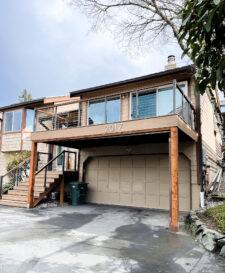
Repair or Replace? Reading the Signs
Not every tired-looking deck needs to be torn out. But there's a point where patching boards or re-staining stops being a real fix and starts being a way to delay a decision. The honest signs that a Cherry Point deck is past repair usually show up in the structure, not just the surface:
- Soft, spongy, or spring-loaded decking when you walk across it, especially near the house or in shaded areas
- Rot or discoloration at the ledger board where the deck attaches to the house — often the first place water damage starts
- Rusted, streaking, or failing fasteners and hardware, particularly on railings and stair connections
- Persistent moss or black-green staining that comes back within weeks of cleaning, no matter how it's treated
- Wobbly railings, loose posts, or footings that have visibly shifted or heaved
- A deck more than 20-25 years old built to older code, especially if it's never had the ledger or footings inspected
If what you're seeing is limited to a few worn boards on an otherwise sound frame, repair can make sense. If the framing, ledger, or footings are compromised, repair is usually just spending money to postpone a replacement — and in a marine climate, hidden rot tends to spread faster than it would somewhere drier.
What a Proper Deck Replacement Involves
A deck replacement is really a structural project with a nice surface on top of it. Getting the visible decking right matters, but it's the parts you don't see once the job is done — the ledger attachment, the flashing, the framing, and the footings — that determine whether the new deck lasts fifteen years or thirty in this climate.
Ledger and Flashing: The Water Path
The ledger board, where the deck ties into the house, is the single most common failure point on decks anywhere in western Washington, and salt-laden rain makes it worse at Cherry Point. Water has to be directed away from that connection with proper flashing that laps correctly with the house's existing water-resistive barrier or siding, not just caulked and hoped for. We treat ledger flashing as the most important five minutes of the whole job, because a mistake there is invisible until the rot shows up years later.
Framing and Footings
Joists, beams, and posts need to be sized correctly for the actual span and load, using fasteners and connectors rated for exterior and, ideally, coastal exposure. Footings need to sit below frost depth and bear on solid, undisturbed soil — something worth double-checking on any lot near the water where fill soil or higher moisture content in the ground is common. We also build in proper airflow underneath the deck, since stagnant, damp air under a low deck is one of the biggest contributors to hidden rot and mold in this climate.
Choosing Decking Material for This Site
There's no single "best" decking material — there's the material that fits your budget, your maintenance appetite, and the punishment a Cherry Point site is going to put it through. Here's how the common options actually compare for a salt-air, high-moisture, moss-prone location:
| Material | How It Holds Up Here | Maintenance | Typical Lifespan |
|---|---|---|---|
| Pressure-treated lumber | Affordable and strong, but absorbs moisture and needs regular sealing to resist moss and rot in this climate | Annual cleaning, periodic staining/sealing | 10-15 years before major repairs |
| Cedar | Naturally rot-resistant and handsome, but softens and grays faster under constant marine humidity without upkeep | Regular sealing to maintain rot resistance | 15-20 years with consistent care |
| Composite decking | Resists rot and doesn't need staining; surface texture matters for moss and algae grip in shaded, damp spots | Periodic washing; no sealing needed | 25-30 years |
| Capped/PVC decking | Best moisture and salt resistance of the common options; fully sealed surface sheds water and resists staining | Occasional washing | 25-30+ years, often longer |
For most Cherry Point homes, we steer clients away from uncapped wood-plastic composites in heavily shaded, low-airflow spots — the porous edges can hold moisture and feed moss growth faster than a capped or PVC product with a fully sealed surface. That's a maintenance and moisture-behavior tradeoff, not a knock on any particular manufacturer; it's simply what performs best against the conditions this site produces. Real wood still has its place, especially where a homeowner wants that specific look and is willing to keep up with sealing on a schedule.
Fasteners and Hardware in a Salt-Air Environment
This is the detail that separates a deck built for Cherry Point from a deck built anywhere. Standard galvanized fasteners can start showing corrosion within a few years this close to the water, especially on railings, stair stringers, and any hardware that stays wet longer after a storm. We spec stainless steel or heavy-duty coated fasteners and structural connectors rated for coastal/marine exposure on every replacement here, not just where it's visible. Mixing metals matters too — pairing the wrong fastener with the wrong connector or flashing can actually accelerate corrosion through galvanic reaction, which is a mistake we see on decks that were built or repaired by crews without local marine experience.
Our Process, Start to Finish
We keep the process straightforward and try to give you real information at each step rather than surprises:
- Walk-through and assessment — we inspect the existing deck's framing, ledger, footings, and hardware, not just the surface boards, so you know what's actually driving the recommendation.
- Honest scope and estimate — you get a clear breakdown of what's structural, what's cosmetic, and what your material options cost and mean long-term.
- Permitting — we handle the paperwork with Whatcom County where a permit is required, so the finished deck is properly documented for future insurance or resale needs.
- Demolition and disposal — the old deck comes out and is hauled away; we protect landscaping and access points during the work.
- Structural rebuild — footings, framing, ledger flashing, and hardware are installed to current code and matched to this site's exposure.
- Decking, railings, and finish work — surface material, railings, stairs, and any lighting or fascia details go in last.
- Final walk-through — we go over the finished deck with you before calling the job done.
Keeping Moss and Drainage Under Control After the Build
Even a well-built deck needs a little seasonal attention in a climate like this. Moss doesn't mean the deck was built wrong — it means the region has a long wet season and shaded, damp surfaces are going to attract growth no matter what. A few habits go a long way:
- Sweep debris and needles off the deck regularly, especially in fall — trapped organic matter holds moisture and feeds moss
- Rinse or lightly wash the surface a couple of times a year, more often in shaded areas
- Keep gutters and downspouts near the deck clear so runoff isn't dumping extra water onto or under it
- Check railings and stair hardware once a year for early rust or looseness — catching it early is a five-minute fix, not a repair job
- Make sure under-deck airflow paths (lattice, skirting vents) stay clear of vegetation and debris
We build proper drainage and slope into every replacement so water sheds off the surface instead of pooling, which cuts down significantly on how much moss maintenance a deck needs over its life.
Permits and Building Code in Whatcom County
Most deck replacements that involve structural changes — new footings, a rebuilt frame, or a deck attached at a different height or configuration than before — require a permit through Whatcom County. Decks near shoreline setback areas can also have additional review depending on the parcel's location relative to the water. We handle this as part of the job rather than leaving it to the homeowner to sort out, and we build to current code on ledger attachment, guardrail height, stair geometry, and footing depth even when an older deck being replaced wasn't up to that standard.
Choosing a Contractor Who Actually Works Cherry Point
A deck built by a crew that mostly works dry, inland sites will often make reasonable decisions that just aren't right for a marine location — standard fasteners instead of coastal-rated hardware, decking chosen for looks over moisture behavior in shaded spots, or ledger flashing detailed for a house that doesn't take the wind-driven rain this shoreline gets. None of that shows up on day one. It shows up in year three or four, as corrosion, soft spots, or moss that won't go away no matter how often it's cleaned.
Before hiring anyone for a deck replacement in this area, it's worth asking a few direct questions:
- What fastener and hardware grade do you use, and is it rated for coastal/marine exposure?
- How do you flash the ledger connection, and can you explain why?
- Will you pull the required Whatcom County permit, and is that included in the estimate?
- What's your recommendation for decking material given shade, drainage, and moss exposure on this specific site?
- Can you walk me through how footings will be sized and placed for this lot?
- What does your estimate include and exclude — demolition, disposal, railings, permits?
A contractor who's done real work in Cherry Point and the surrounding Birch Bay area should have straightforward, specific answers to all of that, not vague reassurance.
If your deck is showing its age or you're just not sure whether it needs repair or full replacement, we're happy to take a look and give you a straight answer along with a free, no-pressure estimate — use the form below to get started.