 Birch Bay Window
 Cottonwood Beach sits right up against the water on one of the more exposed stretches of the Birch Bay shoreline, and that location shapes everything about how siding performs there. Homes here take a steady diet of salt-laden air, wind-driven rain that comes in sideways instead of straight down, and a damp, shaded moss season that can run most of the year on north- and west-facing walls. Siding that would hold up fine a few miles inland in Whatcom County often shows problems faster in this neighborhood — and the fixes are more expensive than the maintenance would have been.
We install James Hardie fiber cement siding exclusively, and Cottonwood Beach is exactly the kind of environment that decision was made for. This page walks through what the local climate actually does to siding, what a correct Hardie installation looks like on a home in this neighborhood, and why the crew doing the work matters as much as the product itself.
Why Cottonwood Beach Is Hard on Siding
Three conditions stack up against exterior cladding here, and they compound each other rather than acting independently. Salt air carries fine mineral particles that settle on every exterior surface, and over time that accelerates corrosion on fasteners, trim hardware, and any metal flashing that isn't properly protected. Wind-driven rain off the water doesn't just wet a wall face — it gets pushed up under laps, into seams, and behind trim edges that would stay dry in a calmer inland setting. And the combination of shade, moisture, and mild temperatures common along this part of the Birch Bay shoreline creates ideal conditions for moss and algae growth, which holds moisture against the siding surface for extended stretches rather than letting it dry between rain events.
None of that is unique to any one house — it's the baseline environment for this neighborhood. Siding that's going to hold up here needs a material that resists moisture intrusion at the fiber level, a finish that resists staining and fading under UV and salt exposure, and an installation that accounts for wind-driven water rather than assuming it behaves like ordinary rainfall.
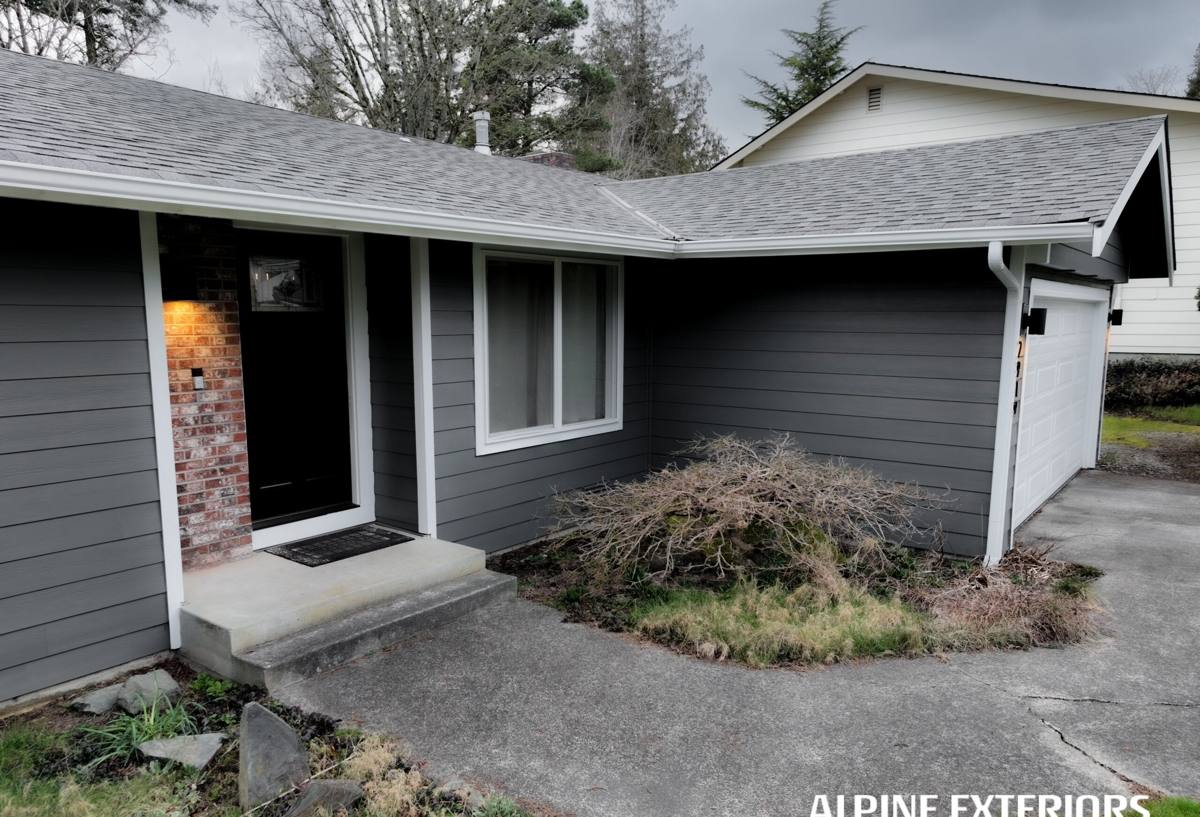
Why We Only Install James Hardie Here
We made the decision years ago to stop installing vinyl, LP SmartSide, Cemplank, Allura, primed spruce, and cedar, and to install James Hardie fiber cement exclusively. That standard applies everywhere we work, but Cottonwood Beach is one of the clearest cases for why it's the right call.
Non-Combustible, Moisture-Resistant Fiber Cement
James Hardie siding is made from cement, sand, and cellulose fiber — it doesn't absorb and swell with moisture the way engineered wood products can, and it isn't a fuel source the way wood-based sidings are. In a marine environment where a wall assembly is going to see repeated wetting cycles over its lifetime, that moisture stability matters more than it does in a drier climate.
HZ5 Climate Engineering
Hardie manufactures its siding in different formulations engineered for different climate zones, and Western Washington falls into the HZ5 zone — the product line built to handle sustained damp, moderate-temperature conditions rather than the dry-heat or freeze-thaw profiles other regions deal with. That's a meaningfully different product than what gets installed in the Southwest or the upper Midwest, and it's part of why we spec the right zone product rather than treating "Hardie" as one generic material.
ColorPlus Factory Finish
Hardie's ColorPlus finish is baked on at the factory under controlled conditions, which gives it more consistent UV and fade resistance than a field-applied paint job typically achieves, along with a longer repaint interval. In a neighborhood where salt air and sun both work against a painted surface, that factory finish buys real time before the exterior needs attention again.
What a Correct Hardie Installation Involves in This Environment
James Hardie siding performs to spec when it's installed to spec — and in a high-exposure location like Cottonwood Beach, the margin for shortcuts is smaller than it would be inland. A handful of details matter more here than the average installation guide emphasizes.
Clearances and Drainage
Hardie's installation instructions call for specific clearances between the bottom edge of the siding and grade, roof lines, decks, and other horizontal surfaces, along with a drainage plane behind the siding itself. Those clearances exist so water has somewhere to go instead of wicking up into the bottom edge of a board. On a wind-driven-rain site, skipping or shrinking those clearances is one of the fastest ways to create a moisture problem that won't show up until the wall assembly behind the siding is already damaged.
Fastening and Joint Treatment
Fasteners need to be corrosion-resistant and driven correctly — not overdriven, which crushes the material and creates a water entry point, and not underdriven, which leaves the board loose. Butt joints and panel seams need to be treated according to Hardie's specifications, whether that's caulked, flashed, or both, since an unsealed seam is exactly the kind of gap wind-driven rain finds first.
Cut Edges and Field Painting
Factory ColorPlus finish covers the face and factory-cut edges of a board, but any edge cut on site needs to be sealed and, on Hardie's ColorPlus product, touched up with matching factory-formulated touch-up paint. Skipping that step leaves raw fiber cement exposed at every cut end — around windows, corners, and trim — which is a slow but real path for moisture to get into the material over years of salt air and rain.
Signs Your Current Siding Is Already Losing the Ground Here
If your home in Cottonwood Beach still has its original siding, or siding that was installed without much attention to the local exposure, a few signs tend to show up before a full failure does. Persistent moss or algae staining that keeps returning within a season of cleaning usually means moisture is staying in contact with the surface longer than it should. Soft spots, visible swelling, or delamination — especially near the bottom edge of walls or around window trim — point to moisture that's already gotten past the surface. Chalky, faded, or peeling paint on a field-painted material is a sign the finish has given out faster than it would in a less exposed location. And visible gaps or cracked caulk at butt joints and trim edges are open invitations for wind-driven rain to keep working its way in.
None of these signs mean a home needs immediate replacement, but they're worth having looked at before they turn into sheathing or framing repairs, which cost significantly more than a siding job on its own.
Hardie Siding Profiles for Cottonwood Beach Homes
James Hardie makes several distinct product lines, and which one fits depends on the home's architecture and how it's oriented to the wind and water exposure.
| Hardie Product | What It Is | Where It Fits Well |
|---|---|---|
| HardiePlank lap siding | Traditional horizontal lap boards, the most common Hardie profile | Most homes; works well on both water-facing and sheltered walls when installed with correct laps and clearances |
| HardieShingle panels | Individual or panelized shingle-look siding | Cottage and coastal-style homes where a shingle aesthetic is part of the design |
| HardiePanel with battens | Vertical board-and-batten look using large-format panels | Modern or mixed-material exteriors, and accent walls paired with lap siding |
| HardieTrim boards | Trim and fascia boards matched to the siding system | Corners, window and door surrounds, and fascia — high-exposure edges that need the same moisture resistance as the field siding |
We'll walk through which combination makes sense for your home's specific exposure and architecture rather than defaulting to one profile for every job.
Our Process, Start to Finish
- On-site assessment — we look at the existing siding, the wall assembly where it's accessible, and the specific exposure your home has to wind and water given its position in the neighborhood
- Honest scope and product recommendation — which Hardie profile, texture, and color fit the home, explained with the reasoning behind it
- Removal and substrate check — old siding comes off carefully, and any hidden sheathing or framing damage gets identified and addressed before new siding goes on
- Weather barrier and flashing — the drainage plane, window and door flashing, and clearances are set up correctly, since this is the layer that actually keeps water out over time
- Installation — Hardie boards are fastened, lapped, and jointed to manufacturer specification, with cut edges sealed and touched up as they're made
- Final walk-through — we go over the finished job and what maintenance, if any, it'll need going forward
Cost Factors on a Cottonwood Beach Siding Job
| Factor | Tends to Lower Cost | Tends to Raise Cost |
|---|---|---|
| Substrate condition | Sheathing and framing are sound underneath the old siding | Moisture damage found during removal requires repair before new siding goes on |
| Home shape and trim detail | Simple rectangular walls, fewer corners and penetrations | Complex rooflines, multiple gables, or extensive trim and window surrounds |
| Siding profile | Standard lap siding across the whole exterior | Mixed profiles — shingle accents, board-and-batten sections, custom trim |
| Access and site conditions | Standard lot access for scaffolding and material staging | Steep grades, limited access, or proximity constraints common on some waterfront lots |
| Color and finish | Standard ColorPlus color selections | Special-order colors or extensive custom trim color-matching |
We won't quote a number without seeing the house and the condition of what's underneath the existing siding. What we can tell you upfront is that substrate condition is usually the single biggest swing factor on an older Cottonwood Beach home, simply because of how long wind-driven rain and moss have had to work on the wall assembly.
Living With Hardie Siding Through a Long Moss Season
James Hardie siding doesn't eliminate moss and algae growth — nothing installed on an exterior wall in this climate does — but it holds up to the cleaning that keeps it in check far better than wood-based or engineered-wood alternatives, since the fiber cement substrate isn't degraded by the moisture that moss and algae hold against a wall. Routine care is simple and doesn't require specialized products.
- Rinse the exterior with a garden hose or low-pressure wash once or twice a year, focusing on shaded, north-facing walls where moss establishes fastest
- Avoid high-pressure washing directly at joints, seams, or under laps — it can force water past details that were never meant to take that kind of direct pressure
- Trim back vegetation and tree cover where practical to reduce the shade and moisture that feed moss growth
- Check caulked joints and trim edges annually and have any cracked or missing caulk addressed before the next wet season
- Touch up any field-cut edges or minor finish damage promptly rather than letting exposed material sit through a winter
Why a Local Cottonwood Beach Crew Matters
Manufacturer installation guidance is written for average conditions, and Cottonwood Beach's exposure isn't average — it's a tighter combination of salt air, wind-driven rain, and sustained dampness than most of Whatcom County sees. A crew that has actually installed Hardie siding on homes in this specific neighborhood knows which clearances and flashing details are worth extra time here, even in spots where a generic installation would technically pass inspection. That's the kind of judgment that doesn't show up in a sales pitch — it shows up fifteen years later in whether the siding is still performing or already showing the moisture and staining problems this climate is known for.
What to Ask Before Hiring for Siding Work Here
- Ask whether they install one siding system or several, and why — a single-product specialist typically has deeper installation expertise than a crew that installs whatever's cheapest that month
- Ask how they handle clearances and drainage on a water-facing wall specifically
- Confirm current Washington contractor licensing and insurance
- Ask what's covered under the manufacturer's product warranty versus the installer's labor warranty
- Get a written scope of work before committing to a schedule
If you're looking at replacing aging or failing siding on a Cottonwood Beach home, or planning ahead before moss and moisture damage turn into a bigger repair, it's worth having someone look at the actual wall assembly before you start pricing materials. We offer free, no-pressure estimates for James Hardie siding projects in Cottonwood Beach and the surrounding Birch Bay area — use the form below to get a time on the schedule.