 Birch Bay Window
 Why Sandy Point's Exposure Is Different
Sandy Point sits close enough to the water that homes here deal with a combination most inland Whatcom County properties don't: near-constant salt-laden air off the bay, driving rain that comes in sideways during winter storms, and dense tree cover on many lots that keeps north- and west-facing walls shaded and damp for long stretches of the year. Any one of those factors is manageable. All three together, on the same wall, is what actually wears siding out.
We've worked on enough homes in this pocket of Birch Bay to know the failure pattern isn't usually dramatic. It's slow. Paint chalks and fades faster than it should. Caulk joints open up a season or two before you'd expect. Moss and green algae creep across shaded siding and hold moisture against the wall long after a storm has passed. None of that is unique to one product, but it's a big part of why we're picky about what goes on a Sandy Point home in the first place.
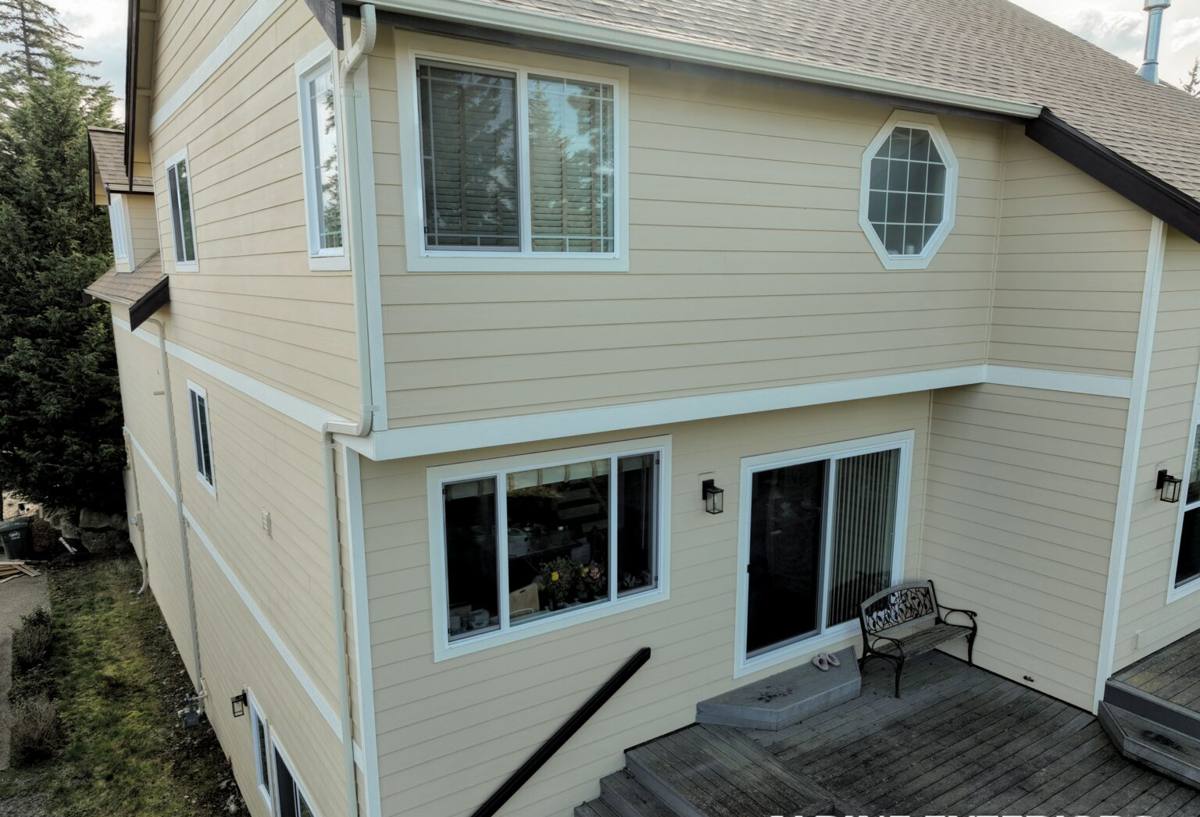
What Siding Actually Has to Do Here
Good siding in this location needs to manage water on both sides of the board. On the outside, it has to shed wind-driven rain without letting water track sideways under laps or through fastener holes. On the back side, it has to tolerate the shaded, humid microclimate that builds up behind cladding on a heavily treed lot without swelling, delaminating, or feeding mold growth.
It also has to hold a finish. Salt air accelerates the breakdown of paint film and oxidizes exposed metal fasteners and trim faster than a typical inland exposure. A siding system that depends on a site-applied paint job to protect it is starting the clock on repainting the day the crew leaves. That's one of the main reasons we standardized on James Hardie fiber cement with a factory-applied ColorPlus finish rather than field-painted board products — the color coat is baked on and warranted before the material ever reaches the job site, not brushed on in variable weather conditions after installation.
The Moss Season Problem
Whatcom County's wet season runs long, and shaded walls on wooded Sandy Point lots can stay damp for weeks at a stretch. Wood-based products and some engineered wood siding are vulnerable here because moss and algae growth sits directly on an organic substrate that can absorb moisture and begin to break down underneath the growth. Fiber cement doesn't feed that process the same way — it's not an organic wood fiber substrate, so moss sitting on the surface is a cosmetic and maintenance issue rather than a structural one, provided the installation behind it is correct.
Why We Install Only James Hardie Fiber Cement
We don't install vinyl, LP SmartSide, Cemplank, Allura, or primed wood siding, and that's a deliberate standard, not an oversight. Each of those products has legitimate uses elsewhere. On a salt-air, high-rain, shade-heavy site like Sandy Point, we've found the trade-offs stack up against the homeowner:
- Vinyl expands and contracts significantly with temperature swings, can warp or distort in direct afternoon sun on exposed elevations, and its color is the material itself — it can't be professionally refinished if it fades or gets damaged.
- LP SmartSide and similar engineered wood products use a wood-strand substrate. It's treated against moisture, but any breach in the coating or caulk joint gives water a path into an organic material, which is a worse bet in a climate with a long wet season and heavy shade on some walls.
- Primed spruce or cedar requires the homeowner to maintain the paint film indefinitely. Miss a repaint cycle in salt air and you're chasing rot, not just touching up color.
James Hardie fiber cement is non-combustible, dimensionally stable across our temperature range, and comes from the factory with a ColorPlus finish engineered to hold color and resist the fading that salt air and UV cause faster here than in drier inland climates. Hardie also builds specific product lines — HZ5 and HZ10 — engineered for different moisture and freeze exposure zones, which matters on a site like this where wall-by-wall exposure varies with shade and wind direction.
What a Correct Installation Actually Involves
Fiber cement is only as good as the installation behind it. This is where a lot of the real-world performance difference comes from, especially on a site with Sandy Point's exposure. A correct install includes:
- A drainage plane and weather-resistive barrier installed and lapped correctly, with a rainscreen gap where the wall assembly calls for it, so incidental moisture behind the siding has somewhere to go
- Flashing at every window, door, and penetration, integrated with the water-resistive barrier rather than just caulked over the top
- Manufacturer-specified fastener type, spacing, and penetration depth — corrosion-resistant fasteners matter more here than in a dry inland climate
- Correct board clearance from grade, decks, roof lines, and other siding terminations, so board edges aren't sitting in standing water or snow
- Factory-cut and pre-primed field cuts sealed per Hardie's specifications before installation, not left raw
- Caulk and sealant used only where Hardie's installation instructions call for it — over-caulking traps moisture just as reliably as under-caulking lets it in
Skip any one of those steps and you can have the right material on the wall with the wrong performance. That's why installation quality is the actual variable that determines whether a fiber cement job lasts 10 years or 40.
Our Process for a Sandy Point Job
Assessment First
Before we talk products or pricing, we look at the wall assembly that's already there. On older Sandy Point homes that means checking sheathing condition behind the existing siding, especially on shaded north and west walls where trapped moisture is most likely to have done quiet damage. We also look at how each elevation is exposed — direct bay-facing walls, wind-driven rain corners, and shaded tree-line walls often need different attention even on the same house.
Tear-Off, Not Overlay
We remove existing siding rather than installing over it. That's the only way to actually inspect and correct the water-resistive barrier, flashing, and any hidden sheathing damage — which matters more on a site with this much moisture exposure than it would somewhere drier.
Build the Water Management System
Barrier, flashing, and drainage details go in before a single piece of Hardie board goes up. This is the step that determines long-term performance, and it's also the step that's invisible once the job is finished — which is exactly why it has to be done right the first time.
Install to Manufacturer Spec
Fastening, clearances, joint treatment, and finish work follow James Hardie's published installation requirements, which is also what keeps the manufacturer's warranty intact.
Final Walkthrough
We walk the finished job with the homeowner, checking every elevation, trim detail, and transition before calling it done.
Comparing the Options Homeowners Actually Consider
| Factor | James Hardie Fiber Cement | Vinyl | Engineered Wood (LP-type) |
|---|---|---|---|
| Finish durability in salt air | Factory ColorPlus, engineered for fade/UV resistance | Color is the material; fades and can chalk over time | Field-applied or factory coating over wood substrate |
| Moisture tolerance | Non-organic substrate, does not rot | Doesn't rot, but can trap moisture behind poor installs | Organic wood-strand core vulnerable if coating is breached |
| Combustibility | Non-combustible | Combustible | Combustible |
| Dimensional stability | Low expansion/contraction | Higher expansion/contraction with heat | Moderate; sensitive to moisture uptake |
| Refinishing if damaged | Can be professionally repainted/repaired | Cannot be refinished; panel replacement only | Can be repainted with proper prep |
Maintenance Expectations After Installation
Fiber cement isn't zero-maintenance, but the maintenance is manageable. In a moss-prone, shaded environment like parts of Sandy Point, plan on:
- An annual visual check of caulk joints, especially around windows and trim, before the wet season sets in
- Periodic gentle washing of shaded elevations to keep moss and algae from building up — a soft wash, not high-pressure blasting that can force water behind boards or damage the finish
- Prompt attention to any physical damage (impact chips, cracked boards) so the underlying moisture barrier stays protected
Compare that to the repaint cycle a wood-based or field-painted product needs in this climate, and the maintenance gap becomes one of the more concrete reasons Hardie holds up as the better long-term choice for this specific location.
What to Check Before Hiring Anyone for This Job
- Do they carry manufacturer certification or documented training on James Hardie's installation requirements specifically, not just general siding experience?
- Will they remove existing siding to inspect the wall assembly, or are they planning to install over what's there?
- Can they explain, specifically, how they'll handle drainage and flashing on your shaded or bay-facing walls?
- Do they have experience with the wind and moisture exposure patterns particular to Whatcom County's coastal communities, not just siding in general?
- Is the fastener and sealant plan specific to Hardie's published requirements, or generic to "siding installation"?
A crew that already works this stretch of Birch Bay knows which walls on a Sandy Point lot tend to hold moisture, which corners take the worst of the wind-driven rain, and how long the shaded sides stay wet after a storm rolls through. That local pattern recognition is hard to substitute with general siding experience alone.
If you're weighing a siding replacement on a Sandy Point home, we're glad to come take a look and walk the property with you. The estimate is free, there's no pressure, and you'll get a straight answer about what your walls actually need — use the form below to get started.