 Birch Bay Window
 Birch Bay Village Sits in One of the Toughest Climates for Exterior Siding in Whatcom County
Homes in Birch Bay Village take a steady beating that inland Whatcom County properties simply don't. You're close enough to the water that salt-laden air reaches your siding on windy days, wind-driven rain gets pushed sideways into wall assemblies during winter storms, and the region's long, damp shoulder seasons keep exterior surfaces wet for days at a stretch. Add in the shade from mature evergreens common throughout the neighborhood, and you get a near year-round moss and algae season that most siding products aren't built to handle.
None of that is unusual for this stretch of coastline. But it does mean the siding decisions that work fine forty miles inland don't hold up the same way here. Salt air accelerates corrosion on fasteners and trim. Driving rain finds every gap in flashing and caulk. Moss and algae hold moisture against the wall surface long after a storm has passed, which is exactly the condition that rots wood-based products and delaminates poorly engineered composites. This is the environment we design every Birch Bay Village installation around.
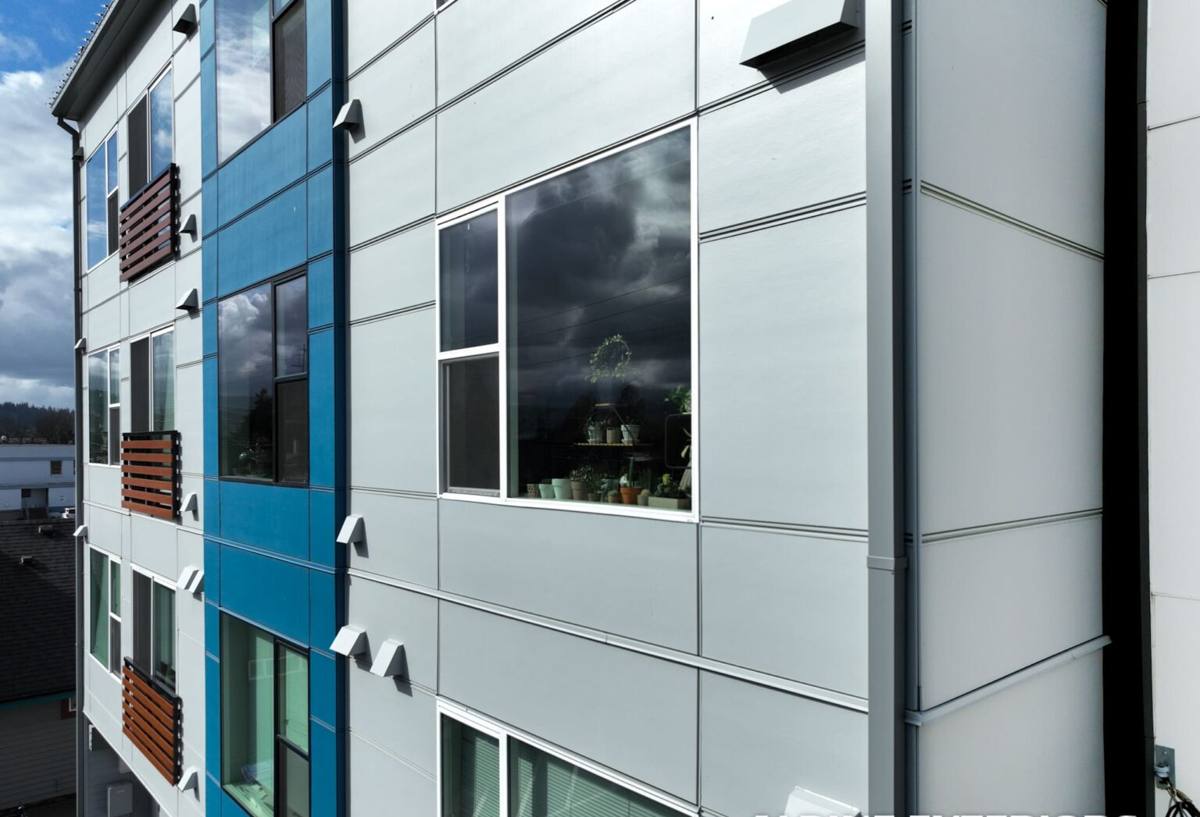
Why We Only Install James Hardie Fiber Cement in This Neighborhood
We don't install vinyl, LP SmartSide, primed spruce, cedar, or other fiber cement brands like Allura or Cemplank. That's not a marketing position — it's a standard we set after years of seeing what actually survives a Whatcom County coastal exposure and what doesn't.
Vinyl softens, warps, and can crack in freeze-thaw cycles, and its seams give wind-driven rain a path inward. Wood-based products like primed spruce or cedar look great on day one, but they're organic material sitting in a climate that stays wet for months — that's a maintenance commitment most homeowners don't want to sign up for indefinitely. Engineered wood composites vary in quality, and their long-term moisture performance depends heavily on how well the factory coating and edge sealing hold up over time, which is hard to verify at install.
James Hardie fiber cement is engineered specifically for exposures like this. It's non-combustible, doesn't rot, resists moisture intrusion at the material level, and its ColorPlus factory finish is baked on rather than field-applied, which matters a great deal when your siding is exposed to salt spray and near-constant humidity. That combination is why we standardized on it and why it's the only product we put our name behind.
The Hardie Product Lines That Actually Fit Birch Bay Village
James Hardie makes climate-specific product formulations under its HZ5 engineering, built for regions that see the freeze-thaw cycles and moisture load we get here in northwest Washington. That's the baseline we install from — not a generic national product.
HardiePlank Lap Siding
The most common choice for Birch Bay Village homes, available in a range of textures including smooth and cedar-shake profiles. It gives you the traditional lap-siding look without the maintenance burden of real wood.
HardiePanel Vertical Siding
Often used as an accent on gables, dormers, or entry features to break up a home's façade — common on the mix of traditional and more contemporary homes throughout the area.
HardieTrim
Fascia, corner boards, and window trim in matching fiber cement, so the entire exterior envelope — not just the field siding — gets the same moisture resistance. Mixing Hardie panels with wood trim just moves the maintenance problem to a different part of the house.
ColorPlus Technology
A factory-applied finish that's cured under controlled conditions rather than painted on site. It holds color and resists fading, chalking, and moisture-driven peeling far better than field-applied paint, which is especially valuable in a climate where a fresh paint job rarely gets a full dry cure window.
What a Correct Installation Actually Involves
Fiber cement siding is only as good as the installation behind it. Hardie's own warranty terms are specific about installation practices for a reason — get the details wrong and you can end up with moisture problems regardless of how good the material is.
Water Management Comes First
Before a single piece of siding goes up, we address the drainage plane: correct weather-resistive barrier, properly lapped and taped seams, and a rainscreen gap where conditions call for it. In a driving-rain climate like Birch Bay's, this hidden layer matters more than the visible siding.
Flashing at Every Penetration
Windows, doors, hose bibs, vents, and any other wall penetration need proper head flashing and kick-out flashing where rooflines meet walls. This is where most siding failures actually originate — not in the field of the siding itself, but at the transitions.
Clearances and Gaps
Hardie specifies minimum clearances from grade, roofing, decks, and adjacent materials, along with gap and caulking requirements at butt joints and trim. Skipping these is one of the most common ways installers void the manufacturer's warranty without the homeowner ever knowing.
Fastening
Corrosion-resistant fasteners, installed at the correct pattern and depth, are non-negotiable this close to salt air. Overdriven or underdriven nails compromise both the weather seal and the long-term hold of the panel.
Our Process, Start to Finish
- On-site assessment — we walk the exterior, check existing sheathing and moisture conditions, and note problem areas like north-facing walls or spots shaded by trees where moss buildup is worst.
- Product and color selection — we go through HardiePlank profiles, trim options, and ColorPlus colors suited to the home and neighborhood.
- Written estimate — a clear scope covering removal of existing siding, water-resistive barrier and flashing work, material, and labor, with no vague allowances.
- Tear-off and substrate check — once old siding is off, we inspect sheathing for hidden rot or moisture damage before anything new goes on. This is often where problems from the old siding system are actually found.
- Installation to manufacturer spec — correct barrier, flashing, clearances, and fastening as outlined above.
- Final walkthrough — we go over the finished job with you before calling it done.
How James Hardie Compares to Other Siding Options in This Climate
| Factor | James Hardie Fiber Cement | Vinyl | Wood / Primed Spruce |
|---|---|---|---|
| Moisture resistance | Engineered for wet climates (HZ5) | Seams allow water intrusion | Absorbs moisture, prone to rot |
| Salt air / corrosion behavior | Non-organic, resists degradation | Can become brittle over time | Finish breaks down faster near salt exposure |
| Moss/algae resistance | Non-organic surface, cleanable | Can trap moisture at seams | Organic surface, more susceptible |
| Finish durability | Factory-baked ColorPlus finish | Color molded in, can fade/chalk | Field-applied paint, needs recoating |
| Fire resistance | Non-combustible | Combustible | Combustible |
| Typical maintenance | Periodic washing | Periodic washing, seam checks | Repainting, caulking, rot inspection |
What Drives the Cost of a Project
Every Birch Bay Village home is different, and a real number only comes from an on-site look. But the factors that typically move the price are consistent:
| Cost Factor | Why It Matters |
|---|---|
| Home size and wall complexity | More corners, gables, and dormers mean more cutting, trim, and flashing detail |
| Condition of existing sheathing | Hidden rot found during tear-off adds repair scope before new siding goes on |
| Siding profile and trim choice | Lap vs. panel vs. shake-style textures, plus how much trim work is involved |
| Access and site conditions | Tree cover, tight lot lines, or difficult staging affect labor time |
| Removal and disposal of old siding | Volume and type of material being torn off |
Maintaining Hardie Siding in a Salt Air, High-Moss Climate
- Rinse siding a couple times a year to clear salt residue and organic buildup, more often on shaded or north-facing walls
- Keep gutters clear so overflow doesn't run down the face of the siding
- Trim back branches and shrubs that keep walls shaded and damp
- Check caulking at trim joints and penetrations annually, especially after a hard winter
- Watch for moss buildup at the base of walls near grade and address it before it spreads upward
- Avoid pressure washing directly into seams — a garden hose and soft brush is usually enough
Why Hiring a Crew That Already Works in Birch Bay Village Matters
Installing siding correctly on paper and installing it correctly for a specific site are two different things. A crew that's already worked this neighborhood knows which walls take the worst of the driving rain, where tree cover creates persistent moss problems, and how the area's wind exposure should factor into flashing and fastening decisions. That local pattern recognition is hard to substitute for, no matter how good the written specs are.
It also means you're working with a crew that understands Whatcom County's coastal conditions well enough to explain, in plain terms, why certain details on your home need extra attention — not just a generic install that happens to be located near the water.
If you're weighing a siding project for your Birch Bay Village home, we're happy to take a look and walk you through what your specific home needs. Reach out for a free, no-pressure estimate using the form below.