 Birch Bay Window
 Why Lynden Homes Need Siding Built for This Climate
Homes in and around Lynden deal with a specific combination of weather stress that most siding products were never designed to handle well. Whatcom County sits close enough to the water that salt-laden air reaches inland further than most homeowners realize, and it settles on exterior surfaces year-round. Add in long stretches of driving rain off the water, short winter days that keep north-facing walls damp for weeks at a time, and a moss season that can run from late fall through spring, and you have an environment that punishes any siding material with a weak point.
Salt air accelerates corrosion on fasteners and trim, driving rain finds every gap in flashing and caulk, and moss holds moisture against the wall long after the rain has stopped. None of these on their own is unusual for the Pacific Northwest. Together, over the life of a house, they separate siding systems that were installed correctly from ones that were not — and they separate materials that were engineered for this climate from ones that were not.
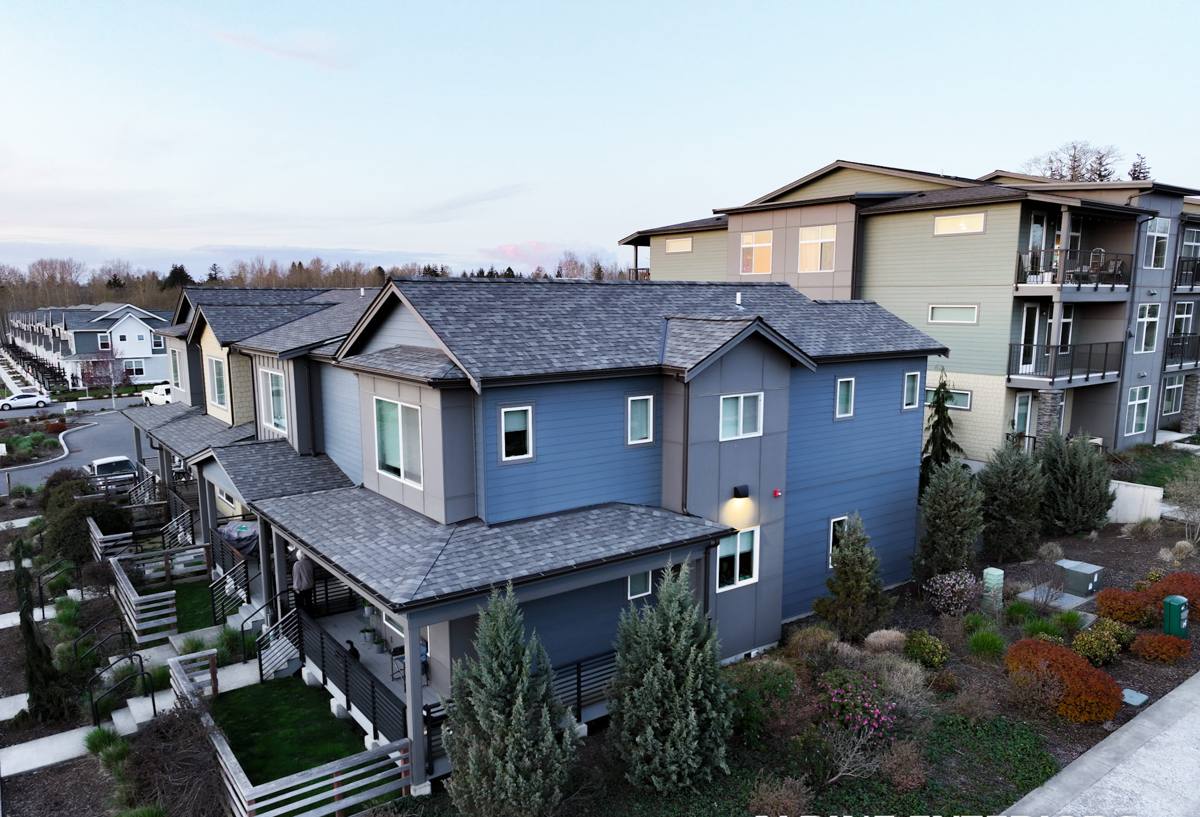
Why We Install James Hardie and Nothing Else
We standardized on James Hardie fiber cement siding because it is the one product line we've found consistently holds up to this exact combination of salt, rain, and moss without turning into a maintenance project. Hardie's HZ5 product line is engineered specifically for climates like ours — freeze-thaw cycles, sustained moisture, and humidity swings are part of the design spec, not an afterthought.
Fiber cement is non-combustible, which matters more each year given regional wildfire smoke and ember exposure even this far from fire-prone terrain. It doesn't swell, rot, or delaminate the way wood-based or wood-adjacent products can when they stay damp for extended periods. The factory-applied ColorPlus finish is baked on under controlled conditions, which gives it a bond and UV resistance that field-applied paint can't match — an important detail in a climate where a paint job needs to survive years of rain before it even gets a dry summer to cure properly.
What This Means Specifically for Lynden
For a Lynden home, that translates to siding that resists moisture intrusion at the board level, holds its finish through repeated wet-dry cycles, and doesn't give moss and mildew the soft, absorbent surface they need to take hold. It also means fewer repaint cycles, which matters in an area where a full exterior repaint is a multi-week weather-dependent gamble.
What a Correct James Hardie Installation Actually Involves
The product only performs as designed if the installation respects Hardie's published specifications, and this is where a lot of the real-world performance difference between siding jobs comes from. It is not just nailing boards to a wall.
- Proper weather-resistive barrier installed and lapped correctly before any siding goes up
- Correct flashing at every window, door, and roof-to-wall intersection — the single most common failure point we find on older installs
- Minimum clearance gaps at the bottom of the siding and at all trim intersections, so water has somewhere to go instead of wicking upward
- Corrosion-resistant fasteners driven to the correct depth — overdriven nails crack the board's outer layer and create a moisture entry point
- Caulking only where Hardie specifies it, not as a substitute for proper flashing and gapping
- Field-cut edges primed or sealed before installation, since a raw cut edge left exposed defeats the factory finish
Skipping any one of these doesn't cause an immediate problem. It shows up two, five, or ten years later as trapped moisture, staining, or a section of siding that has to come off to fix what should have been done right the first time. In a climate that stays wet as much of the year as ours does, there's very little margin for shortcuts here.
How Our Process Works for a Lynden Project
Assessment and Planning
We start with a walk-through of the existing exterior to understand what's underneath the current siding, where past moisture or moss damage has occurred, and where flashing and trim details need attention regardless of what siding goes on top. This matters more in our area than in drier climates, because siding decisions here are really wall-assembly decisions.
Preparation
Any damaged sheathing, compromised flashing, or trapped moisture gets addressed before the first Hardie board goes up. Installing a premium siding product over an unresolved moisture problem just hides the problem for a while — it doesn't fix it.
Installation
Boards, panels, and trim go up to Hardie's fastening and clearance specifications, with particular attention to the details that matter most in wet climates: butt joint treatment, flashing integration, and gap maintenance at grade and at trim.
Finish and Walkthrough
We finish with a walkthrough of the completed exterior, covering what was done, what routine maintenance looks like, and what the warranty covers going forward.
Comparing the Real Options Lynden Homeowners Consider
Most homeowners researching a siding replacement end up comparing James Hardie against vinyl, LP SmartSide, or cedar. Here's an honest look at the trade-offs specific to a salt-air, high-rain, moss-prone climate.
| Factor | James Hardie Fiber Cement | Vinyl | Wood-Based / Cedar |
|---|---|---|---|
| Moisture behavior | Engineered non-organic material, resists swelling and rot | Doesn't absorb water but can trap moisture behind it if installed poorly | Organic material, absorbs moisture and is vulnerable to prolonged dampness |
| Salt air resistance | Not affected by salt exposure; factory finish holds up well | Can fade and become brittle over time near the coast | Finish breaks down faster under salt exposure, requiring more frequent recoating |
| Moss and mildew resistance | Dense, non-porous surface gives moss less to hold onto | Seams and lap joints can trap organic buildup | Porous surface is one of the more moss-friendly materials |
| Fire resistance | Non-combustible | Combustible, can melt or deform near heat sources | Combustible |
| Maintenance over time | Occasional washing; factory finish reduces repaint need | Low maintenance but limited repair options when damaged | Regular repainting or resealing required, especially in wet climates |
Vinyl and wood-based products both have legitimate uses and reasonable upfront costs. Our decision to work exclusively with James Hardie comes down to how each material performs specifically under the sustained wet, salty conditions common in this part of Whatcom County — not a judgment on every use case everywhere.
Color and Finish Choices That Hold Up Locally
James Hardie's ColorPlus finish comes in a range of factory-applied colors, and the finish is baked on with a process that gives better fade and moisture resistance than field-applied paint. In a climate where a home's exterior spends much of the year wet, that factory bond is doing real work — it's less prone to the peeling and premature fading that field-applied finishes can show after a few wet seasons. We can walk through color options during the estimate, including how different tones tend to show or hide the effects of moss growth and rain streaking between cleanings.
Why Hiring a Crew That Already Works Lynden Matters
Siding installation quality depends heavily on details that are specific to the region: how deep to set flashing given local rain patterns, which wall orientations need extra attention for moss and moisture, and how the local building department expects weather-resistive barriers and clearances to be documented. A crew that works Whatcom County regularly has already worked through those details on other homes nearby — they're not learning the local conditions on your project.
There's also a practical scheduling advantage. A local crew can respond quickly if weather interrupts a project mid-install, which happens more often here than in drier parts of the state, and can be reached easily for warranty or follow-up questions long after the job is done.
Maintaining Hardie Siding in a Wet, Salty Climate
James Hardie siding is low-maintenance, not no-maintenance. A little routine attention goes a long way toward getting the full life out of the product in our conditions.
- Rinse the exterior periodically to remove salt residue and organic buildup, especially on north- and west-facing walls
- Check caulking at trim and window intersections annually, since caulk ages faster than the siding itself
- Trim back vegetation and tree cover that keeps a wall shaded and damp longer than it should be
- Address any moss or algae growth promptly rather than letting it establish, since it's far easier to remove early
- Inspect gutters and downspouts each fall so water is actually being carried away from the wall, not sheeting down it
Get a Straight Answer for Your Home
Every home in the Lynden area carries its own combination of sun exposure, wind direction, and existing wall condition, and that affects what a siding project actually needs. If you'd like an honest look at your home's exterior and a clear estimate for James Hardie siding done right, we're happy to come take a look — no pressure, no obligation.