 Birch Bay Window
 Why Lynden Roofs Take a Different Kind of Beating
Lynden sits a little inland from the water, but it doesn't escape what makes Whatcom County roofing different from roofing in most of the country. Moisture-laden air off the Strait of Georgia and Puget Sound moves through the county for most of the year, and it doesn't leave in a hurry. Add the region's long, low-intensity rain events, cool damp summers, and short winter days with little direct sun, and you get a climate that's less about single storms and more about sustained exposure — weeks at a time where a roof surface simply never fully dries out.
That sustained dampness is exactly what moss, moisture-loving algae, and slow-rotting decking need to take hold. It's also why driving rain matters more here than in drier climates: wind-driven rain doesn't just land on a roof, it gets pushed sideways and upward under shingle tabs, around flashing, and into any gap that a rushed installation left open. A roof that performs fine in a drier region can fail years early in Lynden if it wasn't built with this climate in mind from the start.
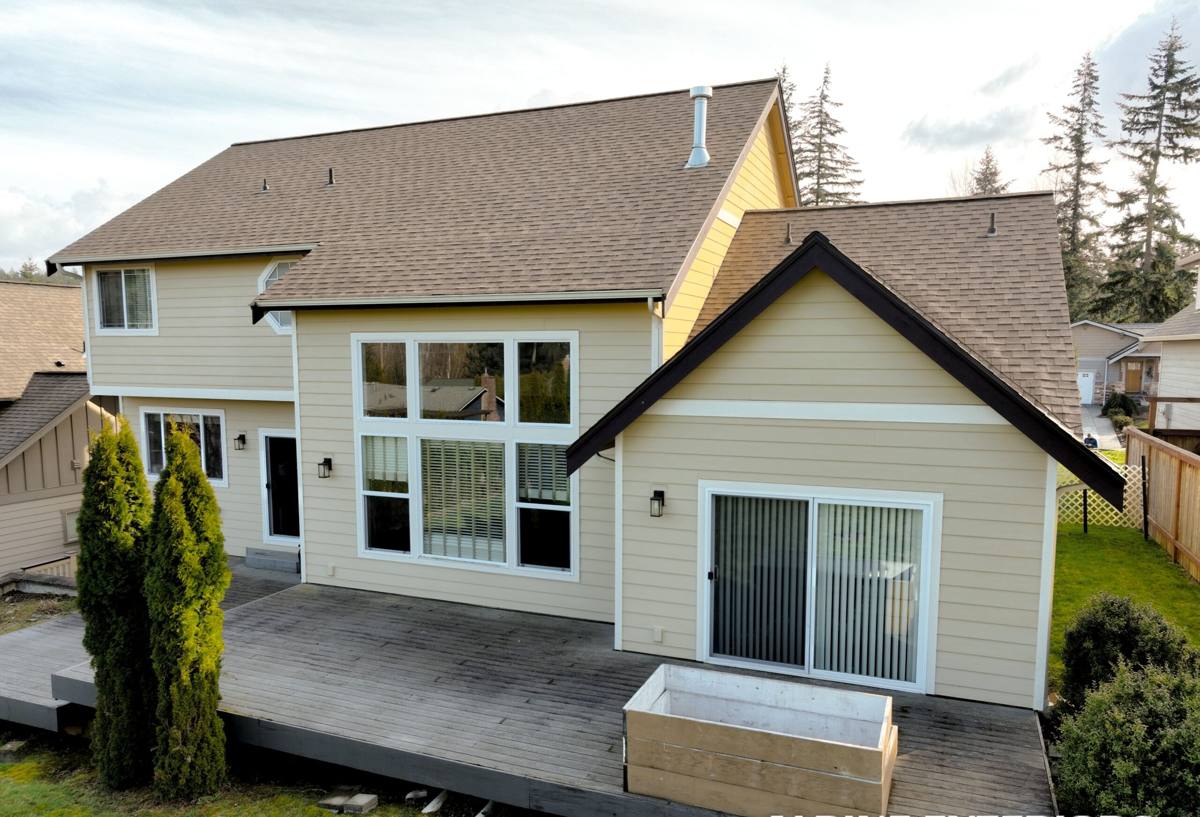
Signs Your Lynden Roof Is Telling You It's Done
Roofs rarely fail all at once. They give warning signs for months or years before a leak shows up inside the house. Knowing what to look for — and whether it's a repair or a full replacement — saves homeowners from paying for patchwork on a roof that's already past the point of being worth patching.
- Granules collecting in gutters or at the base of downspouts, meaning the shingle surface is wearing thin
- Moss mats thick enough that you can't see the shingle texture underneath, especially on north-facing slopes
- Shingles that are cupping, curling at the edges, or visibly brittle
- Dark streaking or soft, spongy spots when walked on, a sign decking underneath may be compromised
- Daylight visible through the roof deck from inside an unfinished attic
- A roof that's 20+ years old and has never had a full tear-off, only repairs
- Rising energy bills paired with an attic that feels noticeably hot or cold relative to the rest of the house
One or two of these on their own might mean a targeted repair is enough. Several together, especially on a roof already past two decades old, usually means repair costs start approaching replacement costs without buying you much extra life.
What a Correct Roof Replacement Actually Involves
A roof replacement is more than swapping old shingles for new ones. In a climate that stays wet as long as Whatcom County's does, the parts of the job you don't see afterward matter more than the parts you do.
Tear-Off and Decking Inspection
We remove the old roofing down to the deck rather than layering over it. Layering over existing shingles hides problems, adds weight, and shortens the life of the new roofing on top. Once the deck is exposed, we check every sheet of sheathing for soft spots, delamination, or water staining and replace anything compromised before a single new shingle goes down. Skipping this step is the single most common shortcut that leads to early roof failure.
Underlayment and Ice-and-Water Protection
The underlayment is the roof's real weatherproofing layer — shingles are the first line of defense, but the underlayment is what keeps the house dry once wind-driven rain gets past them, which it eventually will in this climate. Valleys, eaves, and areas around roof penetrations get a self-adhering waterproof membrane rather than standard felt alone, because these are the spots where driving rain and ice dams do the most damage.
Ventilation
A roof that can't breathe traps moisture in the attic, which speeds up decking rot and shortens shingle life from underneath. Balanced intake at the eaves and exhaust at the ridge keeps air moving through the attic year-round, which matters as much in our damp climate as it does in a hot one.
Flashing and Valleys
Flashing around chimneys, skylights, walls, and valleys is where most roof leaks actually start, not in the open field of shingles. We install new flashing rather than reusing old pieces, and we pay particular attention to valleys, since that's where the largest volume of water concentrates during a heavy Pacific Northwest rain event.
Choosing the Right Roofing Material for Lynden's Climate
There's no single "best" roofing material for every home — the right choice depends on your roof's pitch, your budget, how long you plan to stay in the house, and how much maintenance you're willing to do. Here's how the common options compare for a Whatcom County home.
| Material | Typical Lifespan | Moss & Moisture Behavior | Relative Cost | Best Fit |
|---|---|---|---|---|
| 3-Tab Asphalt Shingle | 15–20 years | More moss-prone; flatter profile holds moisture longer | Lowest | Budget-conscious, shorter-term ownership |
| Architectural (Dimensional) Shingle | 25–30 years | Better runoff and shadow lines reduce standing moisture | Moderate | Most Lynden homes — the standard recommendation |
| Standing Seam Metal | 40–50+ years | Sheds water and moss very well; minimal maintenance | Highest | Long-term owners wanting the lowest lifetime upkeep |
| Synthetic (Composite) Shake/Slate | 30–50 years | Good moisture resistance; check specific product warranty terms | High | Homes wanting a traditional look with less maintenance than wood |
We don't install cedar shake roofing as a standard offering. Wood shake can look excellent, but it demands regular maintenance to manage moss and moisture in a climate this consistently damp, and its warranty structure and upkeep costs don't line up with what we consider a responsible long-term recommendation for most Lynden homeowners. If you specifically want that look, we're happy to talk through synthetic composite alternatives that mimic it with far less ongoing care.
Cost Factors That Change Your Number
Every roof is priced individually, but the same handful of factors move the number up or down on almost every job we quote in this area.
| Factor | Why It Matters Here |
|---|---|
| Roof pitch and complexity | Steeper pitches and multiple valleys mean more labor and more waterproofing detail work |
| Number of existing layers | Tear-off of multiple old layers takes longer and adds disposal cost |
| Decking condition | Rot from long-term moss and moisture exposure means replacement sheathing, priced as it's found |
| Ventilation upgrades | Older Lynden homes often need intake or exhaust vents added to meet current airflow needs |
| Material choice | Asphalt, metal, and composite options span a wide cost range, as shown above |
| Access and roof height | Steep or multi-story roofs require more safety equipment and time |
We give a specific number after walking your roof, not a phone estimate based on square footage alone — too many of these factors only show up on an actual inspection.
Our Process, Start to Finish
The process is straightforward and we keep you informed at every step, because a roof replacement is disruptive and you deserve to know what's happening and when.
- Inspection and estimate: We walk the roof, check the decking where accessible, and give you a written, itemized estimate — no pressure, no gimmicks.
- Material selection: We go over the honest trade-offs between options so you pick what fits your budget and how long you plan to own the home.
- Scheduling around weather: We work with Whatcom County's rain patterns, not against them, and plan tear-off days for the best available weather window.
- Tear-off and deck repair: Old roofing comes off, decking gets inspected and repaired as needed, before anything new goes on.
- Waterproofing, ventilation, and installation: Underlayment, ice-and-water membrane at vulnerable areas, ventilation, flashing, and finally the new roofing material.
- Cleanup and walkthrough: Magnetic sweep for nails, full site cleanup, and a walkthrough so you know exactly what was done and what your warranty covers.
Why Hiring a Crew That Already Works Lynden Matters
Roofing crews that work all over Western Washington aren't automatically wrong for the job, but there's real value in hiring people who already understand this specific area's conditions. A crew familiar with Whatcom County knows how much moss growth to expect on a north-facing slope after a typical wet season, understands which valley and flashing details fail first under sustained driving rain, and doesn't need to relearn local permitting and inspection expectations on your dime.
There's also a practical service-life argument: a roof installed by a crew that treats moss, moisture, and ventilation as first-order design problems — not afterthoughts — simply lasts longer here than one installed to a generic national spec. That's the difference between a roof that needs attention again in twelve years and one that goes the full length of its expected lifespan.
Keeping a New Roof Looking New
A correct installation gets you most of the way to a long-lived roof, but a small amount of upkeep protects that investment.
- Clean gutters at least twice a year so water isn't backing up under the roof edge during heavy rain
- Trim back overhanging branches to cut down on shade, debris, and moss-friendly conditions
- Have moss treated at the first sign of growth rather than waiting for a full mat to form
- Schedule a quick visual inspection after any major windstorm
- Keep an eye on attic ventilation — blocked vents undo a lot of the benefit of a proper installation
None of this requires a maintenance contract or constant attention — just a few checks a year that catch small issues before Whatcom County's weather turns them into big ones.
If your Lynden home's roof is showing any of the signs above, or you just want an honest read on how much life is left in it, we're glad to come take a look. The estimate is free, there's no pressure, and you'll get a straight answer about whether you need a repair, a replacement, or just a little more time.