 Birch Bay Window
 Lynden's Weather Is Tougher on Siding Than It Looks
Lynden sits inland from the water compared to towns right on Birch Bay, but that doesn't mean the siding on Lynden homes gets an easy ride. Whatcom County's marine-influenced climate reaches well past the shoreline — the same moisture-heavy air that rolls in off the Salish Sea keeps humidity high across the whole county for much of the year, and Lynden's open farmland and river-bottom setting hold onto that dampness longer than you'd expect. Add wind-driven rain during fall and winter storms, and siding here is working harder than it looks like it should be.
Driving rain and wind-driven moisture
Straight-down rain is easy for most siding to shed. Driving rain — rain pushed sideways by wind — is what actually finds the gaps. It gets forced up under laps, into unsealed trim joints, and behind panels that were installed with tight or missing clearances. Over a Pacific Northwest winter, a home might see dozens of these wind-driven rain events. Siding and the water-resistive barrier behind it have to handle that repeatedly, not just once.
A moss season that doesn't really end
Whatcom County's wet season runs long — realistically from early fall through late spring. That's a long stretch where north-facing walls, shaded siding, and anything under trees or eaves stays damp instead of drying out between rains. Moss and algae take hold in exactly those conditions, and once established they hold moisture directly against the siding surface, which accelerates whatever degradation the material is already prone to.
Freeze-thaw cycling in winter
Lynden doesn't see extreme cold most winters, but it does see repeated freeze-thaw cycling — nights near or below freezing followed by daytime thaw. Any siding material that has absorbed moisture is vulnerable during that cycle, because water expands as it freezes. Materials that resist water absorption in the first place hold up far better through a Whatcom County winter than materials that soak it up.
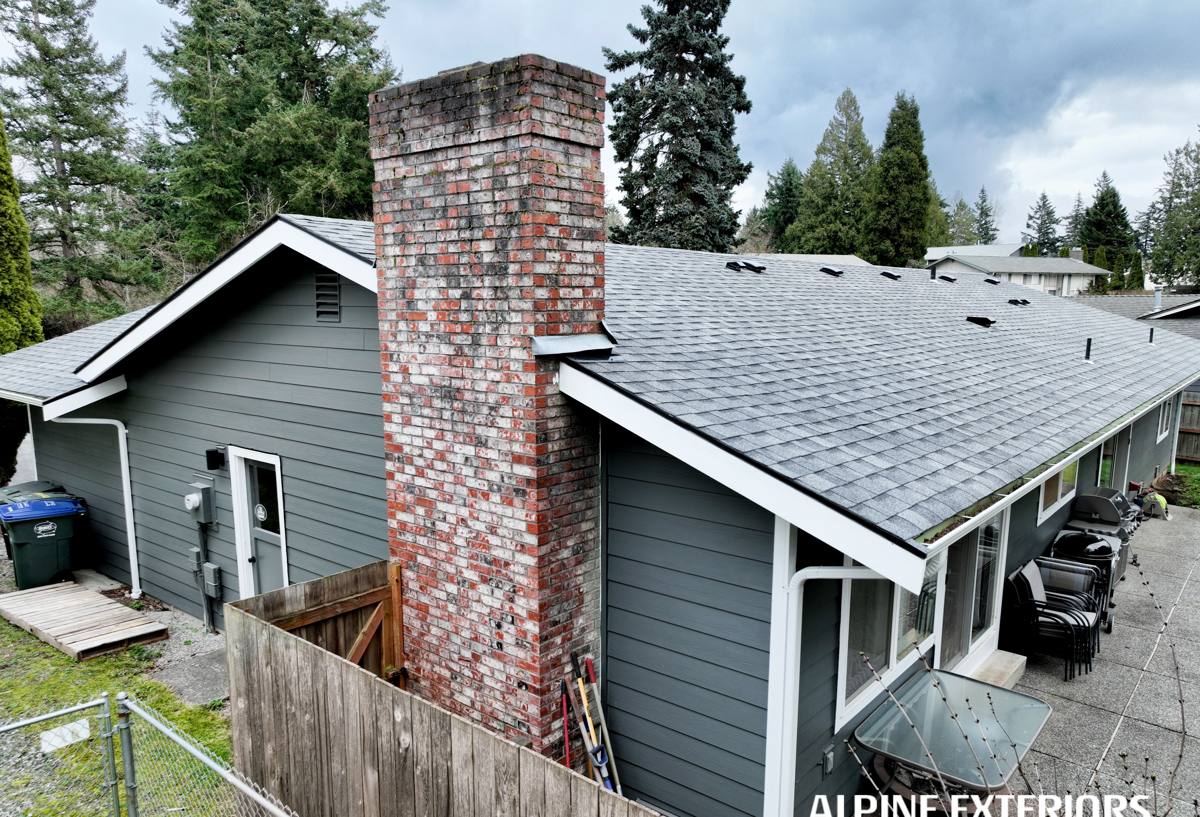
What "Correct" Siding Installation Actually Means
Most siding problems we get called out to inspect aren't a failure of the material — they're a failure of the installation. The material only performs as well as the system behind it.
The drainage plane and water-resistive barrier
Siding is not meant to be 100% waterproof on its own. It's the outer layer of a drainage system. Behind it, a water-resistive barrier (WRB) and a drainage gap are supposed to let any moisture that gets past the siding drain back out instead of sitting against the wall sheathing. Skip or shortcut that layer and you're setting up hidden rot regardless of what siding you put on top.
Flashing at every penetration
Windows, doors, hose bibs, light fixtures, vents — every penetration through the siding is a place water can enter if it isn't flashed correctly. Correct flashing means water is directed out and away, layered so each piece overlaps the one below it, shingle-style. This is the detail work that separates a siding job that lasts twenty-plus years from one that starts showing staining and soft spots in five.
Fastening to manufacturer spec
Fiber cement siding has specific requirements for fastener type, placement, and spacing, and for how much clearance to leave at the bottom edge, at inside and outside corners, and where panels meet trim. Nail it too tight, use the wrong fastener, or crowd the clearances, and you create stress points and moisture traps that show up as problems years later — long after the crew that did it has moved on.
Why We Install Only James Hardie Fiber Cement
We get asked why we don't offer LP SmartSide, vinyl, cedar, or primed spruce siding alongside Hardie. It's not that these products have no merit — each one has a legitimate place in the market. It's that after years of installing and repairing siding in this climate, we made a professional call to standardize on one product system we trust completely rather than offer several we'd have to caveat.
Vinyl siding is affordable and low-maintenance, but it's a thin plastic product that expands and contracts with temperature swings, can crack in impact or extreme cold, and telegraphs every wave or dip in the wall behind it. LP SmartSide is engineered wood — treated to resist moisture — but it's still wood-based, meaning any breach in that treated surface (a deep scratch, an unsealed cut edge, a failed caulk joint) gives moisture a path into a material that will eventually swell or delaminate if it stays wet. Cedar and primed spruce are natural wood products that look great new but demand ongoing painting, sealing, and vigilance against rot and insects — maintenance that a lot of homeowners underestimate when they choose them.
James Hardie fiber cement is cement, sand, and cellulose fiber — non-combustible, dimensionally stable, and engineered specifically for climates like ours. It doesn't rely on a surface coating to keep water out the way engineered wood does, and it doesn't move with temperature the way vinyl does. That's the standard we chose to build our business around, and it's what we install on every siding job we take on.
The Hardie Product Lines We Use in Whatcom County
James Hardie engineers its siding by climate zone, and Whatcom County falls in the wetter, milder HZ5 zone rather than the harsher freeze-zone HZ10 formulation used in colder parts of the country. HZ5 products are formulated for exactly the conditions Lynden deals with: sustained moisture exposure, humidity, and moderate freeze-thaw rather than deep, extended freezes.
On top of the HZ5 substrate, we install Hardie's ColorPlus factory-applied finish, which is baked on under controlled conditions rather than field-painted after installation. That matters here specifically because field-applied paint has to cure in whatever weather shows up, and a long damp season doesn't always cooperate. A factory finish goes on right every time and carries its own finish warranty separate from the substrate warranty.
- HardiePlank lap siding — the most common choice, available in several exposures and profiles
- HardiePanel vertical siding — often used for accents, gables, or a more modern look
- HardieShingle — a shingle profile for homes wanting a more traditional or coastal look without real wood's maintenance
- HardieTrim — matching trim boards so the whole exterior system is consistent, not mixed materials
Our Installation Process From Estimate to Finish
The process is the same discipline on every Lynden job, whether it's a full re-side or a targeted section replacement.
- On-site assessment. We look at the existing siding, the sheathing underneath where accessible, and the trouble spots — north walls, shaded areas, anywhere moss or staining shows up.
- Tear-off and sheathing check. Old siding comes off and we inspect the sheathing for hidden rot or damage before anything new goes on. Problems found here get addressed, not covered up.
- WRB and drainage plane installation. A proper water-resistive barrier and drainage gap go in per code and manufacturer requirements — this is the layer that does the real waterproofing work.
- Flashing at every penetration. Windows, doors, and fixtures get flashed correctly before siding closes in around them.
- Hardie installation to spec. Fastening, clearances, and joint treatment follow James Hardie's published installation guidelines, which is also what keeps the manufacturer warranty valid.
- Trim, caulking, and final detailing. Corners, trim boards, and joints get finished and sealed correctly the first time.
- Walkthrough and cleanup. We review the finished work with the homeowner and leave the site clean.
What Siding Replacement Costs Depend On
Every Lynden home is different, so we don't quote a number until we've actually looked at the house. What we can tell you is what tends to move the price up or down.
| Factor | Why It Matters |
|---|---|
| Home size and wall complexity | More square footage and more corners, gables, and dormers mean more material and more labor-intensive cutting and flashing |
| Condition of existing sheathing | Rot found during tear-off adds repair work before new siding can go on — this is common on older homes with a history of moisture problems |
| Siding profile chosen | Lap, panel, and shingle profiles have different material and labor costs; wider exposures generally install faster than narrow ones |
| Trim and accent work | Matching HardieTrim boards, window surrounds, and accent details add cost but keep the whole system consistent |
| Access and site conditions | Multi-story sections, tight lot lines, or landscaping that limits access can add time and equipment needs |
Signs Your Lynden Home's Siding Needs Attention
You don't need to wait for visible failure to have siding looked at. Watch for these signs, especially heading into another wet season:
- Soft or spongy spots when you press on the siding, particularly near the bottom edge or below windows
- Persistent moss or algae growth that comes back quickly after cleaning
- Visible warping, bowing, or gaps opening up between boards
- Peeling or bubbling paint, or finish that's failed in patches rather than evenly
- Staining or dark streaking below windows, hose bibs, or roof-to-wall junctions — a sign water is getting past the flashing
- Rising energy bills without another explanation, which can point to a compromised weather barrier
Why Hiring a Crew That Already Works in Lynden Matters
Siding installation isn't one-size-fits-all across a state, or even across a county. A crew that regularly works Whatcom County homes already knows how the local wet season behaves, which orientations on a typical Lynden lot take the worst of the driving rain, and where moss tends to establish first. That local pattern recognition shows up in the details — where extra flashing attention goes, which clearances actually need to be generous rather than just code-minimum, and how to sequence a job around a realistic weather window instead of hoping for the best. It's the difference between a crew executing a generic installation manual and a crew adapting that manual to the house actually in front of them.
If your Lynden home's siding is aging, showing early wear, or you're planning ahead of a renovation, we're happy to take a look and walk you through what we see — no pressure, no obligation. Reach out for a free estimate using the form below.