 Birch Bay Window
 Marietta's Coastal Exposure Is Harder on Siding Than Most Homeowners Realize
Marietta sits close enough to the water that homes here deal with a combination of stresses that inland Whatcom County properties rarely see all at once: salt-laden air moving off the Strait, wind-driven rain that hits siding sideways instead of falling straight down, and long stretches of shaded, damp weather that keep exterior surfaces wet far longer than a sunnier lot would. Any one of those factors is manageable. Together, over years, they punish siding that wasn't built for the combination.
Salt air is corrosive to exposed metal fasteners and trim, and it degrades paint films faster than inland air does. Driving rain finds every gap in flashing, caulking, and lap joints that a calmer climate would never test. And a long moss season means siding stays damp for extended periods, which is exactly the condition that lets water intrusion, rot, and coating failure take hold. A siding product and installation method that work fine in a dry inland subdivision can fall short here within a decade.
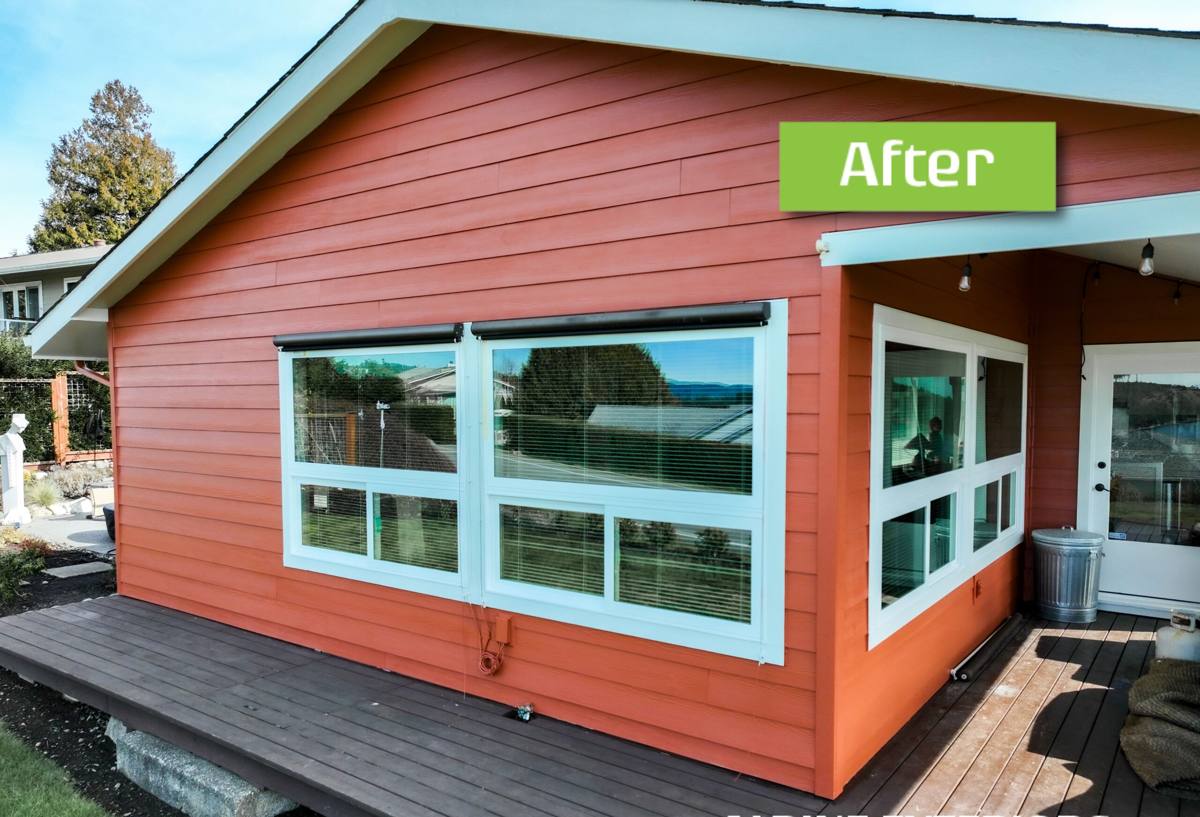
Why We Install James Hardie Fiber Cement and Nothing Else
We standardized on James Hardie fiber cement siding for every home we work on, including Marietta, because it's engineered specifically for climates like this one. James Hardie makes region-specific product lines under its HZ5 designation for the Pacific Northwest, formulated to resist moisture absorption and swelling in wet, humid conditions rather than a one-size-fits-all national formula. That matters directly for a property dealing with salt air and a long wet season.
Fiber cement is also non-combustible, which is a real consideration for coastal Washington properties near vegetation and tree cover. And it holds paint and factory finish far more consistently than wood-based or vinyl alternatives, which is part of why we don't install LP SmartSide, cedar, primed spruce, or vinyl siding on the homes we work on. Each of those products has legitimate strengths, but each also comes with a maintenance burden or moisture vulnerability that shows up faster in a climate like Birch Bay's than it would somewhere drier.
What ColorPlus Factory Finish Solves For
James Hardie's ColorPlus finish is baked on at the factory under controlled conditions, rather than field-applied paint or stain. In a salt-air environment, that matters because factory-cured finishes resist fading, chalking, and peeling far longer than paint applied on-site, and touch-up product is available to match rather than requiring a full repaint. For a home exposed to constant moisture and airborne salt, that's the difference between repainting every several years and going a decade or more before any finish work is needed.
What a Correct Installation Actually Involves
Fiber cement siding is only as good as the installation behind it. Hardie's own installation instructions are detailed for a reason — skipping steps is the single biggest cause of premature siding failure, and it's the same whether the home is in Marietta or anywhere else on the water. A correct job includes:
- Proper water-resistive barrier and drainage plane behind the siding, so any moisture that does get past the surface has somewhere to go
- Correct fastener type, spacing, and depth — over-driven or corrosion-prone fasteners are a common failure point in salt air
- Manufacturer-specified clearances at grade, roofline, and adjoining surfaces so water can't wick into the bottom edge of the boards
- Properly lapped and sealed flashing at every window, door, and penetration, since driving rain finds gaps that vertical rain never would
- Correct joint treatment and caulking at butt joints, using products rated for the exposure rather than generic sealant
- Field-cut edges primed or sealed before installation, since raw cut edges are the most vulnerable point on any fiber cement board
Every one of these steps is inspectable, and every one of them is also easy to skip if a crew is moving fast or isn't used to working with fiber cement specifically. On a property exposed to Marietta's conditions, shortcuts here show up as problems in years rather than decades.
How Our Process Works for Marietta Properties
Assessment and Planning
We start with a walk-around of the exterior to look at current siding condition, moisture staining, trim and flashing detail, and anything specific to the lot — tree cover, prevailing wind direction, and sun exposure all affect how a home dries out after weather moves through. That assessment shapes the plan for water-resistive barrier, flashing detail, and product selection.
Preparation
Old siding, damaged sheathing, and any compromised trim get addressed before new siding goes up. This is also where we catch and repair any hidden moisture damage — something that's more common on homes that have gone a long time with siding that wasn't managing water well, which is a real possibility given how much rain this area sees.
Installation
Hardie panels, planks, or trim go up to manufacturer specification: correct fastening, clearances, flashing, and joint treatment as described above. We don't deviate from Hardie's published installation requirements, because those requirements are what the product warranty is built around.
Finish and Walkthrough
Once siding is installed, we walk the exterior with the homeowner, review the work, and go over basic care so the siding performs the way it's designed to for the long term.
Why Local Experience Matters More Here Than It Sounds Like It Should
Siding installation isn't a one-size-fits-all trade. A crew that mostly works inland, drier properties can do technically fine work and still miss details that matter specifically near the water — flashing details that account for wind-driven rain, fastener choices that hold up to salt exposure, or timing installation around the wetter stretches of the year so materials aren't sealed in while damp. A crew that already works Marietta and the surrounding Birch Bay area has already made those adjustments and isn't learning them on your home.
Local experience also means familiarity with how Whatcom County's coastal exposure behaves across seasons — not just what the weather does on installation day, but how a home dries out (or doesn't) for months afterward. That's the difference between a job that looks right at completion and one that actually holds up.
| Consideration | Generic Inland Approach | Marietta-Adapted Approach |
|---|---|---|
| Fastener selection | Standard fasteners, minimal corrosion consideration | Fasteners and hardware selected with salt-air exposure in mind |
| Flashing detail | Standard vertical-rain assumptions | Detailed for wind-driven, sideways rain |
| Product line | General-purpose formulation | HZ5-engineered James Hardie product for the Pacific Northwest |
| Installation timing | Scheduled without regard to moss/wet season | Sequenced to avoid sealing in damp materials |
What Affects the Cost of a Marietta Siding Project
Every home is different, and we'll always give you specifics after seeing the property, but a few factors consistently move the price on a project like this:
| Factor | Why It Matters |
|---|---|
| Home size and complexity | More square footage, corners, and rooflines mean more material and labor |
| Current siding condition | Hidden moisture or sheathing damage found during tear-off adds repair scope |
| Product selection | Hardie plank, panel, and trim options carry different material costs |
| Color and finish | ColorPlus factory-finished options vs. field-painted affect both cost and long-term maintenance |
| Access and site conditions | Tree cover, slope, and site access can affect labor time |
Keeping Hardie Siding Performing in This Climate
James Hardie siding is low-maintenance compared to wood or vinyl, but "low-maintenance" doesn't mean "no maintenance," especially in a salt-air, moss-prone environment. A short annual routine goes a long way:
- Rinse siding periodically to remove salt residue and organic buildup, especially on shaded sides of the home
- Keep gutters clear so overflow doesn't run down the siding face repeatedly
- Trim back vegetation and tree limbs that keep sections of siding shaded and damp
- Inspect caulking at joints and trim annually and touch up if it's cracking or pulling away
- Address any moss or algae growth promptly rather than letting it sit against the surface
Signs Existing Siding Is Already Struggling With Marietta's Climate
If your current siding is showing soft spots, persistent moss or algae that keeps coming back, visible warping, peeling paint that won't hold, or staining near the bottom edges and seams, that's usually moisture winning the battle rather than a cosmetic issue. Catching it early keeps the fix a siding project instead of a siding-plus-structural-repair project.
If you're weighing a siding replacement in Marietta and want a straight answer about what your home needs, we're glad to take a look. Reach out for a free, no-pressure estimate — we'll walk the exterior with you and tell you honestly what we see.