 Birch Bay Window
 Point Whitehorn's Coastal Climate Is Hard on Siding
Homes along Point Whitehorn sit close enough to the water to catch salt-laden air off the Strait of Georgia year-round, and that air doesn't stay offshore. It settles on exterior walls, works into seams and fastener heads, and slowly breaks down materials that aren't built to handle it. Add in the wind-driven rain that comes with fall and winter storms off the Salish Sea, and siding here takes on moisture from angles that inland Whatcom County homes rarely see.
Then there's the moss and algae season, which in this part of Washington isn't really a season at all — it's most of the year. Shaded walls, tree cover, and long stretches of damp, mild weather give organic growth exactly what it needs to take hold on any surface that can feed it or hold moisture against it. Combine all three factors — salt exposure, wind-driven rain, and a long wet season — and you get a climate that punishes cheap materials and sloppy installation faster than almost anywhere else in the state.
This is the environment we design every siding job around when we're working in Point Whitehorn. It's also the reason we don't install anything but James Hardie fiber cement.
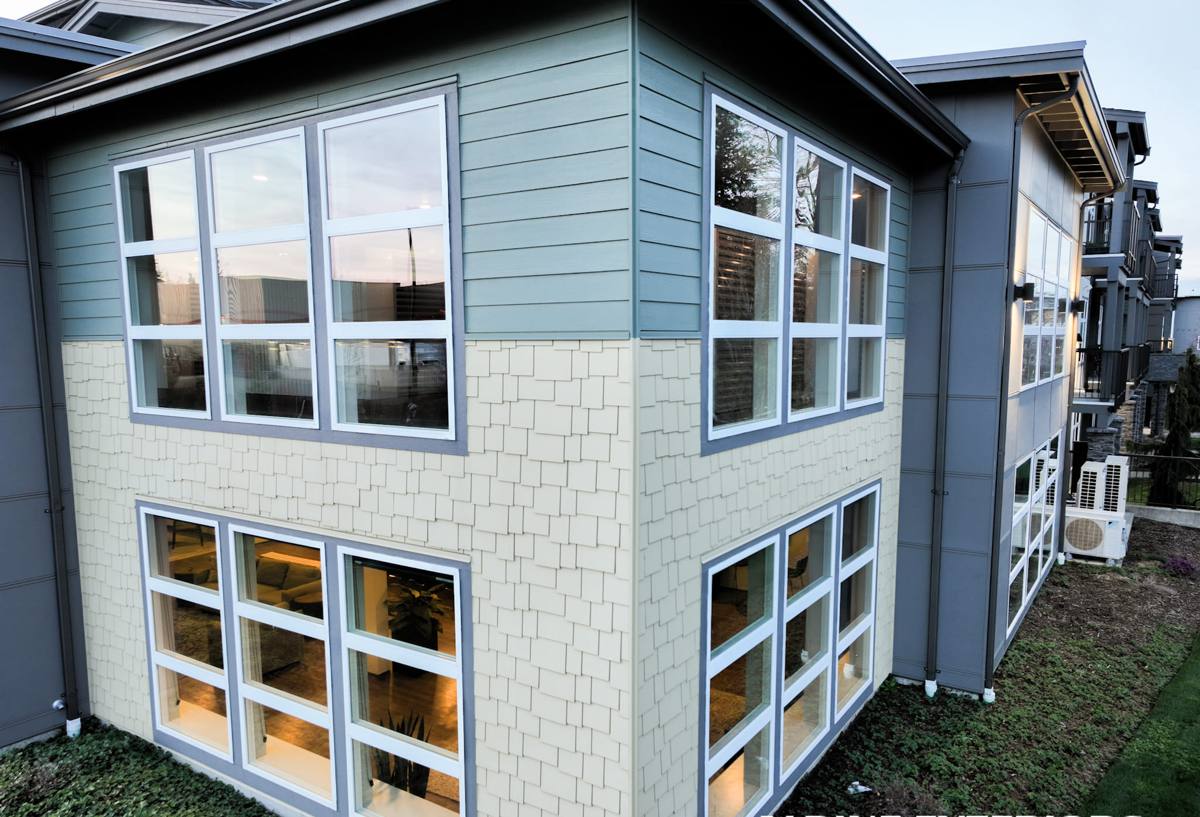
Why We Only Install James Hardie Fiber Cement Here
We've made a deliberate decision as a company to install James Hardie exclusively — not LP SmartSide, not vinyl, not cedar, not other fiber cement brands. On a property exposed to salt air and near-constant moisture, that decision matters more than it would somewhere drier and more sheltered.
James Hardie siding is fiber cement, not wood-based. That means it doesn't have the organic wood fiber that vinyl-backed or engineered wood products rely on, so it isn't a food source for the rot, fungus, and insects that thrive in damp coastal conditions. It's also non-combustible, which matters given the dry-season wildfire risk that affects even the wetter parts of Western Washington in late summer.
James Hardie also engineers its siding by climate zone. The HZ5 product line used in this region is built specifically for areas that see the combination of high moisture and freeze-thaw cycling — exactly what Point Whitehorn gets between wet winters and the occasional hard frost. And the ColorPlus factory finish is baked on under controlled conditions, which holds up to UV and salt exposure far better than a coat of paint applied on-site after installation.
None of this means other products are worthless everywhere. It means that for the specific combination of salt air, wind-driven rain, and moss pressure found on this stretch of coastline, we're not willing to put our name on anything less durable.
What a Correct Installation Looks Like on a Point Whitehorn Home
Drainage and rainscreen approach
Fiber cement siding is only as good as what's behind it. In a high-moisture environment like this one, we install with a drainage gap between the siding and the water-resistive barrier so any moisture that gets past the surface has somewhere to go besides your sheathing. Skipping this step is one of the most common reasons siding fails early in wet coastal climates, regardless of the brand on the wall.
Fastening, clearances, and flashing
James Hardie publishes exact fastening patterns, nail penetration depths, and minimum clearances from grade, roof lines, and decks. Those numbers aren't arbitrary — they're calibrated to keep water from wicking up into the bottom edge of the boards or pooling behind trim. We follow them to the letter, because a quarter-inch clearance mistake at ground level is exactly the kind of detail that turns into a rot problem two winters later.
Trim, joints, and sealing
Every seam, corner, and penetration is a potential entry point for wind-driven rain. We use trim and joint treatments that match Hardie's warranted assemblies, and we're deliberate about where we caulk versus where we let the drainage plane do the work — over-caulking can trap moisture just as easily as under-caulking can let it in.
Factory finish versus field painting
Whenever possible, we install ColorPlus pre-finished boards rather than field-painting primed siding after installation. The factory finish is more consistent, resists fading and chalking longer under coastal UV and salt exposure, and comes with its own finish warranty — something a site-applied paint job simply can't match.
Moss and Algae: What to Expect and How Hardie Holds Up
Moss and algae aren't a defect — they're a fact of life in this climate, especially on north-facing walls and any wall shaded by trees or neighboring structures. What matters is how the siding responds to that growth over time.
Because fiber cement doesn't have an organic substrate, moss and algae sitting on the surface aren't feeding on the material itself the way they can with wood or wood-composite siding. Growth stays a surface-level issue rather than a structural one, which means it can be washed off without the underlying board having already started to soften or delaminate. That said, no siding is maintenance-free in a climate like this — periodic gentle cleaning and keeping vegetation trimmed back from walls goes a long way toward keeping growth from building up in the first place.
Our Process for Point Whitehorn Projects
1. Site assessment and moisture check
We start by walking the exterior and checking for existing moisture damage, especially around window and door openings, deck ledgers, and any wall sections with heavy shade or limited airflow — the areas most exposed to this area's specific combination of rain and moss pressure.
2. Tear-off and sheathing inspection
Once old siding comes off, we inspect the sheathing and water-resistive barrier underneath. Any soft spots, existing rot, or compromised house wrap get addressed before a single new board goes up — covering a problem instead of fixing it just delays the failure.
3. Installation to manufacturer specification
Drainage gap, fastening pattern, clearances, and trim details all follow James Hardie's published requirements for this climate zone, not shortcuts or "close enough" substitutions.
4. Final walkthrough and inspection
Before we call a job finished, we walk the exterior with the homeowner to check clearances, sealant lines, and finish consistency, and to answer any questions about care going forward.
Cost Factors to Know Before You Get a Quote
Every home is different, and we don't quote prices without seeing the property, but these are the factors that most affect what a Point Whitehorn siding project costs.
| Factor | Why It Matters Here |
|---|---|
| Home size and number of stories | More wall area and taller elevations mean more material and more scaffolding or lift work |
| Existing siding removal and disposal | Tear-off complexity varies by what's currently on the house and how it was originally fastened |
| Sheathing or framing repair | Moisture damage found during tear-off has to be repaired before new siding goes on |
| Trim complexity | Homes with more windows, dormers, or architectural detail take longer to trim and flash correctly |
| Wind and rain exposure | Walls facing the water or prevailing weather may need extra attention to flashing and joint sealing |
| Site access | Tree cover, slope, and driveway access affect staging, scaffolding, and material delivery |
Why Local Experience in Point Whitehorn Matters
A crew that regularly works this part of Whatcom County already understands which walls tend to take the worst of the wind-driven rain, where moss builds up fastest, and how salt exposure differs from a job five miles inland. That familiarity shows up in small decisions — where extra flashing attention pays off, which clearances need to be treated conservatively — that a crew unfamiliar with this specific coastline might not think twice about.
It also means fewer surprises during the project itself. Local permitting familiarity, realistic scheduling around this region's weather windows, and knowing what past installations in the area have held up well against all make the difference between a siding job that's just installed correctly on paper and one that's actually built for where it sits.
Keeping Your Hardie Siding Looking Right in This Climate
- Rinse siding with a garden hose (not a pressure washer aimed directly at seams) once or twice a year to clear salt residue and light surface growth
- Trim back trees and shrubs so walls get more airflow and sunlight, especially on north-facing sides
- Walk the exterior after major storms and check for loose trim, cracked caulk, or debris buildup at the base of walls
- Keep gutters and downspouts clear so runoff isn't sheeting down siding it wasn't designed to handle
- Address any small caulk gaps or trim issues early, before wind-driven rain finds its way behind them
If you're weighing siding options for a home in Point Whitehorn, we're glad to take a look and walk you through what we'd actually recommend for your specific walls and exposure. Reach out for a free, no-pressure estimate using the form below.