 Birch Bay Window
 Why Lummi Island Roofs Wear Differently Than Roofs Just a Few Miles Inland
A roof on Lummi Island doesn't fail the same way a roof does ten miles inland in Whatcom County. Being surrounded by the Salish Sea means salt-laden air is a constant, not an occasional coastal breeze. That salt content accelerates corrosion on any exposed metal — flashing, fasteners, vent caps, gutter hardware — well before it would show wear on a mainland roof of the same age. Add in driving rain that comes in sideways off the water during winter storms, and you get wind-driven moisture finding its way under shingle edges, around chimneys, and through any flashing that isn't sealed exactly right.
Then there's the tree cover. Many island homes sit under a canopy of fir, cedar, and madrona that keeps roofs shaded and damp for long stretches of the year. That shade is part of what makes the island beautiful, but it also means moss and algae get a longer growing season here than they would on a roof that gets full sun most of the day. A roof repair on Lummi Island has to account for all three of these factors at once — salt, wind-driven rain, and a long moss season — not just patch the spot where water is currently coming through.
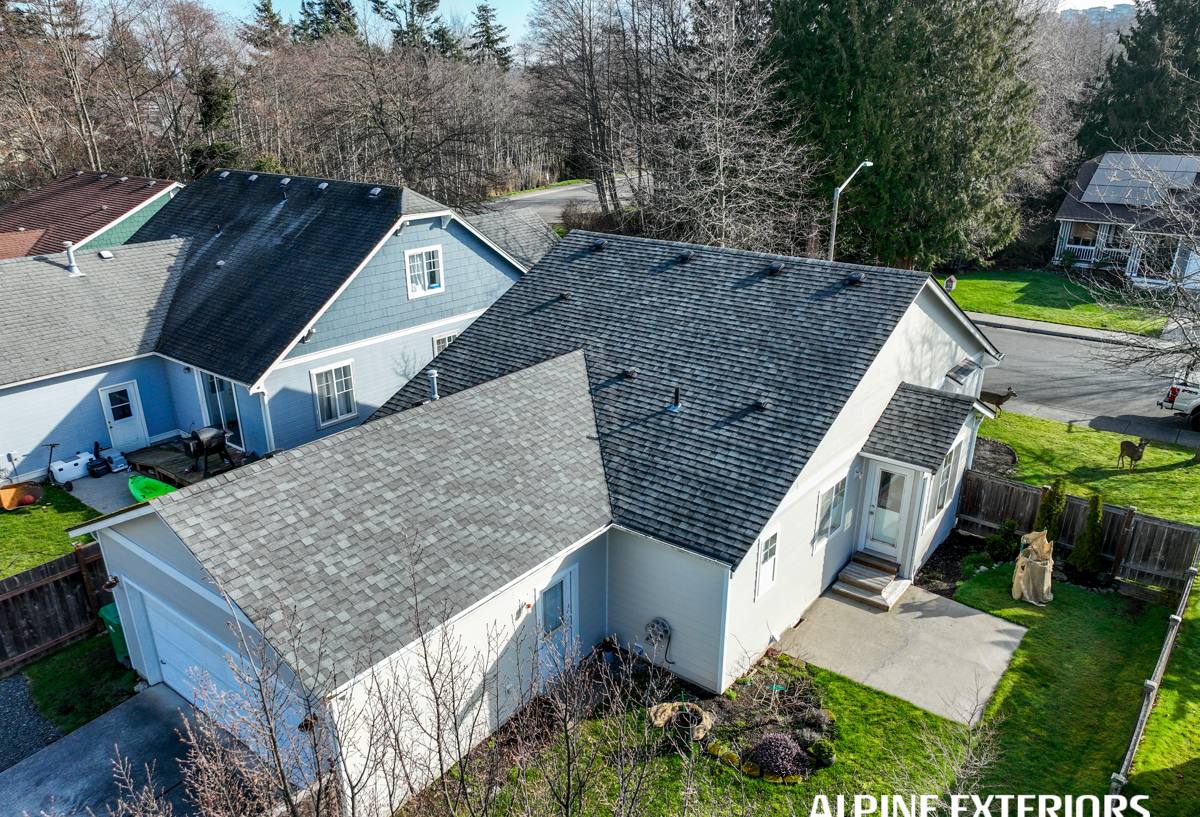
Signs Your Roof Needs Real Repair, Not Just a Rinse
A lot of moss and staining can be cleaned off without touching the roofing material underneath. But some signs point to actual damage that a cleaning won't fix. Homeowners on the island should treat the following as reasons to get a repair estimate, not just a maintenance call:
- Granules collecting in gutters or at the base of downspouts, which means the shingle surface is wearing thin
- Moss growing thick enough to lift shingle edges, which lets wind-driven rain get underneath instead of running off
- Rust streaks below any metal flashing, vent pipe, or chimney cap
- Dark stains or a soft, spongy feel on interior ceilings after a hard rain, especially near valleys or penetrations
- Shingles that have curled, cracked, or lifted at the edges after a windstorm off the water
- Visible daylight or gaps around flashing at chimneys, skylights, or where a lower roof meets a wall
None of these mean a full roof replacement is automatically necessary. Most of the time, they point to a specific, repairable failure point — but only if someone traces the actual cause instead of just resealing the spot where water is showing up inside.
What an Honest Roof Repair Actually Involves
Tracing the Water, Not Just the Stain
Water rarely enters a roof exactly where it shows up on a ceiling. It often travels along rafters or sheathing before dripping somewhere lower. A correct repair starts by tracing the path back to the actual entry point — usually a flashing detail, a nail hole, or a shingle course that's been compromised by moss holding moisture against it.
Flashing Comes First
On a coastal, tree-shaded island roof, flashing failure is the most common root cause of leaks we find — more often than the shingles themselves. Salt air corrodes fasteners and thin metal faster than inland exposure does, and driving rain finds any gap that opens up. A repair that only replaces shingles over failed flashing will leak again within a season or two.
Matching Materials Correctly
Shingle color, profile, and granule type vary by manufacturer and by production run. We match as closely as the existing roof allows, and we're upfront when an exact match isn't available — patchwork that clearly doesn't blend is a cosmetic trade-off homeowners should decide on, not something we spring on them after the fact.
Restoring Ventilation and Drainage
A repair that ignores the reason moss took hold in the first place — usually poor airflow or a low spot holding water — just buys time before the same section fails again. Where it's practical, we address drainage and ventilation as part of the repair, not as a separate upsell.
Common Roofing Materials on Lummi Island and How We Repair Each
| Material | What This Climate Does to It | Repair Approach |
|---|---|---|
| Asphalt composition shingle | Granule loss from moisture cycling; moss lifting edges; algae staining in shaded areas | Remove and replace affected courses, correct underlying flashing, match shingle type as closely as available |
| Cedar shake or shingle | Moisture retention under moss growth speeds rot; salt air accelerates weathering of exposed grain | Replace individual rotted shakes, clear organic buildup, treat exposed wood before it becomes structural |
| Standing seam or metal panel | Fastener and seam corrosion from salt air; minor denting from falling branches | Reseal or replace corroded fasteners and seam sealant, address panel damage without disturbing sound sections |
| Low-slope membrane (torch-down or similar) | Standing water in shaded low spots; seam separation from thermal cycling | Patch or reseal seams, correct drainage at low points, inspect flashing at all penetrations |
Whatever is on your roof now, the repair approach depends on matching the fix to how that specific material fails — not applying a generic patch to all of them the same way.
Our Process for Roof Repair Jobs on the Island
Working on Lummi Island means building the ferry into the schedule, not treating it as an inconvenience discovered on the day of the job. Here's how a repair typically moves from first call to finished roof:
- Initial assessment by phone or photos. A lot can be ruled in or out before anyone crosses the water, which saves time on both ends.
- On-site inspection. We look at the full roof, not just the reported leak, and identify the actual entry point before quoting the fix.
- One trip for materials. Because ferry crossings take planning, we order and bring everything needed for the job in a single trip rather than discovering a missing part mid-repair.
- The repair itself. Flashing, underlayment, and shingle or membrane work completed to match the surrounding roof and correct the underlying cause.
- Cleanup and walk-through. We show you what was found and what was done before we leave the site.
None of this is complicated, but it does require a crew that already accounts for island logistics instead of learning them on your job.
What Roof Repair Costs Depend On
There's no honest flat rate for roof repair, because the same-sized leak can cost very differently depending on a handful of factors. Here's what actually moves the price on a Lummi Island job:
| Factor | Why It Matters |
|---|---|
| Roof pitch and access | Steeper roofs and homes with limited equipment access take longer and require more safety setup |
| Material type and match availability | Cedar and metal repairs involve different labor and material costs than asphalt shingle work |
| Extent of hidden damage | A leak traced back to rotted sheathing costs more to correct than a surface-level flashing fix |
| Moss and organic buildup | Heavier buildup means more removal labor before the actual repair can even start |
| Ferry and logistics planning | Efficient, well-planned trips keep this from adding meaningful cost; last-minute or repeat crossings do the opposite |
We'll always give you a clear estimate after inspecting the actual roof — broad ranges over the phone before we've seen the damage aren't useful to you or accurate for us.
Moss and Algae: A Maintenance Reality, Not a One-Time Fix
Given the tree cover and damp climate around Birch Bay and the surrounding Whatcom County shoreline, moss isn't a one-time problem you solve and forget. It's an ongoing condition to manage. A few things worth checking on your own between professional inspections:
- Green or dark streaking on north-facing or shaded slopes, which shows where moisture sits longest
- Granules building up in gutters or downspout screens after heavy rain
- Overhanging branches close enough to keep sections of roof shaded and damp all day
- Any spot where moss has grown thick enough to look like a raised cushion rather than a thin film
- Standing water or slow drainage in valleys after a storm has passed
Catching these early is usually the difference between a simple cleaning and an actual repair. If you're not sure which category what you're seeing falls into, that's a reasonable thing to ask about before it becomes a leak.
Why Hiring a Crew That Already Works Lummi Island Matters
A roofing crew that's never worked on the island before has to figure out ferry timing, material logistics, and access on your job — which either shows up as delays or gets rushed in ways that show up later as callbacks. A crew that already works Lummi Island has that logistics problem solved before your call ever comes in. That means fewer surprises on scheduling, materials arriving complete on the first trip, and a repair approach that already accounts for what salt air, driving rain, and shade actually do to roofs out here — because we've seen it before, not because we're guessing from a mainland playbook.
That familiarity matters just as much as the repair itself. The right fix applied without understanding how this specific coastal, tree-covered environment behaves tends to need revisiting sooner than it should.
Get a Straight Answer on Your Roof
If you're seeing moss buildup, a stain on a ceiling, or storm damage after a hard blow off the water, we're glad to take a look. We'll give you a clear, no-pressure estimate based on what we actually find — not a guess over the phone. Use the form below to reach out and we'll get back to you to schedule a visit.