 Birch Bay Window
 Siding Repair in Semiahmoo: A Different Kind of Exposure
Semiahmoo sits out on a low, exposed spit at the north end of Birch Bay's stretch of Whatcom County coastline, with open water on more than one side of most properties. That position means siding here takes a harder hit than siding on a home set back a mile or two inland. Salt-laden air moves across these lots almost constantly, storms push rain sideways instead of straight down, and the damp, shaded conditions common on this part of the coast support a moss and mildew season that can run for most of the year. Siding repair in Semiahmoo isn't just smaller-scale new construction work — it's a specific skill set built around figuring out what this exposure has already done to a wall assembly, and fixing the actual problem instead of just patching what shows.
We get called out to Semiahmoo properties regularly for exactly this kind of work: a section of siding that's cracked, delaminating, stained, or pulling away from the wall, on an otherwise sound house. The goal on every one of those calls is the same — figure out why that section failed while the rest of the wall held up, fix the cause, and repair the section so it matches and performs like the surrounding siding, not like a patch.
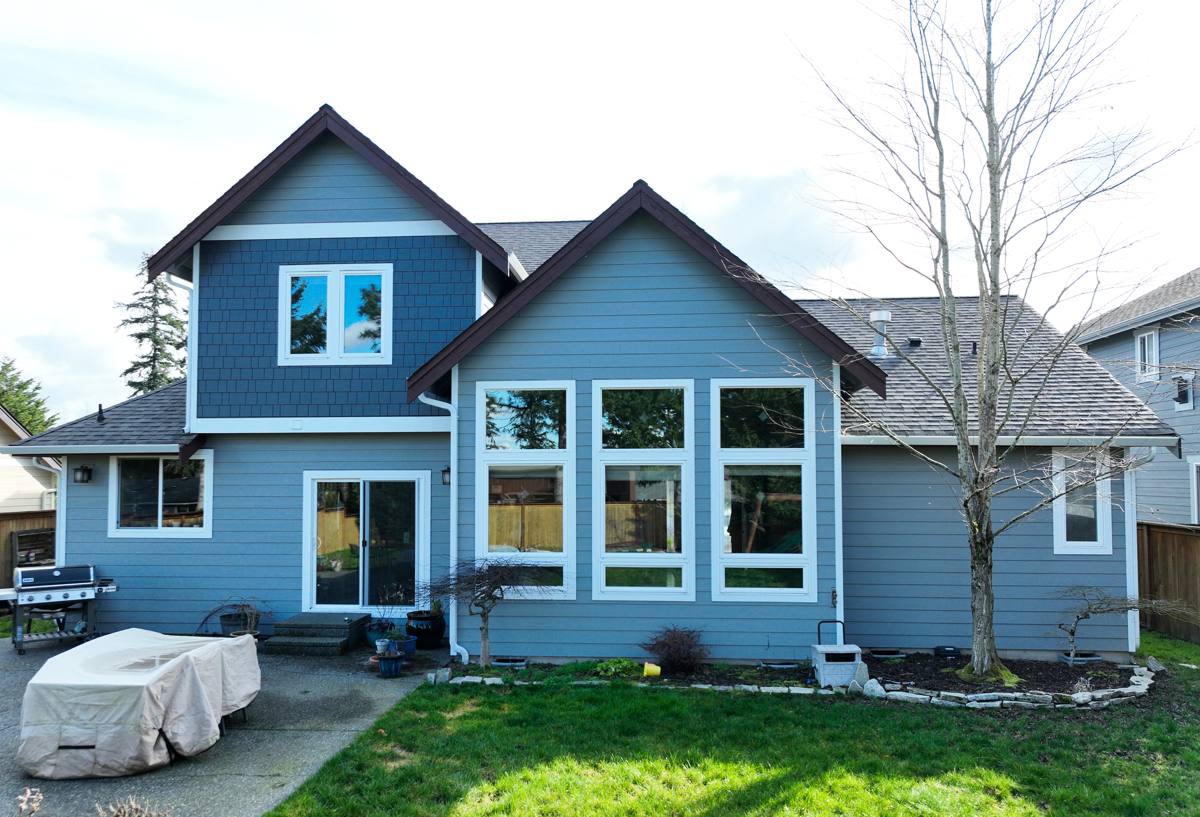
What Semiahmoo's Marine Climate Does to Siding Over Time
Salt Air and Wind-Driven Rain
Being this close to open water means more direct salt exposure than most of Whatcom County sees, and salt is hard on fasteners, flashing, and lower-grade finishes. It accelerates corrosion on anything metal and can break down a weak paint film faster than a drier, more sheltered site would. On top of that, storms coming off the water rarely drop rain straight down — they drive it sideways into wall assemblies, trim joints, and anywhere flashing was cut short. A wall that would stay dry in a calm inland setting can still take on water here because the rain is coming in at an angle, not from above.
A Long Moss and Mildew Season
Mild temperatures, shade from mature trees or neighboring structures, and near-constant moisture add up to a moss and mildew season that can stretch across most of the year on north-facing or shaded walls. Any siding material that's even slightly porous, or that's losing its factory finish, becomes a growth surface. Left alone, that growth holds moisture directly against the substrate, which is where a lot of the failures we get called out for actually start.
Freeze-Thaw and Seasonal Movement
Whatcom County doesn't see extreme cold most winters, but Semiahmoo's waterfront lots do get repeated freeze-thaw cycling through the wet season. Water that's worked its way behind or into a piece of siding expands when it freezes, which widens cracks and loosens fastener holes a little more with every cycle. It's a slow process, which is exactly why it tends to go unnoticed until a section of siding is visibly failing.
Signs a Semiahmoo Home Needs Siding Repair (Not Full Replacement)
Most of the siding calls we get in this area aren't full re-sides — they're isolated sections that failed faster than the rest of the house, usually because of a specific moisture path or an old installation shortcut in that one spot. Recognizing the difference early keeps a repair a repair.
- Cracking, splitting, or visible delamination on a specific section rather than across the whole house
- Soft spots or a spongy feel when pressed, which usually means moisture has already reached the substrate
- Persistent staining, dark streaking, or moss regrowth in the same spot even after cleaning
- Siding pulling away from the wall or fasteners backing out, especially near corners and trim
- Bubbling, peeling, or chalking paint concentrated in one area rather than uniform wear
- Interior signs — a musty smell, discoloration, or soft drywall on an exterior wall behind the affected siding
If a problem is limited to one wall, one elevation, or a run of boards around a specific window or corner, repair is usually the right call. Widespread failure across most of the house, especially with signs of moisture behind the cladding in multiple places, points toward something more systemic that a patch won't solve.
Repair or Replace? How We Make That Call
There's no single rule that decides this for every house — it comes down to how much of the wall is actually affected, what's causing the damage, and how much service life the rest of the siding has left. Here's how we weigh it on a typical Semiahmoo property.
| Factor | Leans Toward Repair | Leans Toward Full Replacement |
|---|---|---|
| Extent of damage | Limited to one section, wall, or elevation | Present across most of the exterior |
| Cause of failure | Isolated flashing or fastener issue | Systemic moisture intrusion or original installation defects |
| Age of existing siding | Well within expected service life | Near or past the material's realistic lifespan |
| Material match | Matching product still available or close enough to blend | Discontinued profile, color, or product line |
| Underlying sheathing condition | Sound once affected boards are removed | Rot or damage found behind multiple sections |
We'll walk the affected areas with you, open up a section if needed to see what's actually happening behind the cladding, and give you a straight read on which side of this table your house falls on — not a default push toward the bigger job.
What a Correct Siding Repair Actually Involves
A repair that just swaps out the visibly bad boards and leaves the underlying cause untouched tends to fail again within a season or two, especially in this kind of exposure. A repair done right addresses the whole path water took to get there.
- Diagnose the actual moisture path — where water is getting in, not just where the damage shows, since those two spots aren't always the same on a wind-driven-rain wall.
- Open the wall enough to inspect the water-resistive barrier and sheathing behind the failed section, since siding is only ever as good as what's underneath it.
- Correct the underlying detail — often a flashing gap, a missing kickout at a roof-wall intersection, or a caulked joint that should have been left open to drain.
- Replace damaged boards with matching fiber cement, cut and fastened to the same specification as the surrounding siding, not just whatever fits.
- Re-seal and re-finish so the repaired section blends with the rest of the wall rather than reading as an obvious patch.
That last step matters more with fiber cement than with some other materials, since Hardie's factory ColorPlus finish is applied under controlled conditions and can be harder to match perfectly with field-applied paint on a small repair. We'll walk you through what to expect on color match before starting, rather than after.
Why We Repair — and Install — Only James Hardie Fiber Cement
A fair number of the Semiahmoo homes we're called to aren't currently sided in Hardie. We see vinyl, LP SmartSide, cedar, and older fiber cement products on repair calls regularly, and we'll still repair those materials when a straightforward fix is the right answer for the homeowner. What we won't do is install any of them new. On new siding work and larger repairs, we install James Hardie fiber cement exclusively, and that standard came out of years of service calls in exactly this kind of coastal, wet climate.
- Non-combustible core: fiber cement doesn't feed a fire the way wood-based siding can.
- Factory-applied ColorPlus finish: baked on under controlled conditions rather than brushed on site, so it holds color and resists chalking longer than field-applied paint.
- Climate-engineered HZ formulation: built specifically for regions with heavy moisture exposure and freeze-thaw cycling, which describes Semiahmoo well.
- Dimensional stability: it doesn't swell, cup, or warp the way some engineered wood products can after repeated wet-season exposure.
- Strong transferable warranty: backed by Hardie provided the installation follows their published spec.
When a homeowner's existing siding is another material and a section keeps failing in the same spot year after year, we're honest that the underlying issue may be the material itself, not just bad luck with one section. In those cases, a partial re-side in Hardie for the affected wall is sometimes a more durable answer than repeating the same repair on a product that's fighting the climate.
Our Process for a Semiahmoo Siding Repair Call
We start with an on-site look at the affected area and enough of the surrounding wall to understand whether the problem is isolated or spreading. If there's any sign moisture has reached the sheathing, we'll open the wall to confirm before quoting anything, since that changes the scope. From there we put together a clear, written repair scope — what's being replaced, what's being corrected in the flashing or drainage detail, and a realistic timeline — before any work starts. We handle the repair itself with the same fastener spacing, clearance, and moisture-management details called for in new Hardie installation, because a repair only lasts as long as its weakest detail.
Before You Hire Anyone for Siding Repair in Semiahmoo
- Ask whether they'll open the wall to check for hidden moisture before quoting, not just look at the surface
- Ask what caused the failure, not just what they plan to replace
- Confirm current Washington contractor licensing and active liability insurance
- Get a written scope that specifies material, flashing corrections, and color-match expectations
- Ask how the repair is warrantied, separate from the underlying siding material's own warranty
If you've got a section of siding on a Semiahmoo property that's cracking, staining, or pulling away, it's worth having someone look at it before the next wet season makes the repair bigger than it needs to be. We offer free, no-pressure estimates for siding repair in Semiahmoo and the rest of the Birch Bay area — use the form below to get a time on the schedule.