 Birch Bay Window
 Siding Repair Built for the California Creek Stretch of Birch Bay
California Creek sits along the water in Whatcom County, part of the broader Birch Bay area where homes face a steadier, harder version of Pacific Northwest weather than properties set back further inland. Salt-tinged marine air moves in off the water daily, storms drive rain sideways into walls instead of letting it fall straight down, and the damp, shaded stretches around the creek and tree-lined lots rarely get a long enough dry spell to fully shed moss and mildew during much of the year. Siding here doesn't fail because it's old — it fails because the local climate finds every weak point faster than a drier, more sheltered location would.
That's the environment this page is about: not siding replacement in general, but siding repair specifically for homes in and around California Creek. A lot of repair calls we get in this stretch of Birch Bay start the same way — a homeowner noticed a small problem months ago, assumed it was cosmetic, and by the time it gets a closer look, water has already moved past the surface. Catching that earlier, and fixing it correctly rather than just patching over it, is the point of this page.
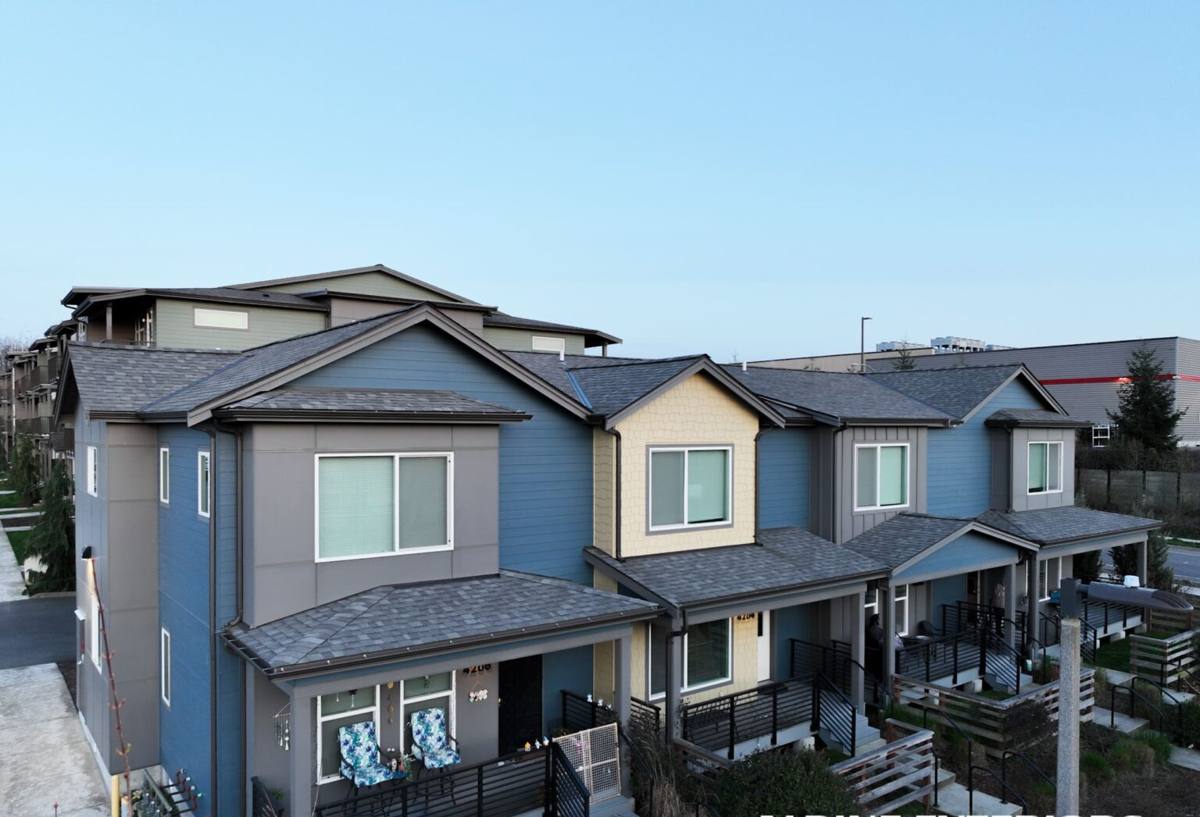
What This Climate Does to Siding on California Creek Homes
Salt Air and Driving Rain
Marine air carries a mild salt content that spreads well beyond the immediate shoreline in this part of Whatcom County, and California Creek properties sit close enough to the water to feel it directly. Salt-laden moisture works on fasteners, flashing, and lower-grade finishes faster than a drier inland setting would, showing up as premature corrosion around nail heads and trim, or a finish that chalks and dulls ahead of schedule. Layer on wind-driven rain — storms that push water sideways into seams, laps, and trim joints instead of letting gravity carry it straight down the wall — and you get an exposure pattern that tests every joint and fastener line on the house, not just the ones facing the weather.
A Long Moss and Mildew Season
Shaded, tree-covered lots near the creek rarely dry out completely for long stretches of the year, and that persistent dampness is exactly what moss and mildew need to establish themselves. It shows up first on north-facing walls, under eaves, and anywhere airflow is limited. Materials or finishes that hold moisture at the surface instead of shedding it give organic growth more time to take hold, and once it's established, it tends to trap even more moisture against the wall underneath.
Why Small Damage Spreads Fast Here
A hairline crack, a popped fastener, or a gap at a trim joint doesn't stay minor for long in this climate. Once water finds a way behind the siding, the same wind-driven rain and sustained moisture that stress the exterior surface work just as hard on the sheathing and framing behind it. A repair that would sit fine for a season or two in a drier climate can turn into a much bigger job here if it's left alone through even one more wet Whatcom County winter.
Common Siding Repair Issues We See Around California Creek
- Cracked or split boards, often at butt joints or near window and door trim
- Popped or corroding fasteners, particularly on walls that take direct wind-driven rain
- Soft or spongy sections near the bottom courses, around trim, or close to grade
- Gaps or separation at caulk joints and trim transitions that have opened up over time
- Impact damage from storms, falling branches, or yard equipment
- Persistent moss or mildew on shaded walls that keeps returning after cleaning
- Chalking, fading, or finish breakdown on older or lower-grade siding materials
- Water staining or discoloration at the base of walls or below window sills
Repair or Replace? How We Make That Call
Not every siding problem in California Creek needs a full replacement, and not every problem is safely fixed with a patch. We look at three things before recommending either direction: how much of the wall is actually affected, whether the damage is isolated to the surface or has already reached the sheathing behind it, and what material is currently on the house. A single cracked board on an otherwise sound James Hardie wall is usually a straightforward repair. Widespread soft spots, repeated moisture intrusion in the same area, or a material that's reached the end of its practical service life is a different conversation, and we'll say so honestly rather than stack repairs on a wall that needs more than that.
| Situation | Repair Usually Makes Sense | Replacement Usually Makes Sense |
|---|---|---|
| Damage extent | Isolated to a few boards or a single section | Spread across multiple walls or elevations |
| Moisture behind the surface | Surface damage only, sheathing is dry | Sheathing or framing shows moisture damage |
| Underlying material | James Hardie fiber cement, correctly installed | Aging vinyl, cedar, primed wood, or engineered wood past its service life |
| Recurrence | First occurrence in that spot | Same area has needed repeated repairs |
| Color and profile match | Close match available for a clean patch | Discontinued color or profile makes patching visibly obvious |
Why We Repair With James Hardie — and What That Means for a Patch Job
We install and repair James Hardie fiber cement exclusively. We don't install LP SmartSide, vinyl siding, Cemplank, Allura, primed spruce, or cedar, and that standard applies to repair work the same way it applies to new installs. Each of those alternative products has a place in the broader market, but on a wind- and moisture-exposed stretch like California Creek, we've made the professional call to stand behind one system rather than mix materials or patch a wall with something that won't hold up the same way.
- Non-combustible core: Fiber cement doesn't feed a fire the way wood-based siding can, which matters for both safety and insurance considerations.
- Factory-applied ColorPlus finish: Color is baked on in a controlled factory process, which holds its finish against salt-tinged marine air far better than field-applied paint or stain.
- Climate-engineered HZ product lines: Hardie's HZ5 formulation is built for regions with heavy moisture exposure, which fits a water-adjacent setting like California Creek.
- Dimensional stability: Fiber cement doesn't swell, cup, or warp with repeated wetting the way engineered wood or cedar can, which makes a repaired section far more likely to stay flush and sealed long-term.
- Strong transferable warranty: Hardie backs correctly installed and repaired products with one of the more substantial warranty structures in the industry.
If your home already has James Hardie siding, repair is usually a clean, sound process — matching color and profile, replacing the damaged section, and re-flashing and re-caulking correctly. If your home has a different material and it's showing the kind of recurring damage covered above, we'll give you an honest read on whether repair is worth it or whether that section of wall is better addressed as a planned replacement.
What Correct Repair Work Actually Involves
A repair that just covers the visible damage without addressing what's underneath isn't a real fix — it's a delay. On a California Creek home, that matters more than it would somewhere drier, because whatever let water in the first time is still there, and the exposure that caused the original damage hasn't gone anywhere.
- Assess the full extent — checking beyond the visible damage to see whether moisture has reached the water-resistive barrier or sheathing
- Remove the damaged section cleanly — cutting back to sound material rather than patching around the edges of the problem
- Inspect and repair what's behind it — addressing damaged sheathing, house wrap, or flashing before any new siding goes back up
- Match material, color, and profile — matching an existing James Hardie ColorPlus finish and board profile as closely as possible for a clean result
- Correct fastening and flashing — using proper fastener type and spacing, and re-establishing correct flashing and drainage details at the repair
- Seal and finish — caulking and sealing joints to Hardie's specifications, built for wind-driven rain, not just a straight-down rain assumption
Our Process for a California Creek Repair Call
We start with an on-site look at the actual damage, not a phone estimate. On the water-facing side of a property especially, what looks like a single cracked board from the ground can turn out to be part of a larger moisture problem once we get up close, and we'd rather find that out during the initial visit than after work has started. From there, we give a straightforward recommendation — patch repair, section replacement, or a broader conversation about the wall's overall condition — along with the reasoning behind it, so you're not guessing at why one option costs more than another.
Practical Checklist Before You Hire Someone for Siding Repair
- Ask whether they'll inspect behind the damaged siding, not just patch the visible surface
- Confirm they work with James Hardie specifically if that's what's currently on your home
- Ask how closely they can match your existing color and board profile
- Get a clear answer on whether the repair addresses the cause, not just the symptom
- Confirm current Washington contractor licensing and insurance
- Ask what's covered under warranty for both materials and labor on the repaired section
Why a Crew That Already Works California Creek Matters
Manufacturer repair guidance is written for average conditions in a moderate climate, and California Creek doesn't offer average conditions. A crew that already works this stretch of Birch Bay knows which walls take the worst of the wind-driven rain, how far moisture typically travels behind a cracked board in this kind of exposure before it shows up as a soft spot, and where a quick caulk-only fix will fail again within a season versus where it's genuinely sufficient. That judgment doesn't come from a manufacturer's spec sheet — it comes from having already repaired siding on homes a few doors down under the same weather.
It also matters for something more basic: knowing when not to sell you a bigger job than you need. A single damaged board on an otherwise sound wall doesn't require replacing the whole elevation, and we'll tell you that. Equally, we won't patch over damage we can see is going to come back in six months just to keep a job small. Either way, the goal is a repair that actually holds up to what this location throws at it, not one that looks fine until the next storm.
If you've noticed a cracked board, a soft spot, or a section of siding that just doesn't look right on your California Creek property, it's worth having someone look at it before it turns into a bigger repair. We offer free, no-pressure estimates for siding repair in California Creek and the surrounding Birch Bay area — use the form below to get a time on the schedule.