 Birch Bay Window
 Why Terrell Creek Decks Wear Out Faster Than the Manual Says
Every deck manufacturer publishes a lifespan estimate, and almost none of them were written with a Whatcom County coastline in mind. Homes around Terrell Creek sit close enough to Birch Bay's salt water to catch airborne salt on a regular basis, and that salt does two things wood and metal both hate: it holds moisture against a surface longer than plain rain does, and it accelerates corrosion in anything metal that isn't rated for it. Add in the long stretch of gray, wet months typical of this part of Washington, and a deck here is working harder than the same structure would twenty miles inland.
Driving rain off the water doesn't just fall straight down — it gets pushed sideways under railings, into ledger boards, and behind fascia that was never flashed to handle wind-driven moisture. Then there's moss season, which in this region can run half the year. Moss doesn't just look bad; it holds water against boards and traps debris in joints, and it thrives in exactly the shaded, damp corners most decks have at least one of.
None of this means a deck near Terrell Creek is doomed. It means the build details matter more here than they would somewhere drier, and a replacement done without those details in mind will simply fail the same way the old one did — just on a faster timeline.
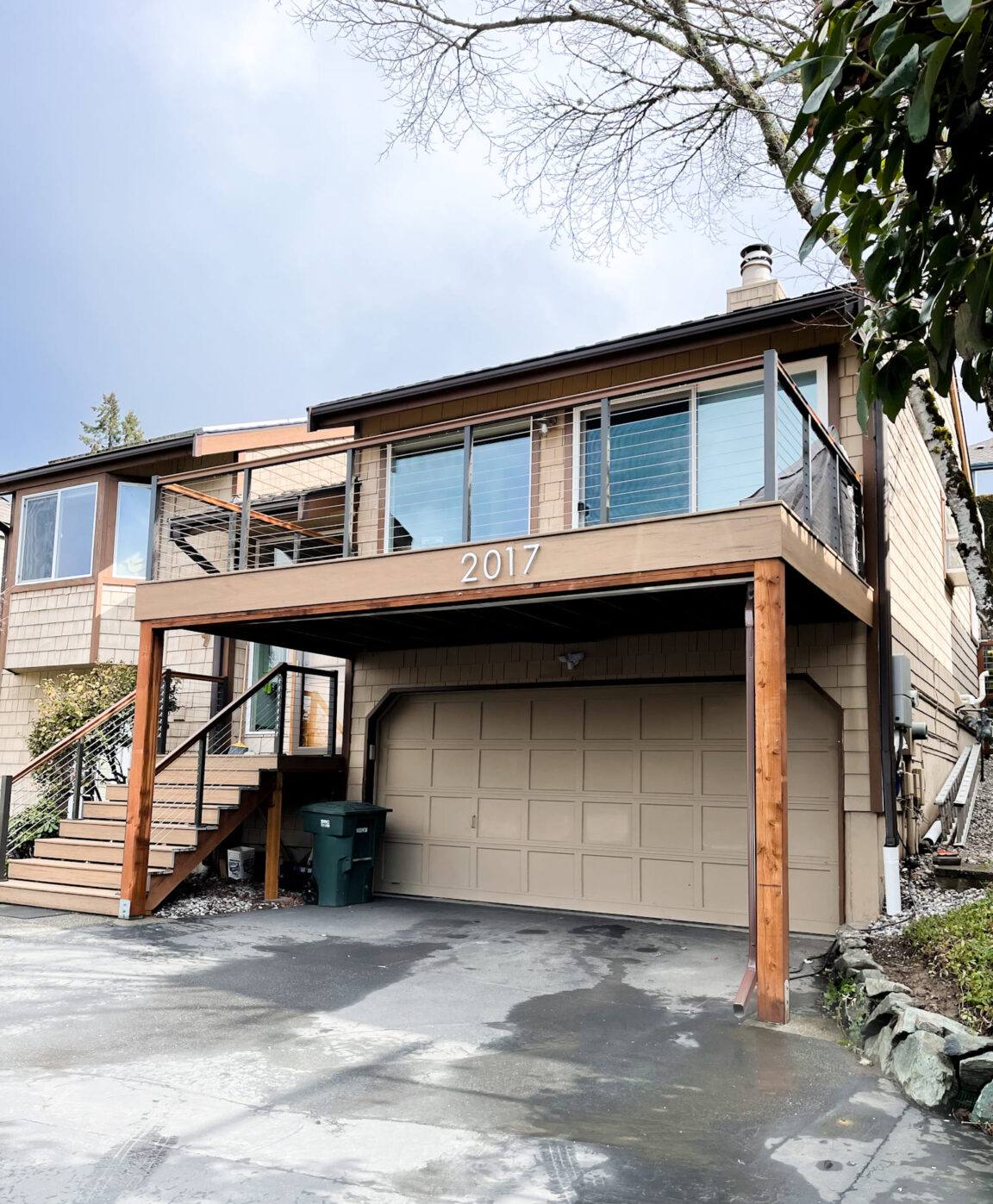
Signs a Deck Needs Replacement, Not Another Repair
We get called out for "a few soft boards" more often than we get called for an obvious total loss, and one of our jobs is telling homeowners honestly which situation they're actually in. Repair makes sense when the problem is isolated. Replacement is the right call when the damage points back to the structure itself.
- Soft or spongy decking in more than one area, especially near the house or in shaded corners
- Visible rot, staining, or gaps at the ledger board where the deck attaches to the house
- Rust streaks running down from fasteners, joist hangers, or railing posts
- Railings or stair stringers that flex or feel loose underfoot
- Persistent moss or algae growth that comes back within weeks of cleaning
- A deck older than 15–20 years that has never had the substructure inspected
If the framing, ledger, and footings are sound and only the surface boards are failing, a resurface can be the honest, lower-cost answer. If any of the items above show up at the structural level, resurfacing just hides a problem that will resurface — usually as a soft spot someone's foot goes through.
What a Correct Deck Replacement Actually Involves
It Starts Below the Boards
The decking itself is the part everyone sees, but the ledger attachment, joist spacing, flashing, and footings are what determine whether the new deck lasts five years or twenty-five. A replacement that only swaps old boards for new ones without addressing the framing underneath is not really a replacement — it's a resurface with a bigger price tag.
Ledger Flashing Is the Detail That Gets Skipped
The ledger board — where the deck bolts to the house — is the single most common failure point we find on older decks in this area, and it's almost always a flashing problem, not a lumber problem. Water gets behind the ledger, has nowhere to drain, and slowly rots the rim joist and sheathing behind it. A correct replacement includes proper flashing and a drainage gap so water sheds away from the house instead of soaking into it.
Fasteners and Hardware Rated for This Environment
Standard galvanized hardware corrodes faster in salt-influenced air than most people expect. We use fasteners, joist hangers, and structural connectors rated for coastal or high-corrosion exposure, because replacing a deck's boards every decade is a lot cheaper than replacing hardware buried inside the frame.
Footings and Structural Support
Older decks in this area were sometimes built to standards that have since changed, particularly around footing depth and post-to-beam connections. Part of a proper replacement is confirming the footings can support current code requirements, not just reusing whatever was there before.
Decking Material Options for a Salt-Air, High-Moisture Climate
There's no single "best" decking material — there's the best material for how a homeowner uses the deck, how much upkeep they want to do, and how exposed the deck is to weather off the water. Here's how the common options actually compare in conditions like Terrell Creek's.
| Material | Moisture Behavior | Maintenance | Typical Lifespan Here |
|---|---|---|---|
| Pressure-treated wood | Absorbs moisture; needs sealing to resist swelling and splitting | Annual cleaning and re-sealing | 10–15 years with upkeep |
| Cedar | Naturally rot-resistant but still needs sealing near salt air | Sealing every 1–2 years, moss removal | 12–18 years with upkeep |
| Composite decking | Doesn't absorb water like wood; can still trap surface moisture if not ventilated | Periodic cleaning, no sealing | 20–25+ years |
| PVC/capped polymer | Fully water-resistant surface; best resistance to moss and staining | Occasional washing | 25–30 years |
Wood costs less up front and can look great, but it asks for more consistent maintenance than most homeowners actually keep up with — and in a climate with this much rain and moss pressure, a missed sealing year or two shows up fast. Composite and capped polymer cost more initially but hold up with far less attention, which is often the better trade for a deck exposed to driving rain and salt air most of the year. We'll walk through the honest cost and upkeep trade-offs for your specific deck rather than push one product line.
Our Deck Replacement Process
- On-site assessment. We inspect the ledger, framing, footings, and railings — not just the decking surface — and tell you plainly what's structural and what's cosmetic.
- Scope and material selection. We go over decking material options, railing choices, and any code items that need addressing, with straightforward pricing for each path.
- Permitting. Deck replacements of most sizes require a permit through Whatcom County; we handle that paperwork so it doesn't fall on you.
- Demolition and disposal. The old deck comes out, including any hidden rot in the ledger or framing that wasn't visible from the surface.
- Framing and flashing. New ledger flashing, joists, hardware, and footing work as needed — the part that determines how long the new deck actually lasts.
- Decking and railings installed. Boards, fascia, stairs, and railings go in per the agreed plan and current code requirements.
- Final walkthrough. We go over the finished deck together, including basic maintenance guidance specific to the material you chose.
Permits, Setbacks, and Guardrail Code
Whatcom County requires permits for most deck replacements, particularly when the deck is more than 30 inches above grade or when structural framing is being replaced rather than just resurfaced. Guardrail height, baluster spacing, and stair rail requirements are also governed by current building code, and older decks built decades ago frequently don't meet today's spacing rules. Part of a proper replacement is bringing those elements up to current code as part of the job, not leaving a homeowner to find out during a future home sale inspection that the railings never met spec.
Properties near Terrell Creek and other waterway-adjacent areas can also carry setback or critical-area considerations depending on proximity to the water. We check what applies to your specific lot before finalizing a scope, so there are no surprises mid-project.
Maintenance That Actually Matters in This Climate
A well-built deck still needs some ongoing attention in an environment with this much rain and moss pressure. The good news is that the list is short if the deck was built correctly in the first place.
- Sweep debris out of gaps between boards regularly so trapped moisture and moss don't get a foothold
- Clean moss and algae off the surface at the first sign of it, especially in shaded corners
- Check railing posts and stairs once a year for looseness or movement
- Reseal wood decking on the schedule the material actually requires, not just when it looks dry
- Keep gutters and downspouts near the deck clear so runoff isn't dumping extra water onto it
- Look at the ledger area annually — it's the spot most likely to show early trouble
What Drives the Cost of a Deck Replacement
| Factor | Why It Matters |
|---|---|
| Deck size and shape | More square footage and complex angles mean more material and labor |
| Decking material chosen | Wood costs less upfront; composite and PVC cost more but need far less upkeep |
| Framing and footing condition | Hidden rot or undersized footings found during demo add scope |
| Height and stairs | Multi-level decks and stair runs add framing, railing, and code requirements |
| Railing style | Cable, glass, and composite railings cost more than standard baluster rail |
| Permit and code upgrades | Bringing older railings or footings up to current code adds to the scope |
We give a firm, itemized quote after the on-site assessment — not a phone estimate — because the framing condition underneath an old deck is often the biggest variable, and we don't guess on that.
Why a Crew That Already Works Terrell Creek Makes a Difference
Deck construction isn't regional in the way some trades are, but the failure points are. A crew that's replaced decks around Terrell Creek and the rest of Birch Bay has already seen how salt air chews through the wrong hardware, where driving rain finds its way behind fascia boards, and which corners of a typical local lot hold moss longest. That's not a marketing point — it changes which details get extra attention during the build, from hardware selection to how the ledger gets flashed.
It also means fewer surprises on permitting and code questions specific to Whatcom County, and a more realistic sense of how a given material will actually hold up here versus how it performs in a climate with less rain and no salt exposure. A deck built by a crew that understands this specific stretch of coastline is a deck built to survive it.
If your deck near Terrell Creek is showing soft spots, rust streaks, or stubborn moss, or if it's simply old enough that you're not sure what's underneath it, we're happy to take a look. Request a free, no-pressure estimate using the form below and we'll give you a straight assessment of what your deck actually needs.