 Birch Bay Window
 Terrell Creek's Climate Puts Real Demands on Exterior Siding
Homes along Terrell Creek sit in one of the wetter, shadier pockets of Birch Bay. The creek corridor keeps the ground and the air around it damp longer than open, sun-exposed lots nearby, and that combination of tree cover, low-lying moisture, and proximity to the bay's marine air creates conditions that are genuinely tough on siding. Salt-laden air drifts in off Birch Bay itself, driving rain comes in sideways during winter storms, and a long moss season settles in on any surface that stays shaded and damp for months at a time. None of this is exotic for Whatcom County, but it's more concentrated here than it is a few miles inland, and it shows up on siding as premature fading, soft spots, moss staining, and paint failure well before a homeowner expects to be dealing with it.
A siding product and installation that would hold up fine in a drier part of the county can struggle here. That's the starting point for how we approach every Terrell Creek job — the material has to be matched to what this specific stretch of Birch Bay actually throws at a house, not just what's standard everywhere else.
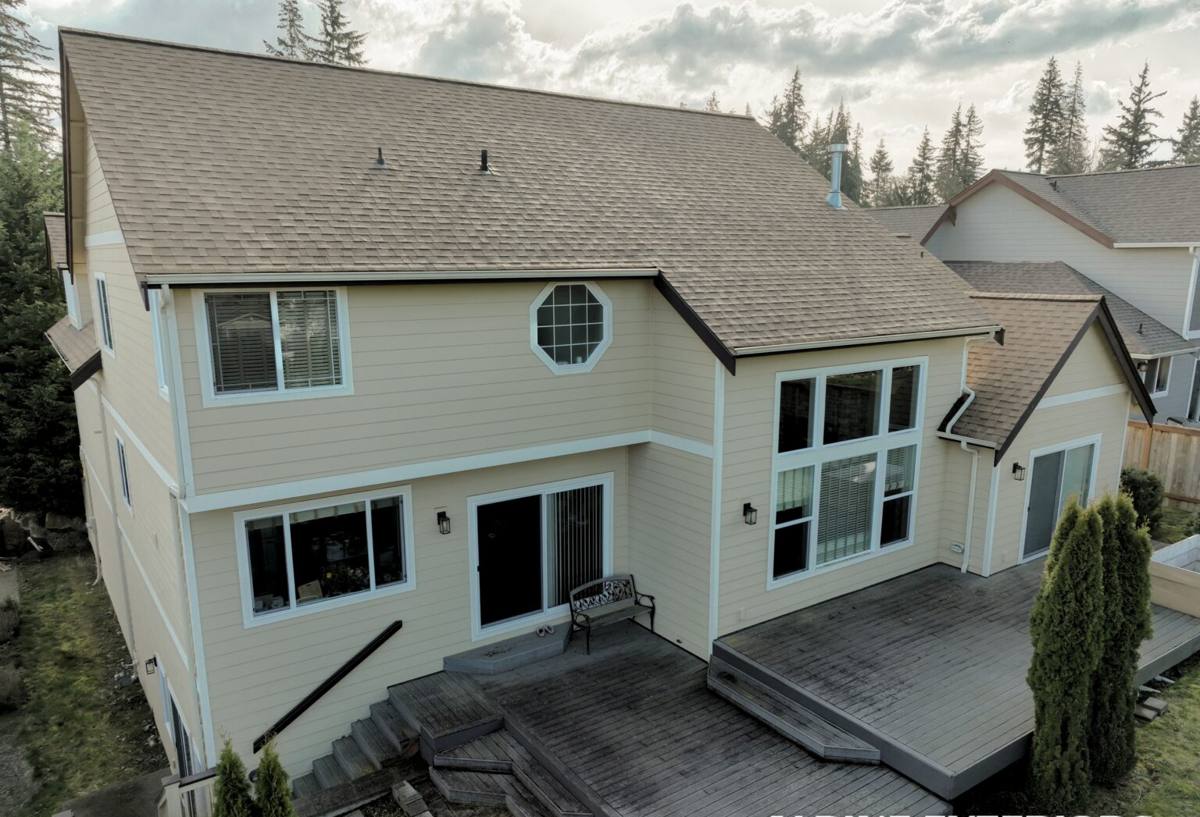
What Siding Actually Needs to Do in This Environment
Handling Salt Air Without Breaking Down
Salt air accelerates corrosion of fasteners and metal flashing, and it degrades paint and coatings faster than inland air does. Siding near the water needs a factory finish that's engineered to resist that breakdown, plus fasteners and flashing details that won't corrode and telegraph rust stains through the face of the siding within a few years.
Managing Driving Rain and Wind-Driven Moisture
Storms off the Strait push rain sideways, not straight down, which means water gets forced into laps, seams, and penetrations that a calm-weather installation might get away with cutting corners on. The wall assembly behind the siding — house wrap, flashing, drainage gaps — matters as much as the siding itself.
Surviving a Long Moss Season
Shade from the creek's tree line and consistent dampness give moss and algae a long runway to establish on north-facing and low-clearance walls. Siding here needs a surface that sheds spores reasonably well and a finish that can be cleaned without stripping the paint, plus enough ground and roofline clearance that moss doesn't have a permanent foothold to begin with.
Why We Install James Hardie Fiber Cement, and Only James Hardie
We install James Hardie products exclusively — no vinyl, no LP SmartSide, no Cemplank, no Allura, no primed spruce or cedar. That's a deliberate standard, not a sales preference, and in a spot like Terrell Creek the reasoning holds up especially well.
Vinyl siding is affordable and low-maintenance in mild conditions, but it softens and warps in direct heat and can crack in hard, cold snaps; more relevantly here, its seams and J-channels give wind-driven rain more places to work its way behind the panel over time. Wood-based products — cedar, primed spruce, engineered wood like LP SmartSide — depend heavily on an intact factory or field-applied coating to keep moisture out, and moisture is exactly what this creek-side environment has in excess. Once water gets past that coating, wood-based siding swells, delaminates at cut edges, or takes on moss and rot faster than a mineral-based product will. Other fiber cement brands (Cemplank, Allura) are legitimate products, but we've standardized on one manufacturer so our crews install one system to spec every time, warranty claims go through one clear channel, and every homeowner gets the same accountability rather than a patchwork of products across the fleet.
James Hardie's HZ5 Climate Engineering
Hardie makes region-specific HZ formulations, and the HZ5 line is engineered for wetter, harsher climates like Western Washington's. It's built with moisture and freeze-thaw cycling in mind, which lines up directly with what Terrell Creek homes are exposed to. Paired with the ColorPlus factory finish — a baked-on, UV-cured coating applied before the boards ever reach the jobsite — you get a surface that resists fading and holds paint adhesion far longer than a field-primed board, which matters when moss and algae cleaning is part of the maintenance routine.
How Different Siding Materials Actually Hold Up Here
| Material | Salt Air / Moisture | Moss & Algae Resistance | Long-Term Upkeep |
|---|---|---|---|
| James Hardie fiber cement (HZ5) | Non-combustible, dimensionally stable, resists moisture-driven warping | Factory finish holds up to gentle washing without stripping | Repaint cycle measured in decades, not years |
| Vinyl | Seams and channels can trap wind-driven moisture | Can be washed, but never repainted if faded | Softens/warps under heat, brittle in cold |
| Cedar / primed spruce | Coating-dependent; moisture entry causes swelling and rot | Prone to moss and mildew once coating fails | Frequent re-coating and edge sealing required |
| LP SmartSide / engineered wood | Engineered strand board core is coating-dependent for moisture protection | Vulnerable at cut edges and fastener points if sealant fails | Edge sealing and touch-up maintenance is ongoing |
What a Correct Installation Involves
Fiber cement siding is only as good as the installation behind it. Most of the problems we get called to fix on other crews' work trace back to a handful of details that get rushed:
- Proper drainage plane and house wrap installed and lapped correctly before any siding goes up
- Corrosion-resistant, manufacturer-approved fasteners set to the correct depth — not overdriven, not proud
- Flashing at every window, door, and penetration, integrated with the water-resistive barrier rather than just caulked over
- Minimum clearance from siding to grade, roofing, and decks so moisture and moss don't have a low, shaded ledge to sit on
- Correct joint and butt-seam treatment, including factory-primed cut edges sealed in the field
- Panel and lap spacing that follows Hardie's published installation instructions for the specific product line used
Skip any one of these and the siding can look fine for a year or two before problems show up behind the face — which is exactly the kind of failure that's expensive to diagnose and fix after the fact.
Our Process for Terrell Creek Homes
Assessment and Product Selection
We walk the property, note sun exposure, tree cover, drainage patterns, and how close the home sits to the creek and the bay's air. That assessment determines which Hardie profile, plank width, and finish make sense for that specific house rather than defaulting to a one-size answer.
Tear-Off and Wall Prep
Old siding comes off, sheathing gets inspected for any hidden moisture damage, and the drainage plane and flashing get installed or repaired before a single new board goes up. This is the step that determines how the siding performs ten years from now, not just how it looks on install day.
Installation to Manufacturer Spec
Boards are installed following James Hardie's fastening, clearance, and flashing requirements exactly, which is also what keeps the manufacturer's warranty valid. We don't deviate from spec to save time.
Final Walkthrough
We check clearances, caulking, and trim details together with the homeowner before calling the job finished.
What Cost Depends On
| Factor | Why It Matters Here |
|---|---|
| Home size and wall complexity | More corners, dormers, and penetrations mean more flashing and cut work |
| Existing wall condition | Hidden rot or moisture damage found during tear-off adds repair scope |
| Product line and profile | HZ5 planks, panels, and trim styles vary in material cost |
| Site access and tree cover | Creek-side lots with limited access or heavy landscaping take longer to stage |
| Finish and color | Factory ColorPlus finish adds cost up front but removes future painting |
Exact numbers depend on the house, but a full fiber cement re-side is a mid-to-upper five-figure investment on most homes — a real number worth getting an actual measurement and quote for rather than guessing from a square-footage rule of thumb.
Living With Hardie Siding in Terrell Creek's Climate
Correctly installed Hardie siding is low-maintenance, not no-maintenance. A yearly rinse to knock back moss and algae before it sets in, keeping gutters clear so overflow doesn't run down the wall face, and trimming back vegetation that shades the siding all extend its life meaningfully in a spot like this. None of it is intensive work, but skipping it lets moss get a head start it's harder to reverse once established.
Why a Local Crew Matters for This Job
A contractor who already works Terrell Creek and greater Birch Bay knows which walls on a given lot orientation take the worst of the driving rain, where moss tends to establish first, and how the marine air changes fastener and flashing choices compared to a job ten miles inland. That's not something you get from a general regional crew doing one job in the area — it comes from repeat exposure to this specific stretch of Whatcom County's coastline. It also means straightforward answers about permitting, realistic scheduling around this area's wet stretches, and a crew that installs one product system correctly every time instead of juggling several.
If you're weighing a siding replacement on a Terrell Creek home, we're glad to walk the property, look at what your walls are actually dealing with, and put together a free, no-pressure estimate using the form below.