 Birch Bay Window
 Terrell Creek sits back from the open beach that gives Birch Bay its name, but siding on homes in this area answers to the same climate that wears down houses closer to the water — salt-laden marine air, wind-driven rain, and a moss season that can run most of the year. The creek corridor adds its own layer on top of that: mature tree cover, shaded and low-lying lots, and pockets that stay damp longer after a storm passes than open, sun-exposed sites nearby. That combination of coastal air and creek-side shade is exactly what shortens the life of siding, and it's why a full replacement here deserves more thought than a straight material swap.
This page covers siding replacement specifically for Terrell Creek — what the local conditions do to siding, how to tell a repair situation from a replacement situation, what a correct tear-off and reinstall actually involves, and why James Hardie fiber cement is the only material we put back on these homes.
Why Terrell Creek Wears Out Siding Differently
Shade and the Creek Corridor
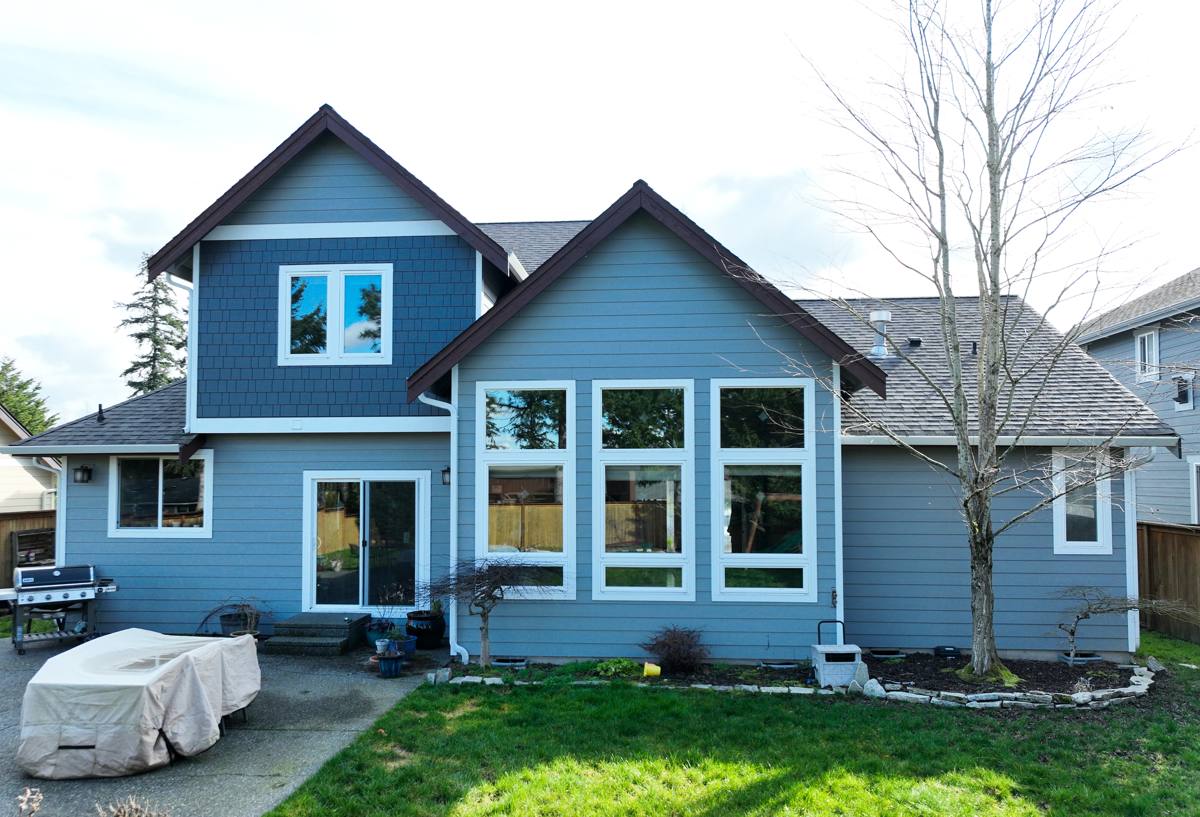
Homes set along or near Terrell Creek often sit under more tree cover than open lots elsewhere in Birch Bay. Shade keeps walls from drying out between rain events, which is good for keeping a house cool in summer but hard on siding that depends on periodic drying to shed moisture and resist moss and mildew growth. North-facing walls and anything tucked under overhanging branches tend to show problems first — persistent green or black staining, softer material, and finishes that break down faster than the sun-facing side of the same house.
Still Inside the Marine Belt
Being set back from the immediate shoreline doesn't take a home out of the marine air and wind-driven rain that define this part of Whatcom County. Salt-laden air still reaches inland enough to accelerate corrosion on fasteners and lower-grade trim, and storms still push rain sideways into wall assemblies rather than letting it run straight down and off. The result is that Terrell Creek homes deal with two compounding factors at once — coastal moisture exposure and creek-corridor shade — rather than just one or the other.
Signs Siding Has Reached Replacement, Not Repair
Not every siding problem calls for a full tear-off. Localized damage — a cracked board, a section of caulk failure, a spot where a downspout has been dumping water against a wall — can often be repaired without replacing the whole system. Replacement becomes the right call once the damage is widespread, structural, or shows up in more than one place at once.
- Soft or spongy spots when pressed, especially near the bottom courses and under windows
- Moss or mildew staining that returns within weeks of cleaning, on more than one wall
- Cracking, splitting, or delamination showing up across multiple boards, not just one or two
- Paint or finish that won't hold anymore even after proper prep and a fresh coat
- Warping, cupping, or boards pulling away from the wall at seams and corners
- Musty smell, staining, or soft drywall on interior walls that back up to exterior siding
If a few of these show up together, or if they're concentrated on the shaded or creek-facing side of the house, that's usually a sign the siding and what's behind it need a full look rather than a spot fix.
What a Correct Siding Replacement Involves
Tear-Off and What's Underneath
A siding replacement starts with removing the old material down to the sheathing, not covering over it. That step matters more on shaded, damp lots like many along Terrell Creek, because it's the point where we find out whether moisture has already reached the sheathing or framing underneath. Soft sheathing, rotted trim blocking, or a compromised weather barrier need to be addressed before any new siding goes on — installing new material over a wet or damaged wall assembly just hides the problem for a while longer.
Weather-Resistive Barrier and Drainage Plane
The house wrap or weather-resistive barrier behind the siding is what actually keeps bulk water out of the wall assembly; the siding itself is the first line of defense, not the only one. On a lot with extended damp periods from shade and tree cover, we pay close attention to how that barrier is lapped, sealed, and drained, and we install a rainscreen or drainage gap where the wall assembly calls for it so any moisture that does get past the siding has somewhere to go instead of sitting against the sheathing.
James Hardie Installed to Spec
Fiber cement only performs the way it's designed to when it's installed to Hardie's published specifications — correct fastener type and spacing, proper clearance from grade and roof lines, and factory-mitered or properly sealed joints. We use Hardie's HZ5 product line, engineered for regions with heavy moisture exposure and freeze-thaw cycling, which fits this part of Whatcom County. A quality material installed loosely will still develop problems in a shaded, wet setting like Terrell Creek — the installation details carry as much weight as the product itself.
Flashing at Windows, Doors, and Penetrations
Every window, door, and wall penetration is a break in the siding's coverage, and those breaks are where water actually gets into a wall. We flash and integrate each one before the surrounding siding goes on, lapped correctly for gravity and wind-driven rain rather than sealed with caulk alone. On a home with mature landscaping or creek-side drainage nearby, we also look at how water moves across the lot and away from the foundation, since siding and drainage work together, not separately.
Why We Only Install James Hardie Fiber Cement
We install James Hardie exclusively. We don't install LP SmartSide, vinyl siding, Cemplank, Allura, primed spruce, or cedar, and that's a professional standard rather than a sales position. Each of those products has a legitimate place in the market and homeowners elsewhere who are satisfied with them. What led us away from them is the pattern we kept seeing on service calls and tear-offs in exactly this kind of climate — sustained moisture, shaded walls, and salt air don't treat every siding material the same way.
Fiber cement's non-combustible core, factory-applied ColorPlus finish, and dimensional stability hold up to repeated wetting and drying without the swelling, warping, or finish breakdown that wood-based and engineered wood products are more prone to in a damp, shaded setting. Hardie also backs the product with a strong transferable warranty when it's installed to spec, which matters on a full replacement — it's the kind of work you want to do once, correctly, rather than revisit in a decade.
Our Process, Start to Finish
- On-site assessment — we inspect the existing siding, check for soft spots and moisture intrusion, and look at how shade and drainage on the specific lot have affected different walls
- Honest scope — repair, partial replacement, or full tear-off, explained with the reasoning behind the recommendation
- Tear-off and inspection — old siding comes off, and the sheathing and framing underneath get checked before anything new goes on
- Weather-resistive barrier and drainage plane — new barrier installed and lapped correctly, with drainage detailing added where the wall assembly needs it
- James Hardie installation — siding installed to Hardie's spec, with correct fasteners, clearances, and joint treatment
- Flashing and trim — windows, doors, and penetrations flashed and integrated before trim goes on
- Final walkthrough — we review the finished work and warranty coverage before calling the job complete
What Actually Drives Replacement Cost
| Cost Factor | Why It Matters for Terrell Creek Homes |
|---|---|
| Extent of hidden damage | Tear-off often reveals soft sheathing or a failed weather barrier — shaded, damp lots make this more likely than sun-exposed ones |
| Home size and wall complexity | More corners, gables, and trim details mean more cutting, fitting, and flashing time |
| Story count and site access | Two-story walls and wooded or sloped lots slow staging and increase labor |
| Trim and accessory work | Fascia, trim boards, and window or door casing replaced alongside siding add scope but keep the whole envelope consistent |
| Color and finish selection | Factory ColorPlus finishes cost more upfront than a field-painted option but remove a recurring repaint cost |
| Existing siding removal | Older wood or engineered wood siding usually needs full removal, not a cosmetic cover-over |
We won't quote a number without seeing the house in person, since the biggest swing factor — what's actually underneath the old siding — isn't knowable until tear-off begins. What we can do upfront is walk through which of these factors are likely to apply to your specific home before you commit to anything.
Why a Local Terrell Creek Crew Matters
Manufacturer installation guidance is written for average conditions, not for a shaded, creek-adjacent lot inside a marine climate. A crew that has actually replaced siding on homes along this corridor knows which walls tend to hold moisture longest, where a rainscreen gap earns its keep, and how much lap a flashing course needs to hold up to wind-driven rain coming off the bay. Those are decisions made on-site, not from a spec sheet, and they're the difference between a replacement that performs for decades and one that starts showing the same problems within a few wet seasons.
What to Ask Before Hiring for a Siding Replacement
- Ask what's happening to the weather-resistive barrier — is it being replaced, or reused underneath the new siding
- Confirm current Washington contractor licensing and insurance
- Ask how they handle sheathing repair if it's found during tear-off, and how that gets priced
- Get a written scope that specifies flashing details, not just a line item that says "siding replacement"
- Ask what's covered under the material warranty versus the installation warranty
If siding on your Terrell Creek home is showing soft spots, persistent staining, or finish that won't hold anymore, it's worth having someone look at it in person before deciding between repair and replacement. We offer free, no-pressure estimates for siding replacement in Terrell Creek and the surrounding Birch Bay area — use the form below to get a time on the schedule.