 Birch Bay Window
 Why Blaine Homes Need a Different Approach to Siding
Blaine sits close enough to the water that salt air is a daily fact of life for the exterior of a house, not an occasional nuisance. Combine that with the driving rain that rolls in off the Strait of Georgia and the long, damp moss season that Whatcom County sees for much of the year, and you have an exterior envelope that's under near-constant pressure. Siding here doesn't just need to look good on a sunny July afternoon — it needs to hold up through eight or nine months of wet weather, wind-driven moisture, and salt exposure that slowly degrades weaker materials from the outside in.
We install James Hardie fiber cement siding exclusively, and Blaine is a good example of why. It's not that other products can't be installed here — it's that after years of working on homes in this exact stretch of coastline, we've settled on the one material system that consistently holds paint, resists moisture damage, and doesn't need to be babied through a Pacific Northwest winter.
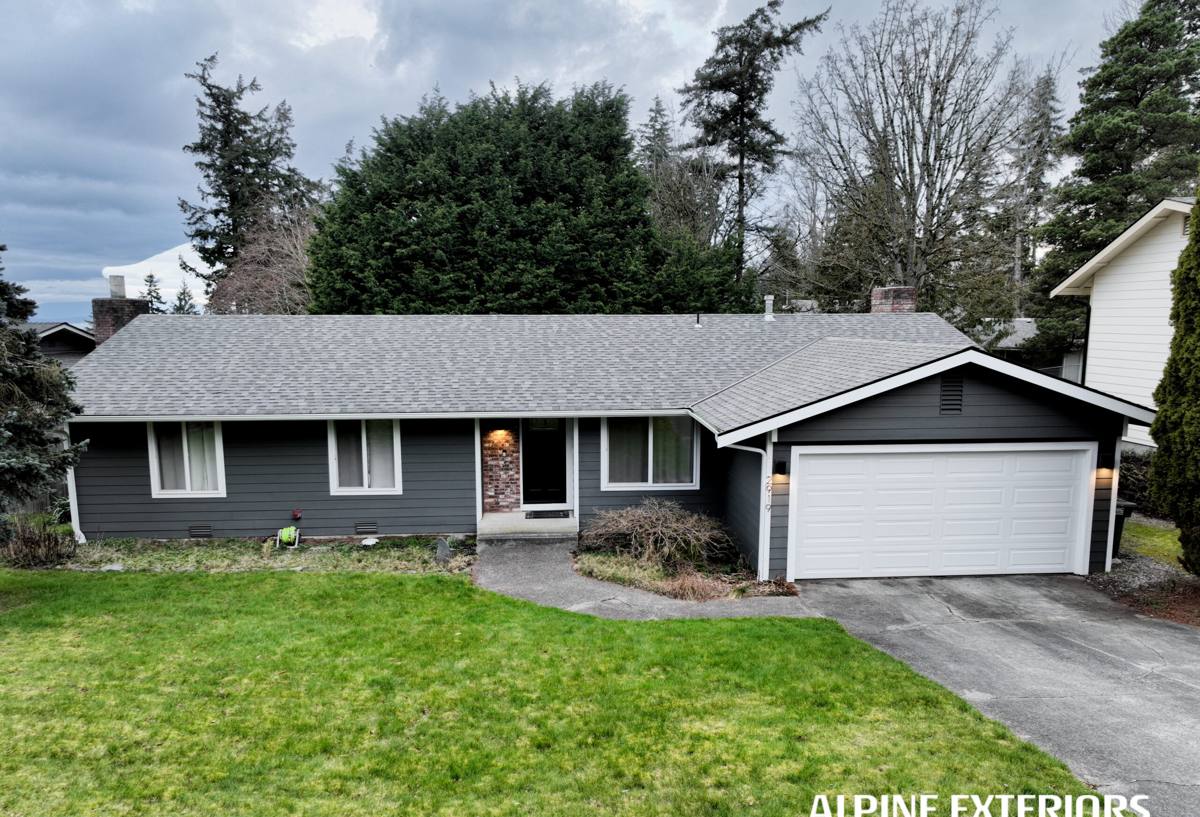
What Salt Air and Driving Rain Actually Do to a House
Salt Air
Airborne salt is corrosive and hygroscopic — it pulls moisture out of the air and holds it against whatever surface it lands on. On wood-based siding, that means slower drying times, more paint failure, and a head start on rot at seams and fastener points. On metal trim and fasteners, it accelerates corrosion. Homes closer to the water take the brunt of it, but Blaine's proximity to Birch Bay and the Strait means very few properties in the area are fully sheltered from it.
Driving Rain
Rain that falls straight down is manageable. Rain that's pushed sideways by wind — which is common along this stretch of coast — finds every gap, lap, and seam in a siding system and tries to get behind it. This is why flashing details, lap spacing, and caulking matter more here than they would in a drier, calmer inland climate. A siding job that would hold up fine in eastern Washington can fail within a few years on the coast if it wasn't detailed for wind-driven moisture.
Moss Season
Moss needs shade, moisture, and time — and Blaine's tree cover and long wet season provide all three. Moss holds water against a surface far longer than open air would, which is hard on any siding material that isn't dimensionally stable or that absorbs moisture. It's also cosmetically relentless: north-facing walls and anything under tree cover will grow moss again within a season or two if the surface underneath isn't suited to resist it.
Why James Hardie Fits This Climate
James Hardie fiber cement is engineered from cement, sand, and cellulose fibers — it doesn't rot, it doesn't support insect activity, and it's non-combustible. For a marine climate like Blaine's, the bigger advantage is dimensional stability: it doesn't swell and contract with moisture the way wood-based products can, which means fewer stressed seams and less paint failure over time. James Hardie also builds region-specific product lines — including HZ5 formulations engineered for wetter, more humid climates — which is the category we specify for homes in this part of Whatcom County.
The factory-applied ColorPlus finish is another piece of this. It's baked on under controlled conditions rather than brushed on in the field, which gives it better adhesion and more even coverage than a job-site paint job — and it comes with its own finish warranty. In a climate where paint failure is one of the most common siding complaints we hear, starting with a factory finish instead of a field-applied one removes a lot of the risk.
What a Correct Installation Involves
James Hardie siding is only as good as its installation. The material is engineered to perform, but a rushed or generic install can undercut all of that. On a marine-climate job like Blaine, the details that matter most are:
- Proper starter strip and lap spacing so water sheds correctly at every course
- Correct fastener placement and depth — over-driven or under-driven nails compromise the plank and void warranty coverage
- Flashing at every window, door, and roofline intersection, not just where it's visually obvious
- Rain-screen or drainage plane detailing appropriate for a high-moisture climate
- Manufacturer-specified clearances from grade, roofing, and decking so the siding isn't sitting in standing water or trapped moisture
- Caulking only where James Hardie specifies it — over-caulking traps moisture just as badly as under-caulking lets it in
Skipping or shortcutting any one of these doesn't usually show up in year one. It shows up in year four or five, as staining, paint failure, or soft spots at the bottom courses — right where most homeowners look last.
Comparing Siding Options for a Coastal Property
We only install James Hardie, but homeowners deserve to understand why, especially when comparing bids that include other materials. Here's how the common options stack up for a property with Blaine's exposure:
| Factor | James Hardie Fiber Cement | Vinyl | Wood / Cedar |
|---|---|---|---|
| Moisture resistance | High — dimensionally stable, engineered HZ5 lines for wet climates | Moderate — won't rot itself, but seams and gaps allow moisture behind the panel | Low to moderate — absorbs moisture, prone to rot without diligent upkeep |
| Salt air performance | Strong — non-organic material, factory finish resists chalking and fading | Can become brittle and discolored over time near salt air | Finish breaks down faster; more frequent repainting needed |
| Fire resistance | Non-combustible | Combustible, can warp or melt under heat | Combustible |
| Maintenance | Periodic washing; repaint only after many years if ever, depending on product | Low maintenance but limited repair options if damaged | Regular painting/staining and moisture monitoring |
| Typical lifespan of finish | Long — factory ColorPlus finish is warrantied | Color can fade unevenly over time | Shorter — finish needs regular renewal |
This isn't a knock on every other product on the market — it's why, after weighing these trade-offs against what this coastline does to a house, we made James Hardie the only thing we put on walls.
Our Process on a Blaine Siding Job
Every job starts with a walk-around inspection of the existing siding, trim, and any water damage already present — this tells us what we're dealing with underneath, not just what's visible from the curb. From there:
- We assess the wall assembly and moisture barrier and determine if it needs repair or replacement before new siding goes on
- We remove old siding and address any rot, damaged sheathing, or flashing issues found underneath
- We install or verify the weather-resistive barrier and drainage plane appropriate for the exposure
- We install James Hardie siding to manufacturer specification, with flashing and fastening detailed for this climate
- We finish with trim, caulking where specified, and a final walk-through
Because we only work with one siding system, our crews aren't switching between installation methods from one job to the next. That consistency is part of what keeps callbacks low.
Why a Crew That Already Works Blaine Matters
A contractor who works this specific stretch of Whatcom County coastline already knows how wind-driven rain behaves against a north- or west-facing wall here, which properties tend to get more moss and shade, and how salt exposure changes depending on how close a lot sits to the water. That's not something you can fully account for from a general specification sheet — it comes from having done the work here before. It also means faster scheduling, familiarity with local permitting, and a crew that isn't learning the microclimate on your project.
Signs Your Current Siding Is Losing the Fight
- Paint that's chalking, peeling, or fading unevenly, especially on north- and west-facing walls
- Soft spots or visible warping near the bottom courses or around window trim
- Persistent moss or algae growth that returns soon after cleaning
- Visible gaps at seams, corners, or trim where caulking has failed
- Musty smell or staining on interior walls that back up to exterior siding
- Siding that flexes or feels hollow when pressed
Any one of these on its own isn't necessarily an emergency, but a few of them together usually mean moisture is getting behind the siding rather than just sitting on top of it.
Get a Straight Answer for Your Property
If you're weighing a siding replacement in Blaine, we're happy to take a look, tell you honestly what condition your current siding is in, and walk you through what a correctly detailed James Hardie installation would involve for your specific property. There's no pressure and no obligation — just a straightforward estimate from a crew that already knows this coastline. Use the form below to request one.