 Birch Bay Window
 California Creek's Coastal Climate Puts Real Stress on Siding
California Creek sits close enough to the water that homes here deal with a different set of exterior conditions than a house twenty miles inland in Whatcom County. Salt-laden air off the bay works its way into fasteners, trim, and any exposed seam. Driving rain off Puget Sound doesn't just fall straight down — wind pushes it sideways into laps, corners, and window trim where lesser siding systems eventually let moisture in. And the marine layer that keeps this area green also keeps siding damp for long stretches, which is exactly what moss, algae, and mildew need to take hold.
None of this means siding here is doomed to fail. It means the material and the installation both have to be matched to the environment. That's the whole reason we standardized on James Hardie fiber cement and stopped installing vinyl, LP SmartSide, primed wood, and other lookalike products. This page is specifically about what a James Hardie job looks like for a California Creek home — not siding in general.
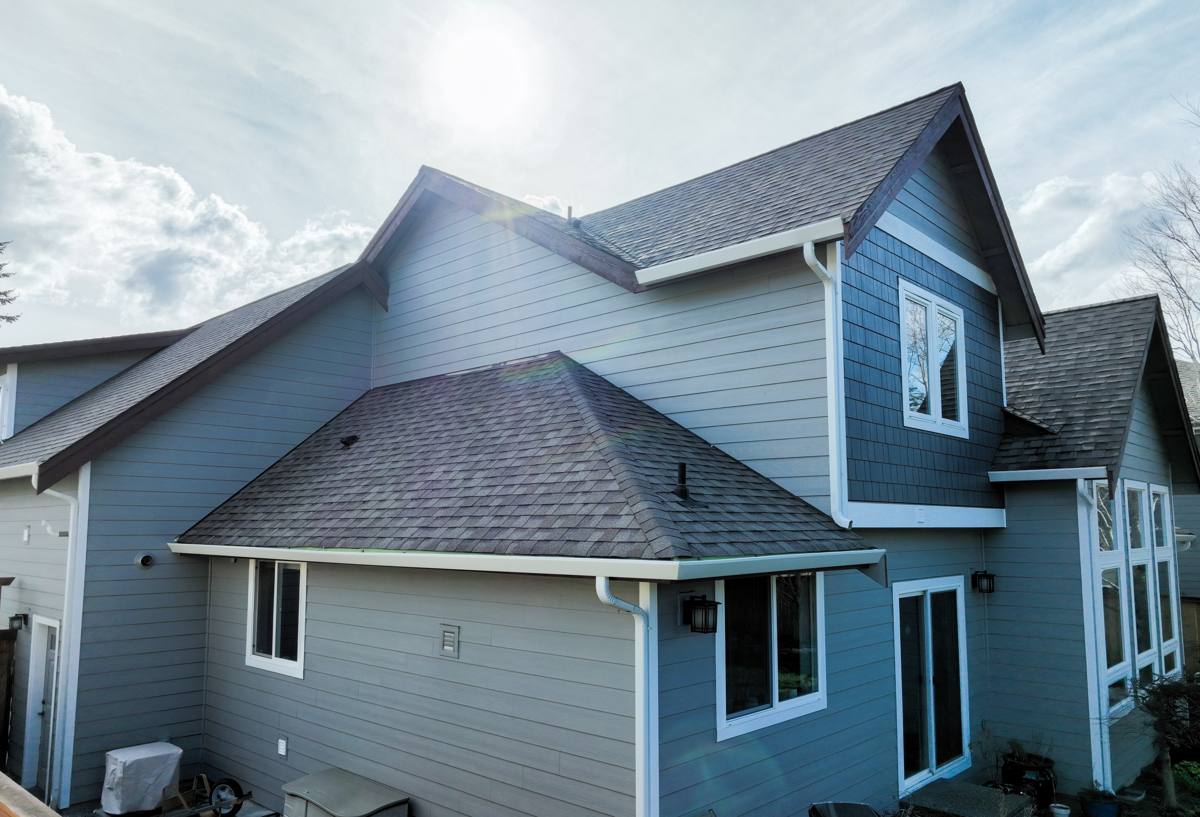
What Salt Air and Long Moss Seasons Actually Do to a House
Salt Air
Airborne salt is corrosive and hygroscopic — it pulls moisture toward itself. On a house near the water, that means fasteners, flashing, and any metal trim are working harder than they would fifty miles east. Siding materials that rely on paint film alone to keep moisture out tend to show their weak points here first: hairline cracks open, moisture gets behind the surface, and the substrate underneath starts to suffer before the paint even looks bad.
Driving Rain
Wind off the water doesn't respect the assumption that rain only hits a wall straight-on. It drives water sideways and upward into laps, butt joints, and anywhere trim meets siding. A siding system is only as good as its weakest joint in this kind of weather — which is why flashing detail and correct overlap matter more here than in a sheltered inland yard.
Moss and Algae Season
Because the marine climate keeps surfaces damp for a large part of the year, north-facing walls and anything shaded by trees or fencing stay wet longer between dry spells. That's the environment moss and algae thrive in. Siding that holds moisture at the surface — or that has open seams where organic debris can collect — will show green and black staining years before a properly sealed, factory-finished product will.
Why James Hardie Fits This Environment
James Hardie fiber cement is cement, sand, and cellulose fiber — it doesn't rot, it isn't a food source for moss or insects, and it's non-combustible. For a coastal property, the more relevant advantages are:
- ColorPlus factory finish — baked-on, not brushed on site, so it resists fading and chipping better than field-applied paint, and touch-up product exists for the rare nick.
- HZ product engineering — Hardie makes climate-specific formulations (HZ5, HZ10) engineered for moisture exposure and freeze-thaw conditions rather than a single one-size-fits-all board.
- Dimensional stability — fiber cement doesn't swell and shrink with moisture the way wood-based products can, which matters when the material is damp more often than it's bone dry.
- A transferable warranty backed by the manufacturer, not just the installer — worth more on a coastal property where material performance is actually tested.
We don't say this to knock every alternative outright. Vinyl is inexpensive and low-maintenance in mild climates; LP SmartSide is a legitimate engineered wood product. But in salt air with long wet seasons, we've seen the trade-offs that come with each — vinyl's seams and thermal movement, engineered wood's dependence on the paint film and edge-sealing staying intact — and we made a professional call to install one system correctly rather than several systems inconsistently.
What a Correct Installation Involves Here
The product is only half the equation. Most siding failures we get called to look at — regardless of brand — trace back to installation shortcuts, not the material itself. For a California Creek home, the details that matter most are:
- Water-resistive barrier and flashing first. Correct house wrap, window and door flashing, and kick-out flashing at roof-wall intersections go on before a single piece of siding, because siding is the second line of defense, not the only one.
- Proper clearances. Hardie's own instructions call for minimum gaps above roofing, decks, and grade — those gaps let water drain and air circulate instead of wicking straight into the bottom edge of the board.
- Correct fastener pattern and type. Coastal installs call for corrosion-resistant fasteners, driven correctly (not overdriven, which cracks the board's edge and opens a moisture path).
- Joint treatment. Butt joints, corners, and trim intersections get sealed or flashed per manufacturer spec — this is where wind-driven rain finds its way in on a sloppy job.
- Field-cut edge sealing. Any cut edge that isn't factory-finished needs to be sealed before installation, or it becomes the first place moisture — and eventually algae — takes hold.
A Quick Checklist for Homeowners Comparing Bids
- Does the estimate specify HZ10 (or the correct HZ rating for this climate) rather than a generic spec?
- Is house wrap and flashing replacement included, or just siding swapped over old wrap?
- Does the crew mention starter strips and clearance gaps, or just "match what's there"?
- Are fasteners specified, or left as "whatever we have on the truck"?
- Is field-cut edge sealing called out as a line item, not an afterthought?
Comparing Hardie Product Lines for This Setting
Not every part of a house needs the same product. Here's how the common James Hardie lines stack up for a coastal Whatcom County property:
| Product Line | Best Use | Coastal Consideration |
|---|---|---|
| HardiePlank Lap Siding | Primary wall siding | Most common choice; correct lap overlap is critical in driving rain |
| HardieShingle | Accent gables, dormers | Adds texture; needs careful flashing at transitions to lap siding |
| HardiePanel | Modern/board-and-batten looks | Vertical joints need battens or trim detailed correctly to shed water |
| HardieTrim | Corners, window and door surrounds | Where most wind-driven rain intrusion actually starts if under-flashed |
Most California Creek homes end up with HardiePlank as the field material and HardieTrim doing the quiet, unglamorous work of keeping water out at every penetration — which is usually the part a homeowner never thinks to ask about but the part that determines whether the job lasts.
Our Process for a California Creek Job
Because we already work in this area, the assessment starts with the specific exposures of the property — which walls take the worst of the weather off the water, where moss has already established itself, where old flashing or caulk has failed. From there:
- Walkthrough and moisture check — we look at current siding, trim, and any soft spots before quoting anything.
- Tear-off and substrate inspection — sheathing gets checked for hidden rot before new siding goes over it; a good-looking new install over a wet substrate is a wasted job.
- Barrier and flashing installation — done to current code and manufacturer spec, not just "same as before."
- Hardie installation — correct clearances, fasteners, and joint treatment as outlined above.
- Final inspection — checking caulk lines, trim seams, and clearances before we call it finished.
Maintenance Through Whatcom County's Wet Season
James Hardie siding is genuinely low-maintenance compared to wood, but "low-maintenance" isn't "zero-maintenance" in a marine climate. A once- or twice-a-year rinse-down (garden hose pressure, not a pressure washer aimed point-blank) keeps salt residue and early moss growth from building up, especially on shaded or north-facing walls. Caulking at trim joints should get a visual check annually — it's cheap to redo and expensive to ignore if it fails and lets water behind the siding. Gutters and downspouts that stay clear keep roof runoff from sheeting down walls, which is one of the more preventable causes of localized moss and staining we see on coastal homes.
Why Local Experience Matters for This Specific Job
Siding installation instructions read the same everywhere, but the judgment calls — how much clearance to leave given this lot's drainage, which walls need extra flashing attention given prevailing wind, how a particular corner detail will hold up through a Whatcom County winter — come from having actually installed and then revisited jobs in this exact environment. A crew that mostly works inland and takes an occasional coastal job doesn't build that judgment. Working California Creek regularly means we've seen which details hold up here and which ones don't, and we build every install around that.
If you're weighing a siding replacement or new install in California Creek, we're happy to take a look and give you a straightforward, no-pressure estimate — no invented urgency, just what we see on your home and what it would take to do it right.