 Birch Bay Window
 Roof Repair in Cottonwood Beach: What This Coastline Does to a Roof
Cottonwood Beach sits close enough to the water that a roof out here takes on a different set of stresses than one a few miles inland in Whatcom County. Salt-laden air drifts off the bay and works quietly on exposed fasteners and flashing metal, rain gets driven sideways and forced up under shingle edges instead of simply running off, and a long, damp moss season settles in on shaded or north-facing slopes and holds on for months. None of that means a roof out here is doomed to leak — it means repairs need to account for those specific stresses instead of treating every roof problem like a generic patch job.
This page is about roof repair specifically — not a full tear-off and replacement — for homes in and around Cottonwood Beach. We'll cover the problems we see most often on this stretch of coastline, how we decide whether a repair actually makes sense versus recommending replacement, what a correct repair involves, and why it matters to hire a crew that already knows how this particular climate behaves.
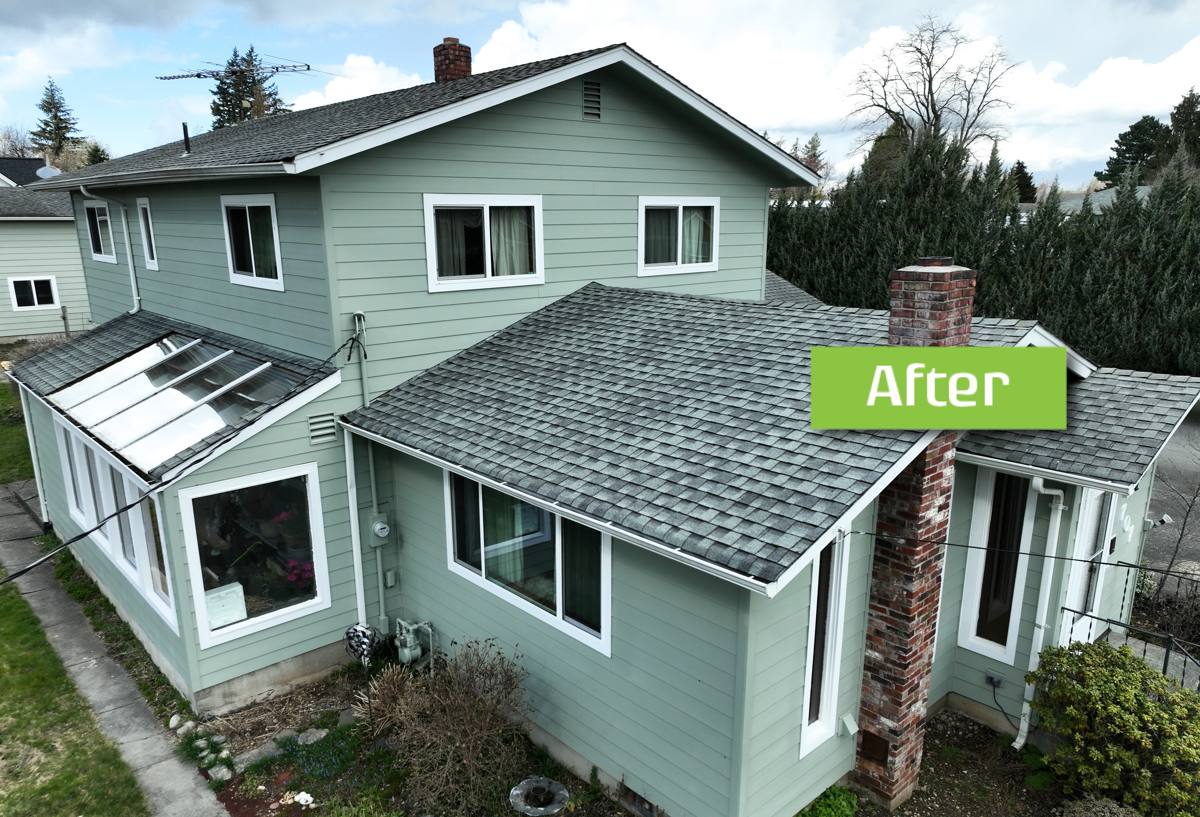
The Roof Problems We See Most Often in Cottonwood Beach
Flashing Failures
More leaks trace back to failed flashing than to worn-out shingles. Valleys, chimney and vent penetrations, and the transitions where a roofline meets a wall are all places where a thin strip of metal is doing most of the work of keeping water out. Salt air speeds up corrosion on lower-grade flashing metal, and once it's rusted through, lifted, or under-sealed, water finds its way in even though the shingles around it look fine.
Moss and Trapped Moisture
Shaded and north-facing roof planes in this area hold moisture long enough for moss to take hold within just a few years, and once it's established, moss roots work under shingle tabs and lift them, giving wind-driven rain a place to get underneath. A roof that "just needs a moss treatment" from the street can already have lifted shingles and softened decking underneath by the time it's inspected up close.
Wind-Driven Rain Intrusion
Rain out here doesn't always fall straight down. Wind off the water pushes it sideways and sometimes upward against roof planes, which means it can get forced under shingle edges and lap joints that would hold up fine in a calmer, drier climate. This is one of the more common reasons a homeowner finds an interior leak with no obvious hole or missing shingle anywhere near it — the water traveled sideways along the deck before it found a way through.
Granule Loss and Aging Shingles
Shingles lose their protective granules gradually as they age, and that process runs faster under sustained UV, wind, and moisture cycling than it does in a more sheltered inland setting. Bald or thinning patches don't always mean the whole roof is done — sometimes it's a candidate for a targeted repair, and sometimes it's a sign the roof is far enough along that a repair would just be a short-term patch on a system that's already failing broadly.
Repair or Replace? How We Make That Call Honestly
Not every roof problem calls for the same fix, and telling the difference correctly is the whole point of an honest repair estimate. We'd rather tell a homeowner their roof only needs a targeted repair than talk them into a replacement it doesn't need yet — and we'll say just as plainly when a repair would only be buying a year or two before the same problem comes back.
| What We Find | Usually a Repair | Often Points to Replacement |
|---|---|---|
| Isolated flashing failure at one valley or penetration | Yes | Only if flashing is failing at multiple points across the roof |
| A handful of cracked, curled, or missing shingles | Yes | Not usually, unless matching shingles are no longer available |
| Moss buildup with lifted shingles in one section | Yes, if decking underneath is still sound | Yes, if decking has softened from prolonged moisture |
| Widespread granule loss across most roof planes | Rarely a lasting fix | Usually — the shingle field is aging out as a whole |
| One active leak with no other visible wear | Yes | No, unless the leak is a symptom of broader deck damage |
| Roof is under 10 years old with isolated damage | Yes, almost always | Rarely justified |
The honest answer usually depends on what we find once we're actually up on the roof and, where needed, in the attic looking at the underside of the decking. A roof that looks rough from the ground can turn out to be a straightforward repair, and one that looks fine from the street can have decking damage that changes the recommendation entirely.
What a Correct Roof Repair Actually Involves
Diagnosis Before Anything Else
A repair that starts with a guess usually ends with a callback. We trace leaks to their actual source rather than patching the spot directly below an interior stain, since water on a sloped roof frequently travels sideways along the deck before it drips through the ceiling. That means checking the attic where accessible, examining flashing at every nearby penetration, and looking at the surrounding shingle field, not just the one obvious trouble spot.
Flashing Repair Done to Spec
When flashing is the problem — and it often is — we replace or re-integrate it properly rather than covering a failure point with a bead of caulk. That means correct lapping with the underlayment and shingle courses above and below it, and metal or sealant rated to hold up against salt exposure rather than the cheapest option available.
Matching Shingle and Underlayment
Repairing a section of an existing roof means working with what's already there. We match shingle profile and color as closely as the market allows, and where the original shingle line has been discontinued, we'll say so upfront and talk through the options rather than surprise a homeowner with a mismatched patch after the fact. Underneath the visible shingles, we use underlayment rated for wind-driven rain in any section we're opening up, even on a repair, because that layer matters just as much on a patch as it does on a full replacement.
Checking Ventilation While We're Up There
Poor attic ventilation traps moisture against the underside of the roof deck, which accelerates rot and feeds moss growth from below at the same time weather is working the roof from above. While we're already on a roof for a repair, we check ventilation as a matter of course, because a repair addressing only the visible symptom while ignoring a ventilation problem underneath tends to need revisiting sooner than it should.
Our Roof Repair Process
- On-site inspection: We get up on the roof and, where access allows, check the attic from underneath, rather than estimating repair scope from photos or a ground-level look.
- Honest diagnosis: We trace the actual source of any leak or damage and explain what we found in plain terms, including if the answer is that the problem is smaller — or bigger — than it looked.
- Written estimate: You get a clear scope covering exactly what's being repaired, what materials we're using, and what it costs, not a vague single line item.
- The repair itself: Flashing, shingles, underlayment, and any related decking work get addressed to the same standard we'd use on a full installation, sized appropriately for a repair scope.
- Walkthrough and cleanup: We review the completed repair with you and do a full site and magnetic nail sweep before considering the job finished.
What Roof Repair Typically Costs — and What Drives the Number
Roof repair pricing varies more than people expect, mostly because "roof repair" covers a wide range of actual scope — from a single flashing detail to a section of decking replacement. Rough ranges for common repair types run from a few hundred dollars for a small, isolated flashing or shingle fix up to a few thousand for repairs involving decking replacement or a larger section of the roof. The factors below have more to do with the final number than the size of the visible problem does.
| Factor | What It Affects |
|---|---|
| Decking condition underneath | Whether the repair is a surface fix or requires replacing soft or rotted plywood/OSB first |
| Flashing scope | How many penetrations, valleys, or wall transitions need to be reworked |
| Shingle availability | Whether an exact match is available or a close alternative has to be sourced |
| Roof pitch and access | Labor time and staging requirements for steeper or harder-to-reach areas |
| Extent of moss or moisture damage | Whether the fix is limited to the surface or extends into treating and drying out the substrate |
A written estimate that breaks these out clearly tells you far more than a flat number, and it's worth asking any contractor to explain what's driving their price line by line before comparing two bids side by side.
Signs a Cottonwood Beach Roof Needs Repair Now
- Water staining on an interior ceiling or wall, especially after a windy storm
- Moss buildup that keeps coming back in the same valley or shaded slope after cleaning
- Granules collecting in gutters or at the base of downspouts
- Shingles that are curling, cracking, or visibly lifted at the edges
- Flashing around a chimney, vent, or skylight that looks rusted, lifted, or missing sealant
- A soft spot or slight sag noticeable when walking near a roof-to-wall transition
Catching any of these early, before the next stretch of heavy weather off the water, is usually the difference between a straightforward repair and a much larger job.
Why a Crew That Already Works Cottonwood Beach Matters
A roofer who works this stretch of coastline regularly already knows what to expect before they climb the ladder — which slopes hold moss longest, how far wind-driven rain typically travels sideways along a deck in a storm off the bay, and which fastener and flashing grades actually hold up against salt exposure instead of corroding again in a few years. That familiarity shows up in small decisions throughout a repair, and those small decisions are usually what determine whether a fix lasts or needs revisiting next wet season.
It also matters after the work is done. A repair warranty is only as good as the company standing behind it, and a crew with an ongoing, established presence near Birch Bay and Cottonwood Beach is one you can actually reach if a question comes up later, rather than a name that's moved on to a different area.
A Simple Checklist Before You Hire a Roof Repair Contractor
- Ask whether they diagnose the actual leak source or just patch the spot below the interior stain
- Confirm they carry current Washington contractor licensing and liability insurance
- Ask what flashing and underlayment materials they use, and whether those are rated for wind-driven rain
- Get a written scope that separates labor, materials, and any decking repair, not a single lump-sum figure
- Ask directly whether your roof is a good repair candidate or if they'd recommend replacement, and why
If you're dealing with a specific leak, storm damage, or just want an honest look at a Cottonwood Beach roof before the next wet season, we're glad to come take a look and give you a straight answer — including if the answer is that it doesn't need much. Reach out below for a free, no-pressure estimate.