 Birch Bay Window
 Cottonwood Beach Asks More of Your Siding Than Most Neighborhoods
Cottonwood Beach sits close enough to the water that your siding is doing a different job than siding fifteen miles inland. It's absorbing salt-laden air, taking driving rain off Birch Bay at angles that push moisture up under laps and around trim, and drying out slower than it would in a drier, more sheltered part of Whatcom County. Add a moss and algae season that runs long on the north side of most homes here, and you've got a wall assembly that's under near-constant low-grade attack for most of the year.
None of that means your siding is doomed — it means the material and the installation details matter more here than they do in a lot of places. A product that's marginal in a dry climate can fail outright in a salt-air, high-moisture one. That's the lens we use on every Cottonwood Beach siding replacement: not "what's the cheapest thing that looks fine on day one," but "what's going to still be doing its job in twenty years of this specific weather."
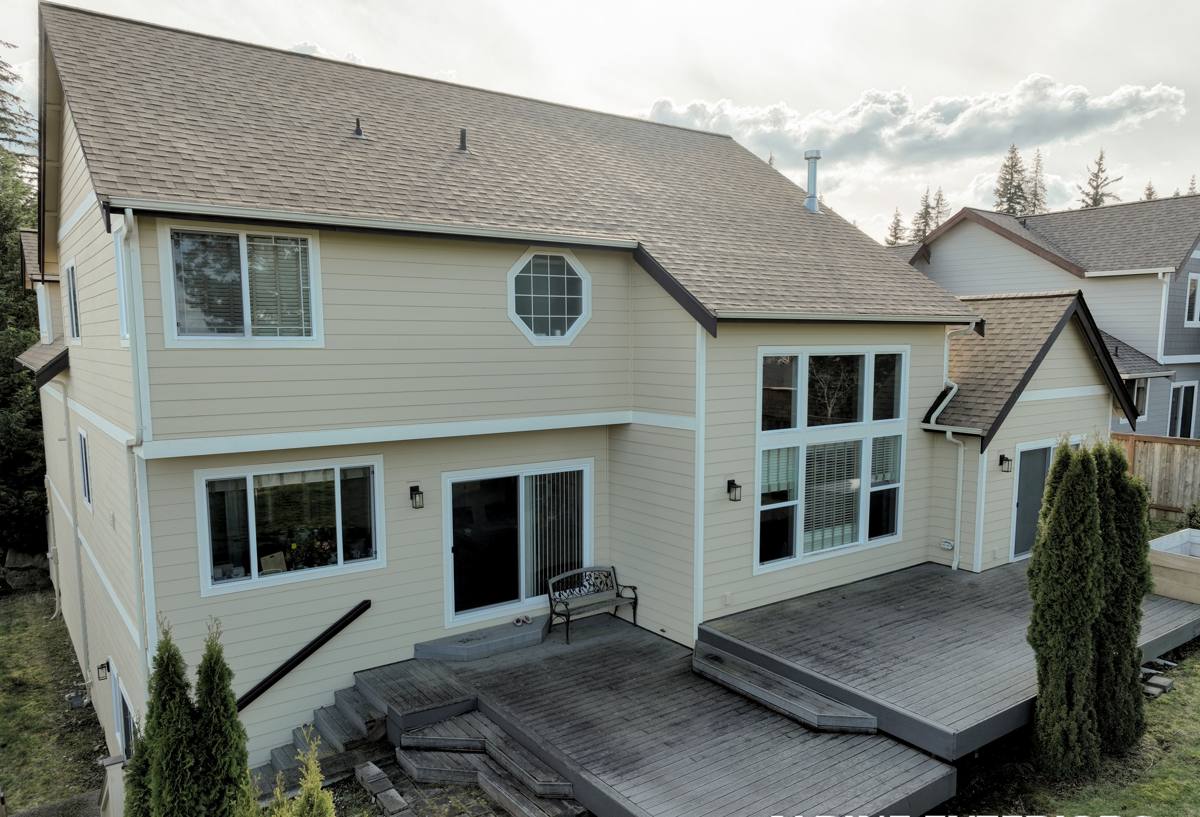
What Actually Wears Out Siding Near the Water
A few mechanisms show up over and over on homes in this stretch of Birch Bay:
- Salt air accelerates corrosion on fasteners, flashing, and any exposed metal trim, which can lead to staining and hidden water paths long before the siding itself looks bad.
- Wind-driven rain forces water sideways and upward, testing lap overlaps, butt joints, and penetrations (hose bibs, vents, light fixtures) that would stay dry in a calmer climate.
- Persistent shade and moisture on north- and west-facing walls feed moss and algae growth, which holds water against the surface long after the rain stops.
- Repeated wet-dry cycles stress paint films and caulked joints, which is usually where visible failure shows up first — even when the siding material underneath is still structurally sound.
When we evaluate a home for replacement, we're looking at all of this together, not just the siding panels themselves. A lot of "siding problems" are actually water management problems that happen to show up as siding damage.
What a Correct Siding Replacement Involves
It Starts Underneath the Siding, Not With It
Full tear-off gives us a look at the sheathing, framing, and existing weather barrier — the parts of the wall assembly you can't see or judge from a drive-by estimate. In a coastal climate like this, that inspection matters more than usual. We're checking for rot at window and door openings, deteriorated or missing flashing, and any spots where the old weather-resistive barrier has failed or was installed with shortcuts. Any damaged sheathing or framing gets addressed before a single new panel goes up — covering rot with new siding just hides the problem and shortens the life of the new work.
Water Management Details That Matter Here
In a driving-rain environment, the flashing details do as much work as the siding itself. That means proper head flashing over windows and doors, correctly lapped and sealed weather-resistive barrier, drainage space where called for, and kick-out flashing at roof-to-wall intersections so water is directed away from the wall instead of behind it. These are the details that separate a siding job that looks right for a season from one that performs for decades in this climate.
Fastening and Finish
Corrosion-resistant fasteners are non-negotiable this close to salt air — the wrong fastener can rust and stain a wall long before the siding itself shows wear. Panels need to be fastened to manufacturer spec (not overdriven, not underdriven), joints need proper caulking with a product rated for the exposure, and trim needs to be detailed so water sheds away from the wall rather than pooling at horizontal surfaces.
Why We Install Only James Hardie Fiber Cement
We install one siding system — James Hardie fiber cement — and we don't offer vinyl, LP SmartSide, cedar, primed spruce, or other fiber cement brands as alternatives. That's a deliberate standard, not a lack of options, and it's worth explaining honestly rather than just asserting.
Where Other Products Fall Short in This Climate
Wood-based siding — cedar, primed spruce, engineered wood products like LP SmartSide — depends heavily on an intact paint or coating film to keep moisture out. In a climate with this much sustained dampness and a long moss season, any breach in that coating (a scratch, a poorly sealed joint, a spot where moss holds water against the surface) gives moisture a path into a material that can swell, rot, or delaminate. Vinyl siding sheds water well enough on its own, but it's a thin material that can warp in temperature swings, doesn't offer the fire resistance of fiber cement, and its appearance and seams tend to read as lower-end on more architecturally detailed homes. None of these products are "bad" — they're widely used and can perform adequately in the right setting. We simply don't think this setting, this close to the water, is the right one for them.
What Hardie Gets Right
James Hardie fiber cement is a cement-and-cellulose composite that doesn't rot, doesn't feed pests, and isn't dependent on an unbroken paint film the way wood-based products are. It carries a factory-applied ColorPlus finish that's baked on and warranted against fading and peeling far beyond what field-applied paint typically achieves, which matters in a climate that's hard on painted surfaces. Hardie also engineers specific product formulations, marketed under its HZ5 line, for climates like ours with real moisture and freeze-thaw exposure — it's not a one-size-fits-all product nationally. It's also non-combustible, which is a real, if secondary, benefit for any home. None of this makes it maintenance-free, but it removes several of the failure modes that show up first and worst in a salt-air, high-rain environment.
Our Process for a Cottonwood Beach Project
- On-site assessment: We walk the exterior, check existing siding condition, look at trim, flashing, and any visible moisture staining, and talk through what you're seeing from the inside (drafts, stains, soft spots).
- Written estimate: A clear scope covering tear-off, any sheathing or flashing repair anticipated, the specific Hardie product and profile, color, and trim package, and a firm price — not a rough range that grows once work starts.
- Tear-off and inspection: Old siding comes off, sheathing and framing get inspected, and we flag anything that needs repair before proceeding, with photos so you can see exactly what we found.
- Weather barrier and flashing: New weather-resistive barrier, corrected or upgraded flashing at windows, doors, and roof-wall intersections, and any drainage detailing the wall assembly calls for.
- Installation to manufacturer spec: Hardie panels installed with correct fastener spacing, joint treatment, and clearances — including proper ground clearance and gaps at other surfaces, which matters for long-term moisture performance.
- Final walkthrough: We go over the finished work with you directly, not through a subcontractor you've never met.
Signs Your Cottonwood Beach Home Needs Replacement, Not Repair
Not every siding problem justifies a full replacement, but in this climate, a few signs usually mean patching won't hold:
- Soft or spongy siding when pressed, especially near the bottom courses or around windows and doors
- Persistent moss or algae staining that returns quickly after cleaning
- Visible warping, cupping, or separation at panel joints
- Paint that's failing across large areas rather than in isolated spots
- Rust streaking from fasteners or trim, a common early sign in salt-air exposure
- Interior signs like peeling paint, musty smells, or soft drywall near exterior walls
If you're seeing two or more of these, especially on walls that take the worst of the wind and rain, it's worth getting a proper assessment rather than another round of caulk and paint.
Cost Factors Specific to This Kind of Project
| Factor | Why It Affects Cost |
|---|---|
| Extent of hidden damage found at tear-off | Rot or damaged sheathing near the water is more common and adds repair scope beyond the base estimate |
| Flashing and trim complexity | Homes with more window/door penetrations and roof-wall intersections need more detailing to manage driving rain |
| Siding profile and trim package | Lap width, trim style, and accessory boards affect both material and labor |
| Height and access | Multi-story walls and limited-access sides (common on view-oriented coastal lots) add labor time |
| Color and finish choice | ColorPlus factory finishes vs. field-applied paint affect both cost and long-term maintenance |
We don't quote from a distance for this reason — an accurate number requires seeing the actual walls, not just square footage.
Why a Crew That Already Works Cottonwood Beach Matters
Coastal Whatcom County exposure isn't uniform — a wall facing open water takes a different beating than one tucked behind other homes or tree cover, and a crew that's worked this specific stretch of Birch Bay has already seen how that plays out on real houses. That shows up in small decisions: where to add extra flashing attention, which details are worth upgrading beyond code minimum, and what timing works around this area's weather windows for tear-off and dry-in. It also means fewer surprises — we're not learning this climate's failure patterns on your house for the first time.
Living With Hardie Siding After Installation
One of the practical benefits of switching to fiber cement here is how little ongoing work it demands compared to wood-based siding. You're not repainting on a recurring cycle to keep moisture out, since the ColorPlus finish is factory-cured and warranted. The main upkeep is the same thing every home in this area deals with regardless of siding material: keeping moss and algae from establishing on shaded walls, which means an occasional gentle wash rather than a repaint. Keeping gutters clear and vegetation trimmed back from walls also goes a long way toward keeping any siding material performing well in this climate.
If your Cottonwood Beach home's siding is showing its age — or you just want an honest read on whether repair or replacement makes more sense — we're happy to come take a look. The estimate is free, there's no pressure, and you'll get a straight answer either way.