 Birch Bay Window
 Building a Deck That Actually Holds Up in Ferndale
Ferndale sits close enough to the water and to the open farmland of Whatcom County that a deck here takes weather from two directions at once — salt-tinged marine air rolling in off Birch Bay and the Strait, and the long, wet Pacific Northwest winter that keeps everything damp for months at a stretch. A deck built to a generic spec sheet, without accounting for that combination, tends to show its age fast: fasteners bleed rust, footings heave, and moss creeps into every shaded corner by the second winter. A deck built correctly for this specific climate can go the other direction and stay solid, dry, and safe to walk on for decades.
This page is about deck building specifically for Ferndale properties — what the ground and weather here demand, what a correctly built deck actually involves under the decking boards, and how we approach the job so it's still doing its work fifteen or twenty years from now.
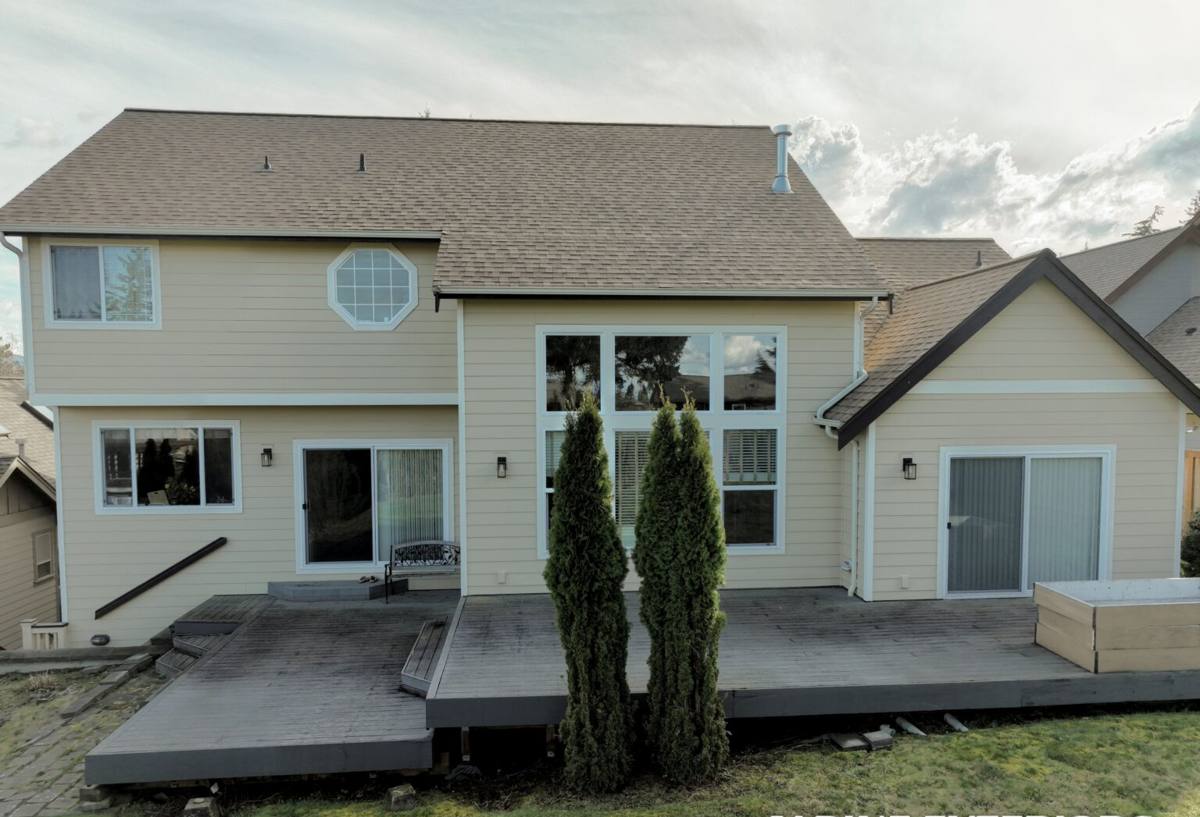
What Ferndale's Climate Does to an Outdoor Structure
Three things drive most of the deck problems we see in this part of Whatcom County:
- Salt-laden air. Proximity to Birch Bay and the Strait of Georgia means airborne salt reaches inland further than most homeowners expect. It accelerates corrosion on any fastener, bracket, or hardware that isn't rated for it.
- Driving, sideways rain. Storms here don't just fall straight down — wind-driven rain gets pushed up under railings, into ledger connections, and behind fascia boards that weren't detailed to shed water away from the house.
- A long moss and algae season. Cool, damp, shaded conditions persist for much of the year, which means any deck surface that holds moisture — low spots, tight board gaps, end grain — becomes a moss farm if it isn't built or maintained to dry out.
None of these problems are dramatic on their own. What they do is compound quietly, underneath the visible parts of the deck, until a homeowner discovers soft framing or a failing ledger board years later than they should have.
The Parts of a Deck That Actually Determine How Long It Lasts
Footings and Post Bases
Whatcom County's frost depth and the often-saturated soils around Ferndale properties mean footings need to be sized and set correctly, not just "deep enough by eye." Post bases should sit above grade on standoff hardware, not buried in soil or concrete, so the post end can dry out between rain events instead of wicking moisture year-round.
The Ledger Connection
Where a deck attaches to the house is the single most common failure point on decks in this region — and it's almost always a flashing problem, not a fastener problem. Water gets behind the ledger board, into the rim joist, and into the wall framing, and it can do real damage before anyone notices from outside. Correct ledger flashing (metal flashing plus a water-resistive barrier detail, not just caulk) is non-negotiable on any deck we attach to a house here.
Joist Protection and Fasteners
Untreated cut ends and joist tops are where rot starts fastest. Joist tape or a comparable protective barrier over the top of each joist, combined with stainless steel or coated fasteners rated for coastal exposure, is the difference between hardware that lasts and hardware that's staining the decking with rust streaks in three years.
Drainage Under the Deck
Low decks and covered decks trap moisture underneath if the ground isn't graded to shed water away from the house and posts. On a lot with poor drainage, that standing moisture is exactly what keeps posts and framing wet during the parts of the year they most need to dry.
Choosing a Decking Material for This Climate
There's no single "best" decking material — the right choice depends on how much maintenance a homeowner actually wants to do and what the deck is used for. Here's how the common options actually perform under Ferndale conditions:
| Material | How It Handles Salt Air & Rain | Moss/Algae Resistance | Maintenance |
|---|---|---|---|
| Pressure-treated wood | Good if fasteners are corrosion-rated; wood itself handles moisture well when it can dry | Needs regular cleaning to stay ahead of it | Annual cleaning, periodic re-staining/sealing |
| Cedar | Naturally moisture- and insect-resistant; still needs correctly rated hardware | Better natural resistance, still needs upkeep | Regular oiling/sealing to hold its color and grain |
| Composite decking | Excellent — doesn't absorb moisture or corrode | Surface can still grow algae in shaded, damp spots; cleans off easily | Occasional washing, no staining or sealing |
| PVC decking | Excellent — fully synthetic, unaffected by moisture | Same as composite; smooth surfaces shed algae easiest | Lowest maintenance of the options |
We install all of these. Our job is to lay out the honest trade-offs — wood costs less up front and looks great but asks for yearly attention; composite and PVC cost more initially but ask almost nothing of the homeowner for the life of the deck. What we won't do is talk a homeowner into a low-maintenance product without being upfront that the underlying framing still needs to be built to the same standard regardless of what's on top of it.
Railings, Fasteners, and Hardware That Won't Rust Out
Railing posts and connections take direct weather exposure and structural load at the same time, which makes them a poor place to save money on hardware. In a coastal-influenced climate like Ferndale's, we spec stainless steel or otherwise corrosion-rated fasteners and brackets throughout — not just at the ledger. The cost difference between standard and corrosion-rated hardware is small relative to the cost of replacing rusted-through connections in a structural railing years down the road.
How We Build a Deck in Ferndale, Start to Finish
- Site walk and design. We look at drainage, sun/shade exposure, the ledger attachment point, and how the deck will actually get used before drawing anything up.
- Permitting. Most decks over a certain height or attached to the house require a permit through Whatcom County or the City of Ferndale, depending on the property. We handle that process rather than leaving it to the homeowner.
- Footings and framing. Footings sized to local frost depth and soil conditions, post bases set above grade, ledger flashed correctly, joists protected before decking goes down.
- Decking and railings. Installed per manufacturer spec (for composite/PVC, that includes gapping and fastening details that matter for warranty coverage), with corrosion-rated hardware throughout.
- Final walkthrough. We go over the deck with the homeowner, including what maintenance (if any) the chosen material needs going forward.
Permits and Code in Whatcom County
Deck permitting requirements vary depending on whether a property falls under Ferndale city jurisdiction or unincorporated Whatcom County, and on the deck's height, size, and attachment to the structure. Requirements typically cover footing depth, guardrail height and spacing, and ledger attachment. We pull permits and coordinate inspections as part of the build rather than treating it as the homeowner's problem to sort out — skipping this step is one of the more common ways decks in this area end up with issues that surface at resale.
Keeping a Deck Ahead of Moss Season
Even a well-built deck needs some seasonal attention in a climate this damp. A short checklist that covers most of it:
- Sweep debris out of board gaps and corners before fall rains set in — trapped leaves hold moisture against the surface.
- Rinse or lightly scrub shaded areas where moss gets a foothold first, before it spreads.
- Check that gaps between boards haven't closed up with swelling or debris buildup, since that gap is what lets the deck dry out between rains.
- Inspect railing posts and ledger flashing once a year for any sign of water intrusion or rust staining.
- For wood decking, plan on re-sealing on the manufacturer's recommended schedule, not just when it starts looking gray.
None of this is heavy work, but skipping it is exactly how moss and moisture problems get a head start in this climate.
Why Hiring a Crew That Already Works in Ferndale Matters
A contractor who builds decks across a range of climates might not think twice about standard fasteners or a quick caulk-and-go ledger detail — and in a drier region, that might hold up fine. In Ferndale, those shortcuts show up as rust stains, soft framing, or a leaking wall within a handful of years. Working this area regularly means we already know which details can't be skipped: the flashing at the ledger, the fastener spec, the footing depth, the drainage grading. That's not a sales pitch — it's the difference between a deck that needs to be partially rebuilt in year six and one that's still solid at year twenty.
Get a Straight Answer on Your Deck Project
If you're planning a new deck or replacing one that's showing its age, we're glad to come take a look, talk through material options honestly, and put together a no-pressure estimate — just fill out the form below.