 Birch Bay Window
 Siding Replacement Is a Different Job Than a First Install
Blaine sits right at the water's edge in the northwest corner of Whatcom County, close enough to Birch Bay and Semiahmoo Bay that salt air is a daily condition for most homes in the area, not just the ones with a water view. Combine that with driving rain that comes ashore hard off the Strait and a moss season that runs long into the year on shaded lots, and you get a climate that is genuinely tough on exterior materials. When siding here reaches the end of its service life, replacing it correctly is a different job than putting siding on a new house. New construction goes over fresh sheathing and a clean weather-resistive barrier. Replacement means removing decades-old material, finding out what's actually happening behind it, and fixing whatever the old siding was hiding before anything new goes up.
This page is specifically about full siding replacement for homes in and around Blaine — what tells you it's time, what the tear-off usually turns up in a coastal town like this, and how we approach the job from first look to final cleanup. We install one siding system, James Hardie fiber cement, and we don't offer LP SmartSide, vinyl, Cemplank, Allura, primed spruce, or cedar as alternatives. That's a professional standard we hold to on every replacement job, for reasons that come directly from what coastal moisture and salt exposure do to a house over time.
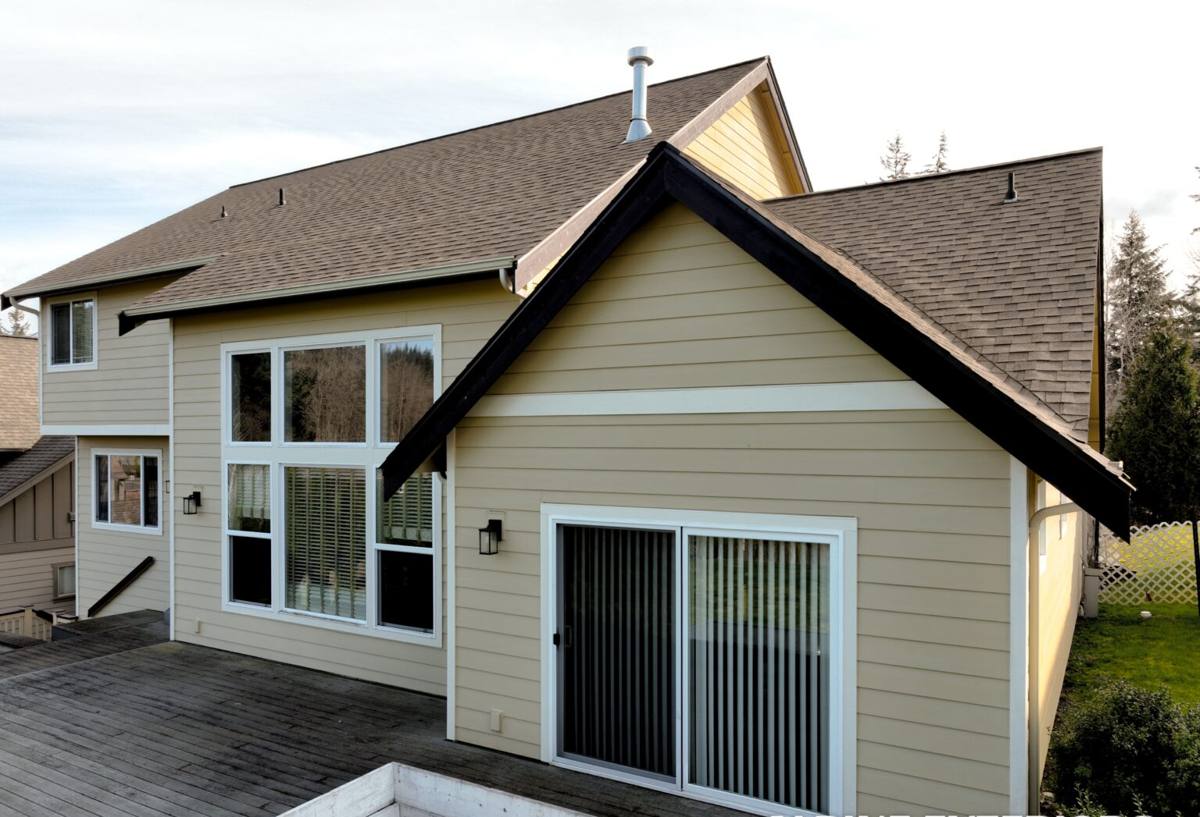
Signs a Blaine Home Needs Replacement, Not Just Repair
Repair makes sense when the damage is limited and the rest of the siding is sound. Replacement becomes the right call when the problems are spread across the house, when the siding material itself has reached the end of what it can offer, or when what looks like a small issue on the surface turns out to be a symptom of something wider once you look closer. A few signs worth taking seriously:
- Soft, spongy, or delaminating siding in more than one or two isolated spots
- Paint that won't hold anymore even after repeated repainting, especially on shaded or north-facing walls
- Visible warping, cupping, or buckling across multiple boards or panels
- Persistent moss or mildew staining that comes back within a season of cleaning
- Rust streaking from fasteners or corroded trim, common on homes closer to the water
- Rot found at even one or two spots during a routine repair — often a sign of more hidden damage nearby
- Siding that's original to a house built more than 20-25 years ago, especially with wood-based products
Any one of these on its own might point to a repair. Several together, or a material that's simply reached the end of its useful life, is usually the point where full replacement costs less over time than chasing repairs on a house that keeps producing new problems.
What Blaine and Birch Bay's Climate Does to Siding Over Time
Salt Air, Close to the Water
Homes near Birch Bay and Semiahmoo Bay take a steadier dose of salt-laden air than towns set further inland in Whatcom County. Salt accelerates corrosion on fasteners, flashing, and exposed metal trim, and it breaks down lower-quality paint and coatings faster than a dry inland climate would. On an aging house, this shows up as pitted or rust-streaked hardware and paint that fails well before it should.
Driving Rain Off the Water
Storms coming off the water rarely drop rain straight down. Wind pushes it sideways into wall assemblies, window flashing, and the joints where trim meets siding. Over enough years, that sideways-driven moisture finds any gap a less careful original installation left behind, and it's usually the real cause behind the rot and soft sheathing we find once old siding comes off a Blaine home.
A Long Moss Season
Mild temperatures combined with near-constant moisture give moss and mildew a growing season that can run most of the year on shaded or north-facing surfaces. Any siding material with even a little surface porosity becomes a growth surface over time, and that sustained dampness is exactly the condition that shortens the life of wood-based and lower-grade siding products in this part of the county.
What Tear-Off Usually Reveals
The most important part of a siding replacement isn't the new material going on — it's what gets found and fixed once the old siding comes off. In a coastal, high-moisture town like Blaine, that discovery step matters more than it would in a drier inland climate. A few things we routinely check for and address before any new siding goes up:
- Sheathing condition: Soft or delaminated sheathing behind old siding needs to be identified and replaced, not covered over.
- Weather-resistive barrier: Older homes often have a degraded or missing WRB, which needs to be corrected as part of the job, not skipped to save time.
- Flashing at windows and rooflines: These are the most common places wind-driven rain gets in, and old or missing flashing is a frequent find during tear-off.
- Framing damage: In more severe cases, sustained moisture intrusion reaches the framing itself, which changes the scope of the job and needs to be addressed before siding goes back on.
- Insulation and air sealing gaps: Tear-off is also a practical opportunity to correct gaps that were never addressed at original construction.
A homeowner won't know which of these apply to their house until the old siding is off. That uncertainty is normal, and it's one of the reasons a fair, honest replacement estimate accounts for the likelihood of some hidden repair work rather than pretending it won't come up.
Why We Replace With James Hardie Fiber Cement Only
We install one siding system on replacement jobs, and it's a decision built on what we've seen hold up in coastal, high-moisture conditions like Blaine's, not a supplier arrangement or a sales angle.
- Non-combustible core: Fiber cement doesn't feed a fire the way wood-based siding products can, which matters for both safety and insurance considerations.
- Factory-applied ColorPlus finish: The color is baked on under controlled factory conditions rather than brushed on in the field, holding up longer against fading, chalking, and salt-air exposure.
- Climate-engineered HZ5 formulation: Built specifically for regions with sustained moisture and freeze-thaw cycling, which describes coastal Whatcom County well.
- Dimensional stability: Fiber cement doesn't swell, cup, or warp the way engineered wood products can after years of exposure to wind-driven rain off the water.
- Strong transferable warranty: Backed by one of the stronger warranty structures in the industry, provided the installation follows Hardie's spec.
Every one of those products we don't install — LP SmartSide, vinyl, Cemplank, Allura, primed spruce, cedar — has a place in the market and homeowners who are satisfied with them. But on a replacement job, where the whole point is to stop redoing the same repair every few years, we've made the call to stand behind one system rather than offer something cheaper that quietly shifts the maintenance burden back onto the homeowner.
What Affects the Cost of a Siding Replacement
Every house is different, and we don't give ballpark numbers without seeing the property, but the factors that drive cost up or down are consistent from job to job:
| Factor | Why It Affects the Job |
|---|---|
| House size and wall complexity | More square footage and more corners, gables, and trim details mean more labor time |
| Condition of sheathing and framing found at tear-off | Rot or water damage discovered underneath adds repair scope beyond the siding itself |
| Current siding material | Some materials come off faster and cleaner than others, affecting demo time |
| Trim, fascia, and detail work | Homes with more architectural detail take longer to flash and finish correctly |
| Access and site conditions | Tight lots, landscaping, or multi-story walls affect staging and labor time |
| Color and board profile selection | Custom ColorPlus colors and specialty profiles can affect material lead time and cost |
How the Replacement Process Works
Assessment and Estimate
We start with a walk-around of the house, looking at the current siding's condition, any visible signs of moisture damage, and the trim and flashing details that will factor into the job. This is also when we talk through material and color options and give an honest estimate based on what we can see from the outside.
Tear-Off and Inspection
Old siding comes off in sections, and the sheathing, WRB, and framing underneath get inspected as we go. This is the point where hidden damage, if there is any, gets identified before anything new goes back on.
Repair Before Re-Cover
Any soft sheathing, damaged framing, or degraded weather barrier gets repaired or replaced. This step doesn't get skipped to save time — covering damage instead of fixing it just guarantees the same problem returns.
Installation to Spec
New James Hardie siding goes on following manufacturer installation requirements: correct fastening, proper flashing at every window and roofline transition, and attention to the details that matter most in a wind-driven-rain climate like Blaine's.
Cleanup and Walkthrough
We clear the site of old material and debris and walk the finished job with the homeowner before calling it done.
Why a Crew That Already Works Blaine and Birch Bay Matters
A crew that works this stretch of Whatcom County regularly has seen how salt air, driving rain, and a long moss season actually play out on real houses here, not just how a product performs on a spec sheet. That local experience shapes practical decisions during a replacement job: where extra flashing attention pays off, which walls hold moisture longest, and how to sequence tear-off around this area's weather windows so a home isn't left exposed longer than necessary. Blaine and Birch Bay's coastal exposure isn't identical to more sheltered inland towns in the county, and a crew that knows the difference builds accordingly instead of applying a generic approach to every job.
Get a Free, No-Pressure Estimate
If your Blaine or Birch Bay home's siding is showing its age, or you're just not sure whether repair or full replacement makes more sense, we're glad to take a look and give you a straightforward assessment. Reach out using the form below to schedule a free estimate — no pressure, no upsell script.