 Birch Bay Window
 Deck Building in Custer: Built for a Wet, Wind-Exposed Corner of Whatcom County
Custer sits in the agricultural flatland north of Ferndale, close enough to the Salish Sea to catch salt-laden marine air on winter storms even though it isn't sitting directly on the waterfront. For a deck, that combination of salt air, driving rain, and open exposure to wind is a tougher test than most homeowners expect. A deck is horizontal, it collects standing water and debris in a way a wall never does, and every fastener, board gap, and ledger connection on it is exposed to the weather year-round. Get the structure and material choices wrong here and a deck can show rot, corroded hardware, or a slick moss coating within a few seasons.
We build and repair decks throughout this stretch of Whatcom County alongside our siding, roofing, and window work, and we treat a deck as a structure that has to shed water and resist decay first, and look good second. A deck that photographs well but traps moisture at the ledger or under the surface boards is a deck that's going to cause problems, usually sooner than a homeowner expects.
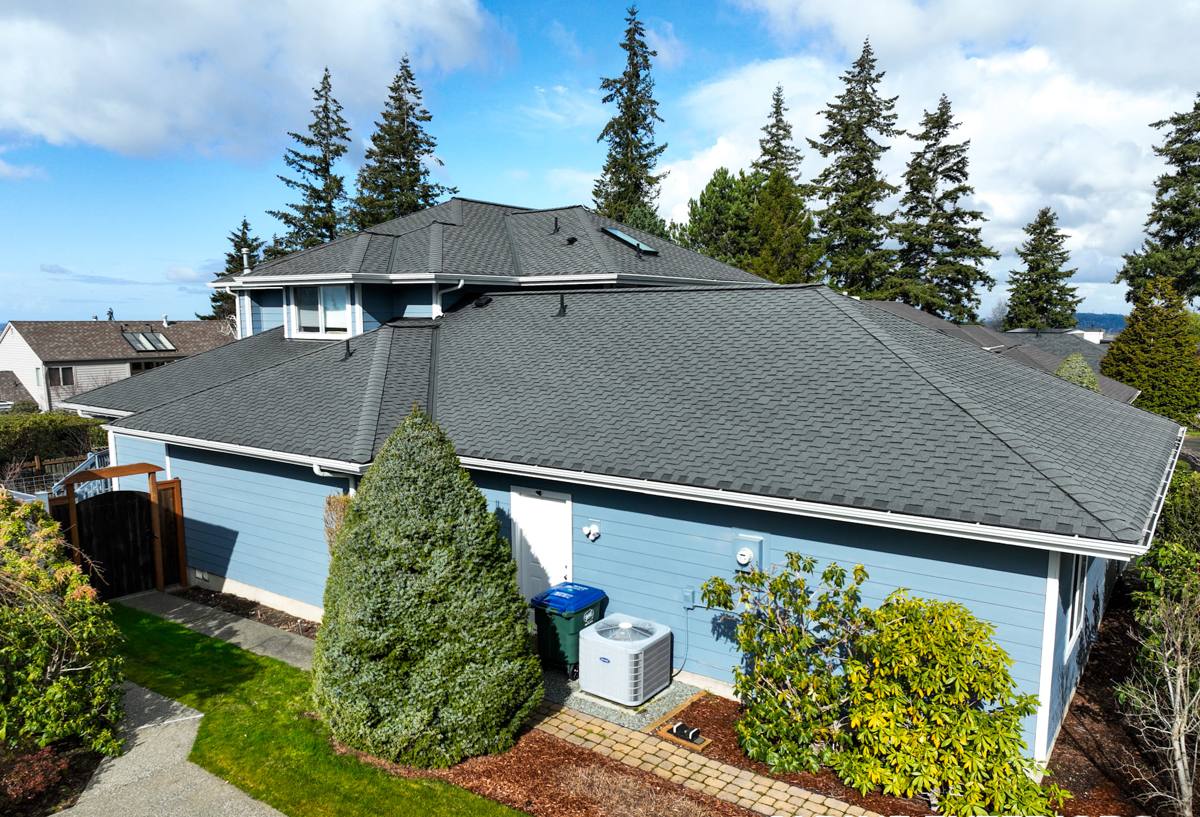
What Custer's Climate Does to a Deck
Driving Rain and Standing Water
Open farmland and flat terrain around Custer don't slow wind down much, so storms coming off the water push rain sideways as often as straight down. On a deck, that means water gets driven under railings, into board gaps, and against ledger boards and posts from angles a more sheltered site would never see. Decking that doesn't drain well, or that's installed tight against the house without a gap for water to escape, holds moisture far longer than it should.
Marine Air and Fastener Corrosion
Even set back from the water, Custer gets enough salt-laden air carried inland to accelerate corrosion on standard-grade fasteners, joist hangers, and structural hardware. This is one of the most common failure points we see on older decks in this area — the boards themselves might still be usable, but the nails, screws, or hangers holding the frame together have rusted, pitted, or weakened well ahead of schedule. A deck is only as strong as the hardware inside it, and that hardware is largely invisible until something fails.
Moss, Algae, and a Long Growth Season
Mild temperatures and near-constant dampness through fall, winter, and spring give moss and algae a long window to take hold across Whatcom County, and a horizontal deck surface is an ideal growth spot. Shaded decks, north-facing decks, and any deck with boards spaced too tight to shed water dry slowly and stay damp long enough for growth to establish. Beyond looking bad, a mossy or algae-covered deck surface gets genuinely slippery and becomes a fall hazard, especially on stairs.
Freeze-Thaw and Wood Movement
Whatcom County doesn't see extreme cold most winters, but it does see repeated freeze-thaw cycling through the wetter months, and wood decking expands and contracts with moisture content more than most homeowners realize. Boards installed without the right gap spacing can cup, crown, or push against each other as they swell, and fasteners that aren't allowed to move with the wood can work loose or split the board around them over time.
Signs a Custer Deck Needs Attention
- Soft, spongy, or visibly darkened spots in decking boards, especially near the house or in shaded corners
- Rust streaks running down from fasteners, joist hangers, or railing hardware
- A railing or stair stringer that flexes or feels loose when you put weight on it
- Persistent moss, algae, or a slick green film that comes back shortly after cleaning
- Gaps between boards that have closed up completely, or boards that have cupped and no longer sit flat
- Visible daylight or a gap where the ledger board meets the house siding
- A musty smell or soft framing when you check underneath the deck
What a Correct Deck Build Looks Like Here
Ledger Attachment and Flashing
The ledger board — where the deck attaches to the house — is the single most important structural and moisture detail on the entire deck. It has to be bolted correctly for structural load and flashed so that water runs over the flashing and away from the house rather than behind it into the wall framing. A poorly flashed ledger is one of the most common sources of hidden rot we find in this climate, because the damage happens behind the deck surface and isn't visible until it's advanced.
Joists, Hangers, and Hardware Grade
Framing lumber, joist hangers, and every fastener on an exterior deck in a marine-influenced climate should be rated for exterior or ground-contact use, and hardware should be corrosion-resistant rather than standard-grade. This is not a place to save money on materials, since hardware failure is a structural safety issue, not a cosmetic one, and it's the hardest part of the deck to inspect once the decking boards are down.
Decking Material and Board Spacing
Whether a homeowner chooses wood or composite decking, board spacing needs to account for drainage and for the material's expected expansion. Boards set too tight trap water and debris between them; boards set with excessive gaps look sloppy and can be uncomfortable underfoot. Correct spacing is a small detail that has an outsized effect on how well a deck sheds water over its lifetime.
Footings and Post Bases
Post footings need to be set to the correct depth for this region's frost and soil conditions, and post bases should hold the post above grade and off standing water rather than burying wood directly in soil or concrete. Wood-to-concrete or wood-to-soil contact is one of the most reliable ways to start rot at the base of a deck post, and it's avoidable with the right hardware.
Decking Material Comparison
| Material | Moisture Behavior in This Climate | Maintenance | Typical Lifespan |
|---|---|---|---|
| Pressure-treated wood | Resists rot when properly sealed and maintained; end cuts and fastener holes are vulnerable points | Needs re-sealing or staining every 1-2 years in this climate | 15-20 years with consistent upkeep |
| Cedar | Naturally more decay-resistant than most softwoods but still absorbs moisture over time | Periodic cleaning and sealing to maintain appearance and moisture resistance | 15-25 years depending on exposure |
| Composite decking | Doesn't rot or absorb water the way wood does; performance varies by manufacturer and product line | Periodic cleaning to prevent moss and algae buildup on the surface | 25-30+ years, manufacturer-dependent |
| PVC decking | Fully synthetic, essentially immune to rot and moisture absorption | Low maintenance; mainly surface cleaning | 25-30+ years |
None of these materials are maintenance-free in a climate like this one — even composite and PVC decking need periodic cleaning to keep moss and algae from taking hold on the surface. The real difference between materials is how much upkeep they demand and how they behave if water does get into a joint, gap, or fastener hole.
Cost Factors on a Custer Deck Project
| Factor | Why It Affects Cost |
|---|---|
| Deck size and shape | More square footage and more complex shapes mean more material and more cut waste |
| Height and stairs | Elevated decks need more substantial framing, railing, and stair construction than ground-level decks |
| Material choice | Pressure-treated wood costs less upfront; composite and PVC cost more but reduce long-term maintenance |
| Footing and access conditions | Difficult site access or soil conditions can add time and equipment cost to footing work |
| Railing style | Custom or code-required railing details, especially on elevated decks, add material and labor |
| Demolition of an existing deck | Removing and disposing of an old structure adds cost before new construction can start |
Repair vs. Full Rebuild
Not every deck problem in Custer requires a full rebuild. If the framing and ledger connection are structurally sound and the issues are limited to surface boards, railing, or isolated hardware, targeted repair can extend the deck's life for a reasonable cost. But if there's rot at the ledger, undersized or corroded structural hardware, or footings that were never set correctly, repair is usually a short-term fix on top of a long-term problem. We give homeowners a straightforward read on which category their deck falls into rather than defaulting to the more expensive answer.
Our Process
We start with an on-site inspection that includes getting underneath the deck to check the framing, ledger connection, footings, and hardware condition, not just a visual look at the surface boards. From there we give a clear assessment of whether repair or rebuild makes more sense, along with a written scope before any work begins. On new builds and rebuilds, ledger flashing, corrosion-resistant hardware, and correct footing depth are standard practice on every job, not upgrades a homeowner has to ask for separately.
Permitting is also part of the process. Most deck construction and many deck rebuilds in Whatcom County require a permit, and elevated decks in particular have railing height and guard spacing requirements that inspectors check. We handle that process rather than leaving it to the homeowner to sort out.
A Simple Checklist Before Hiring for Deck Work in Custer
- Ask specifically how they flash the ledger board, not just what decking material they're proposing
- Confirm current Washington contractor licensing and active liability insurance
- Ask whether footings and framing will be pulled and inspected, or only the visible surface
- Get a written scope that separates material warranty from installation warranty
- Confirm who is handling the permit and inspection process
- Ask about hardware grade specifically — corrosion-resistant hardware matters more here than in a drier inland climate
How a Deck Fits Into the Rest of the Building Envelope
A deck that attaches to a house isn't a standalone structure — the ledger connection ties directly into the wall framing and siding behind it, and a poor connection there can send water into the house rather than just damaging the deck itself. We handle siding, roofing, windows, and decks as connected trades rather than separate specialties, which means the crew building or repairing a deck understands how that ledger connection needs to integrate with the siding and drainage plane around it.
Why a Local Crew Matters for Deck Work
A contractor who works this part of Whatcom County regularly already knows how wind-driven rain and marine-influenced air behave here compared to a drier, more sheltered climate. That shows up in the specific decisions that determine whether a deck lasts one wet decade or three — how the ledger gets flashed, what grade of hardware gets specified, how much drainage gap gets left between boards, and how footings get set for local soil and moisture conditions. Those are the details that separate a deck that holds up from one that starts showing problems within a few years.
If you're dealing with a tired, damaged, or aging deck on a Custer property — or you're planning a new deck and want it built right the first time — we're happy to take a look and give an honest assessment. Reach out below for a free, no-pressure estimate.