 Birch Bay Window
 Why Deck Building in Sumas Takes Local Know-How
A deck built in Sumas has to survive a different year than a deck built on the dry side of the state. Whatcom County's coastal-influenced climate means long stretches of steady rain, salt-laden air drifting in off the water, and a moss season that can run from fall well into spring. None of that is exotic or unusual for this corner of Washington, but it does mean a deck built with generic, one-size-fits-all methods will show its age faster here than it would somewhere drier and more sheltered.
We build decks in Sumas and the surrounding Birch Bay area regularly, which means we're not guessing at how local conditions treat lumber, fasteners, and footings. We've seen what happens when a deck is built to a national-average standard instead of a standard for this specific climate. The fixes are usually the same three or four things done right the first time: better moisture management, corrosion-resistant hardware, proper drainage under and around the structure, and material choices that don't fight the weather.
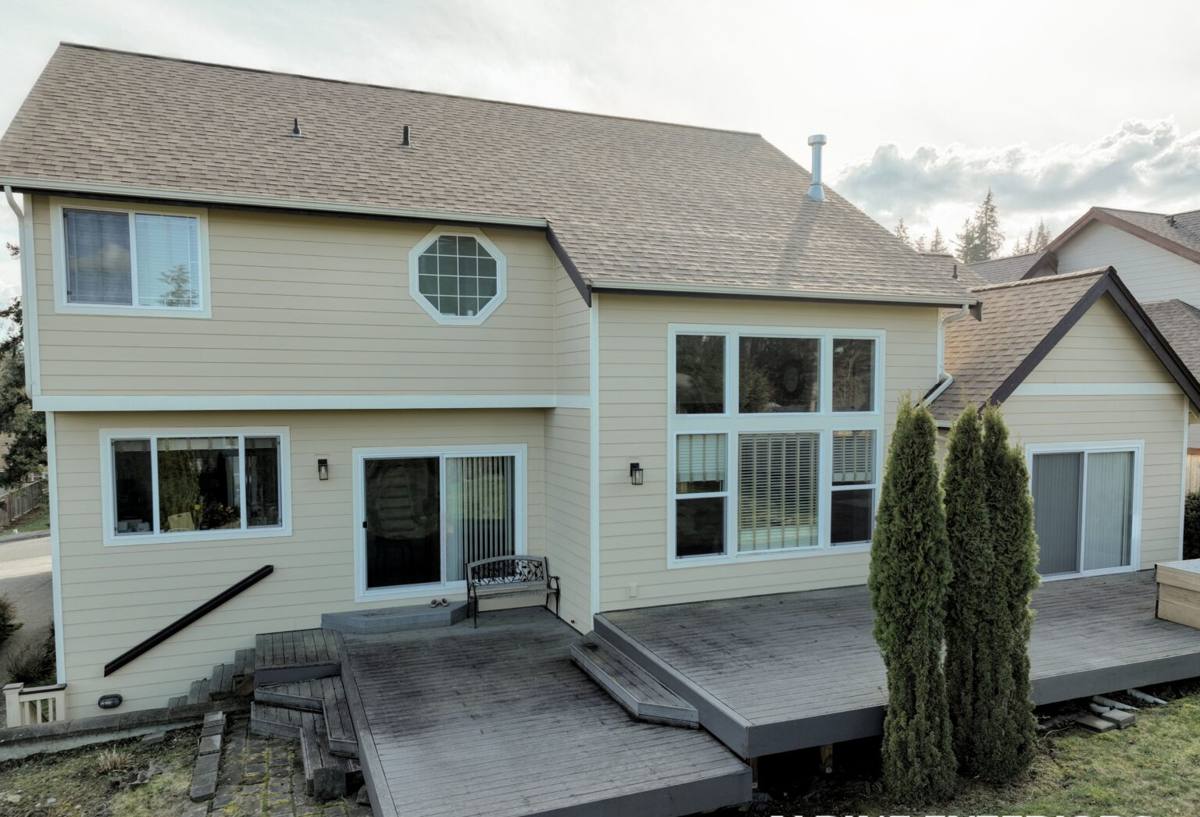
What Salt Air, Rain, and Moss Actually Do to a Deck
Salt Air and Metal Fasteners
Being close enough to the water to catch salt-laden air means every piece of exposed metal on a deck is under slow chemical attack. Standard galvanized fasteners can corrode faster here than their ratings suggest, especially where two dissimilar metals meet or where a fastener sits in a spot that stays damp longer than the rest of the structure. Corrosion doesn't just stain the wood around it — it weakens the connection itself, which matters most at structural points like ledger boards and joist hangers.
Driving Rain and Water Intrusion
Rain that comes in at an angle, rather than falling straight down, finds its way into gaps that vertical rain would never reach — behind ledger boards, under poorly lapped flashing, and into end grain on stair stringers and rail posts. Once water gets past the surface of a board, it doesn't leave quickly in a climate where the air itself stays damp for weeks at a time. That trapped moisture is what actually rots wood, not just rain hitting the surface.
Moss and Prolonged Dampness
A long moss season means more than green streaks on decking boards. Moss holds moisture directly against the wood surface, blocks airflow across boards, and keeps the top layer of decking wet long after the rest of the yard has dried out. On horizontal surfaces like deck boards and stair treads, that constant dampness accelerates surface decay and makes boards slicker and more slip-prone underfoot.
What a Correctly Built Deck Involves Here
A deck that's going to hold up to a Sumas winter needs to get several things right below the surface, long before anyone notices the decking material on top.
- Footings sized and set below frost depth, with proper drainage around them so water doesn't pool at the base of posts.
- Ledger board flashing that actually sheds water away from the house rim joist, installed in the correct shingle-style order rather than just caulked and hoped for.
- Corrosion-resistant fasteners and hardware rated for the actual exposure the deck will see, not just the minimum code requirement.
- Joist spacing tightened up where the decking material calls for it — composite and PVC boards often need closer spacing than solid wood to avoid sagging between joists over time.
- Airflow underneath the deck so the framing can dry out between rain events instead of staying damp continuously.
- Proper board gapping that accounts for seasonal wood movement without leaving gaps wide enough to catch heels or debris.
Skipping any one of these doesn't usually cause an obvious problem in year one. It shows up in year four or five as soft framing, rust streaks bleeding through decking, or a ledger connection that's quietly failing behind the siding.
Choosing the Right Decking Material for This Climate
There's no single "best" decking material — there's a best material for a given budget, maintenance appetite, and exposure. Here's how the common options compare for a deck that's going to face Sumas-area weather.
| Material | Moisture Behavior | Maintenance | Typical Lifespan Here |
|---|---|---|---|
| Pressure-treated wood | Absorbs and releases moisture; needs to breathe and dry | Annual cleaning and periodic staining/sealing | 10–15 years before major repair |
| Cedar | Naturally rot-resistant but still absorbs water | Regular sealing to preserve color and resistance | 15–20 years with upkeep |
| Composite decking | Doesn't absorb water like wood, but can trap moisture at end cuts if not capped | Occasional washing; no staining or sealing | 20-plus years, varies by product |
| PVC decking | Essentially non-absorbent | Low; periodic washing to prevent surface moss and algae | 20-plus years, varies by product |
In an area with this much sustained dampness and moss pressure, we lean toward capped composite or PVC decking for the walking surface on most projects — not because wood is a bad material, but because wood asks for a maintenance commitment that a lot of homeowners underestimate until they're three years in and behind on sealing. If a homeowner wants the look and feel of real wood and is willing to keep up with it, we'll build that correctly too — the framing underneath matters more than the surface material either way.
Framing Material Still Matters
Even with a low-maintenance decking surface on top, the framing underneath is almost always wood, and that framing is what actually determines how long the deck lasts structurally. Using appropriately treated lumber, protecting cut ends with sealant, and keeping the frame ventilated matters just as much on a composite deck as it does on a wood one — arguably more, since a composite surface can hide a rotting frame underneath it for longer before anything looks wrong from above.
Our Process for a Sumas Deck Build
- On-site assessment. We look at grade, drainage, sun and rain exposure, and how the deck ties into the house before recommending anything.
- Design and material discussion. We walk through decking, railing, and structural options with honest trade-offs for cost, maintenance, and longevity in this climate.
- Permitting. Most new decks and significant rebuilds in Whatcom County require a permit — we handle that process rather than leaving it to the homeowner.
- Footings and framing. This is where the long-term durability of the deck is actually decided — proper depth, drainage, flashing, and fastener selection.
- Decking, railing, and stairs. Installed to the spacing and fastening pattern the chosen material requires, not a generic default.
- Final walkthrough. We go over basic care for whatever material was installed so the deck actually gets the lifespan it's built for.
Common Problems We See on Older Sumas-Area Decks
Most deck failures we get called out for aren't sudden — they're the slow result of a few recurring issues:
- Ledger boards attached without proper flashing, leading to hidden rot at the house connection.
- Rusted-through joist hangers and fasteners that were never rated for long-term damp exposure.
- Decking boards installed tight against each other with no allowance for drainage or movement, trapping water and moss between boards.
- Footings that were undersized or not properly drained, leading to posts shifting over time.
- No airflow underneath the deck due to skirting or landscaping that blocks ventilation, keeping the frame perpetually damp.
Any one of these can usually be repaired, but catching them early is far cheaper than waiting until a board fails underfoot or a post connection lets go.
Maintenance That Actually Matters Here
Whatever material a Sumas-area deck is built with, a short annual maintenance routine goes a long way toward getting the full lifespan out of it:
- Clear leaves, needles, and debris from between boards and off ledger flashing before wet season sets in.
- Wash off moss and algae buildup rather than letting it sit through winter — a stiff brush and mild cleaner is usually enough.
- Check railing and stair connections annually for movement or rust staining.
- Keep gutters and downspouts near the deck clear so runoff isn't dumping extra water onto or under the structure.
- Reseal or restain wood decking on the schedule the product actually requires, not just when it looks faded.
Signs It's Time to Call Someone
A soft spot underfoot, visible rust streaks running down from fasteners, a railing post that wiggles, or standing water that doesn't drain within a few hours of rain stopping are all signs worth having looked at before they become bigger repairs.
Why a Local Crew Matters for This Job
Deck building isn't a job where a crew can show up with a generic plan and get a durable result in this climate. A crew that already works in Sumas and around Birch Bay knows what the rain does to a ledger connection over a wet winter, which fastener grades actually hold up against the salt air here, and how much drainage a footing really needs given the local soil and water table. That's the kind of knowledge that only comes from building and repairing decks in this specific area, not from a general contracting background applied anywhere.
It also means we're not disappearing after the last board is nailed down. A local crew is available for the punch-list follow-up, the maintenance question a year later, or the warranty item that comes up after the first hard winter — because we're still working in the same neighborhoods.
Permits and Code Considerations in Whatcom County
Most new deck construction and many substantial rebuilds require a building permit, with requirements around footing depth, railing height, guard spacing, and stair geometry that are there for real safety reasons, not paperwork for its own sake. We handle the permit process as part of the build rather than leaving homeowners to navigate it alone, and we build to code as a floor, not a ceiling — several of the durability practices described above go beyond minimum code because minimum code is written for the whole state, not specifically for a damp, salt-exposed corner of Whatcom County.
If you're planning a new deck or need an honest look at one that's showing its age, we're happy to come out, walk the site, and talk through what it actually needs — no pressure, no upsell. Use the form below to request a free estimate and we'll get back to you to schedule a visit.