 Birch Bay Window
 Deck Repair Built for Birch Bay Village Conditions
Birch Bay Village sits close enough to the water that salt air is part of daily life, and that changes how a deck ages. Fasteners corrode faster here than they do a few miles inland. Wood surfaces stay damp longer because onshore moisture and shade from mature trees slow down drying time. And Whatcom County's long, wet stretch from fall through spring gives moss and algae months to get established on any deck surface that isn't actively shedding water. A deck repair here isn't just about fixing what broke — it's about fixing it in a way that accounts for why it broke in the first place.
We work decks throughout Birch Bay Village regularly, so we're not guessing at how local conditions behave. We've seen which fastener types hold up near the water and which corrode within a few seasons, which framing details trap moisture under composite and wood decking alike, and which repairs are cosmetic patches versus real fixes. That local pattern recognition is what separates a repair that lasts from one you'll be paying for again in two or three years.
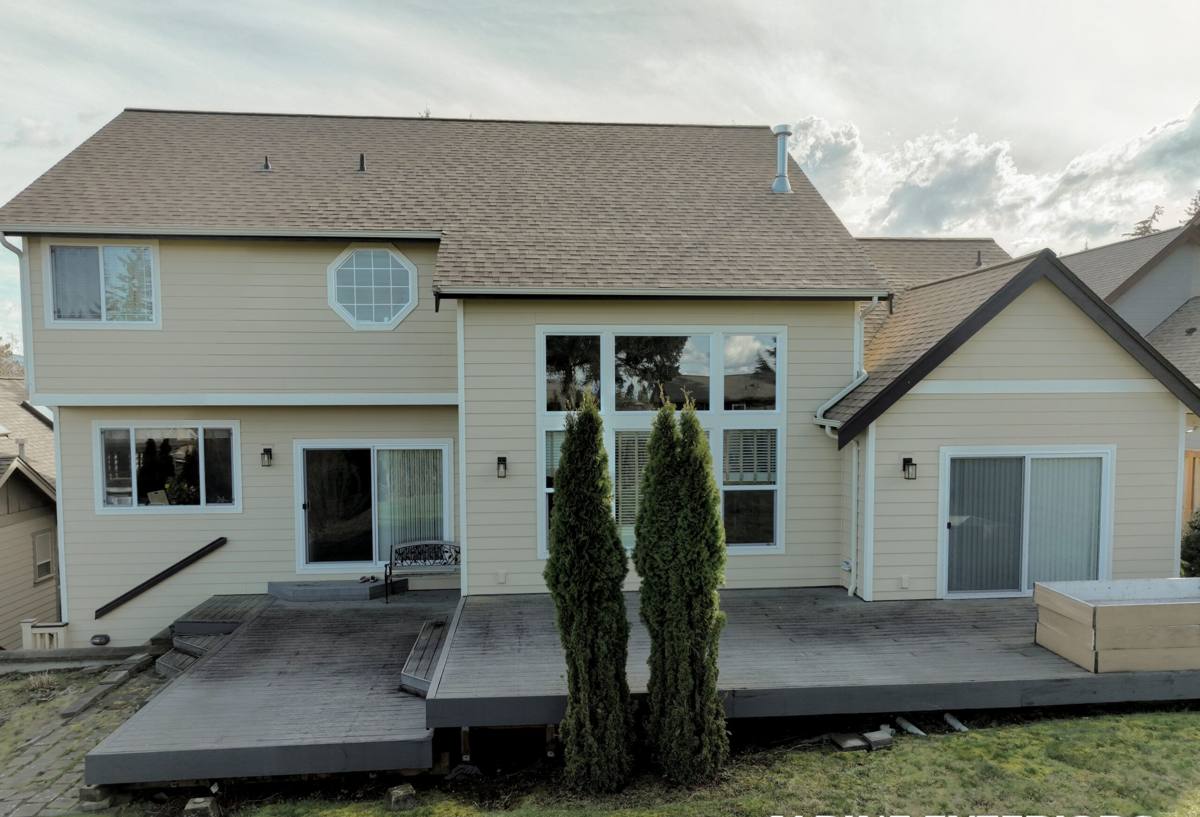
Why Coastal Conditions Age Decks Differently
Salt Air and Metal Fasteners
Standard galvanized screws and nails have a limited lifespan in a salt-air environment. Once the zinc coating breaks down — which happens faster here than in a dry inland climate — the steel underneath starts to corrode. Corroding fasteners lose grip strength, streak the surrounding wood with rust stains, and eventually shear or back out under load. On a deck close enough to Birch Bay to catch regular onshore air, this is one of the most common root causes we find when a board feels loose or a railing has developed play.
Moisture That Doesn't Fully Dry
Driving rain off the Strait combined with shade and tree cover common in this neighborhood means some deck sections simply don't get the sun exposure needed to dry out between storms. Wood that stays damp for extended periods is more prone to rot, especially at ledger boards, joist ends, and anywhere two pieces of lumber meet without a gap for airflow. Composite decking resists rot in the boards themselves, but the substructure underneath — almost always real lumber — is just as vulnerable as any wood deck.
Moss and Algae Growth
Whatcom County's moss season runs long, and a deck surface that holds moisture is an easy place for moss and algae to take hold. Beyond looking bad, moss holds water against the decking material and creates a genuinely slick, dangerous walking surface — especially on stairs. A repair visit is also the right time to address the drainage or slope issues that let moss establish in the first place, rather than just cleaning it off and expecting it to stay gone.
What a Correct Deck Repair Actually Involves
A repair that's done right starts with figuring out why a problem happened, not just patching the visible symptom. We look at the whole system — decking, framing, fasteners, flashing, and drainage — because a soft board is often a symptom of a moisture problem one layer down.
Structural Inspection First
Before replacing a single board, we check ledger board attachment, joist condition, post bases, and any spots where water has clearly been sitting. A deck that looks fine on the surface can still have a weakened ledger connection or rotting joist ends underneath — and that's the kind of thing that matters for safety, not just appearance.
Matching Repairs to Cause, Not Just Symptom
If boards are failing because of standing water, replacing the boards without correcting the drainage or slope just resets the clock on the same failure. If fasteners are corroding, we don't just replace the visible ones — we check nearby fasteners of the same type and vintage, since if one has failed from salt exposure, others installed at the same time are usually not far behind.
Fastener and Hardware Upgrades
Where the original build used standard hardware that hasn't held up to coastal exposure, we typically recommend stepping up to stainless steel or coated fasteners rated for higher corrosion resistance. It costs more up front than matching the original hardware, but for a deck exposed to Birch Bay's salt air, it's the difference between a repair that lasts and one that needs revisiting in a few years.
Our Repair Process
- On-site assessment. We walk the full deck — surface, railings, stairs, and the structure underneath where accessible — and identify every problem area, not just the one that prompted the call.
- Honest scope conversation. We explain what's actually going on, what needs to be fixed now for safety, and what's cosmetic or can reasonably wait. You get a clear picture before any work starts.
- Repair or replace, decided board by board. Sound lumber and structure stays. Anything compromised — soft wood, corroded fasteners, cracked or split boards — gets replaced rather than patched.
- Address the cause. If drainage, slope, or airflow contributed to the damage, we correct that as part of the repair so the same failure doesn't recur in the same spot.
- Final check. We walk the deck again once work is complete to confirm everything is solid — no soft spots, no loose railings, no fasteners backing out.
Common Deck Repair Needs We See in Birch Bay Village
- Soft, spongy, or discolored decking boards near the water side of the deck
- Loose or wobbly railings caused by corroded or failed fasteners
- Rot at ledger boards where the deck attaches to the house
- Stair stringers or treads weakened from prolonged moisture exposure
- Moss and algae buildup creating slick, unsafe walking surfaces
- Rust staining around fastener heads on wood decking
- Gaps or separation between decking boards from repeated wet-dry cycling
- Standing water pooling on the deck surface after rain instead of draining off
Repair vs. Replacement: How We Decide
| Factor | Leans Toward Repair | Leans Toward Replacement |
|---|---|---|
| Structural framing | Joists and ledger are sound, only isolated boards affected | Widespread rot in joists, ledger, or posts |
| Age of the deck | Deck is under 10-15 years old with localized issues | Deck is at or past typical service life with multiple failure points |
| Extent of damage | Damage limited to specific boards or a section | Damage spread across most of the deck surface |
| Cause of failure | Cause is identifiable and correctable (drainage, fastener type) | Original design or construction has a systemic flaw |
| Cost over time | Repair cost is a fraction of full replacement | Repeated repairs are approaching replacement cost |
Most of the calls we get in Birch Bay Village are genuinely repair situations — a section of decking, a run of railing, a spot of ledger rot. Full replacement usually only makes sense when the underlying structure has been compromised across most of the deck, or when repeated patch repairs have already added up to a significant share of what a rebuild would cost.
What Affects the Cost of a Deck Repair
Every deck repair is different, so we don't quote a number until we've seen the deck in person. In general, cost is driven by a handful of factors:
- Scope of damage — a few boards versus a full section versus structural framing work
- Access — decks with tight clearance underneath or limited access for materials take more labor time
- Material match — matching existing decking (especially discontinued or custom-stained boards) can add time and cost versus a straightforward swap
- Hardware upgrades — moving to corrosion-resistant stainless fasteners costs more than standard hardware but pays off in longevity near the water
- Drainage or structural corrections — fixing the underlying cause, not just the symptom, adds scope but prevents repeat repairs
Straightforward board and railing repairs on a healthy structure are generally the most affordable end of the range; anything involving ledger board rot, joist replacement, or major drainage correction runs higher because it's structural work, not cosmetic.
Maintenance That Extends the Life of a Repair
A good repair buys you time, but a few habits stretch that time further in this climate:
- Keep debris — leaves, needles, dirt — swept off the deck surface so it doesn't trap moisture against the boards
- Clean moss and algae off surfaces and stairs before they build up, especially heading into the wetter months
- Check railings and stair treads periodically for movement, which often signals a fastener starting to fail
- Make sure gutters and downspouts near the deck aren't dumping extra water onto or under it
- Re-seal or re-stain wood decking on the manufacturer's recommended schedule rather than letting finish wear through
Why Hire a Crew That Already Works Birch Bay Village
A contractor who works this area regularly isn't learning the local climate on your deck. We already know how salt air treats fasteners, how shaded, moisture-heavy lots behave differently than sun-exposed ones a mile away, and which repair shortcuts don't hold up through a Whatcom County winter. That familiarity means fewer surprises, a more accurate first assessment, and repairs that are built for the conditions your deck actually faces rather than a generic fix that happens to look right on the day it's finished.
If you've got a deck in Birch Bay Village that's showing soft spots, loose railings, moss buildup, or anything else that doesn't look or feel right, we're happy to come take a look. Reach out for a free, no-pressure estimate using the form below.