 Birch Bay Window
 Custer's Exterior Walls Work Harder Than People Think
Custer sits close enough to Birch Bay and the Strait of Georgia that homes here deal with a specific combination of stresses: salt-laden air moving in off the water, long stretches of driving rain through fall and winter, and a moss and algae season that can run most of the year in the shaded, damp spots around a house. None of these things is dramatic on its own. Together, over ten or twenty years, they're what separates a siding job that still looks tight and clean from one that's chalking, staining, or rotting at the bottom courses.
Whatcom County's exterior contractors see this pattern constantly: siding fails first at the places where water lingers — under windows, behind trim, at the base of walls near grade, and on the north and west faces that stay wet the longest between storms. Any siding material can be made to work in this climate for a while. The question for a Custer homeowner isn't "will this look good on day one," it's "what does this wall look like in year fifteen."
Why We Install James Hardie and Nothing Else
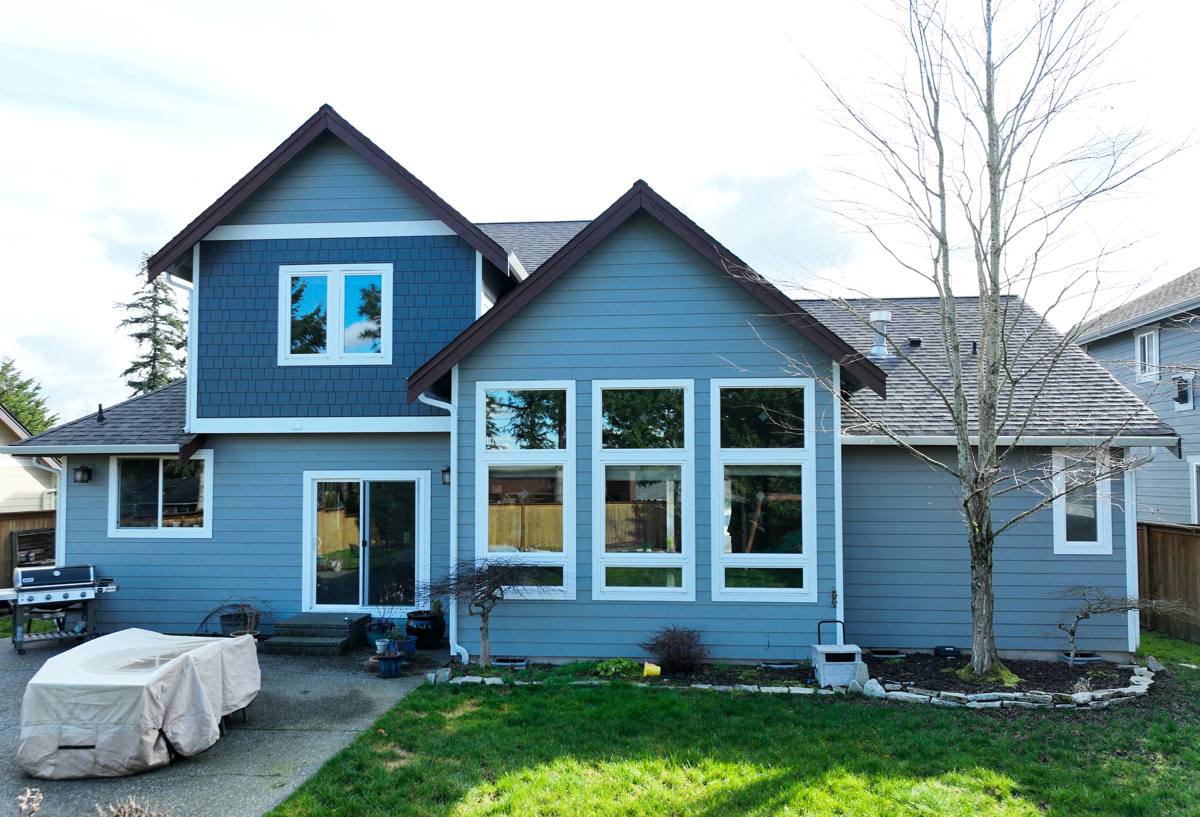
We standardized on James Hardie fiber cement siding for every home we side, including here in Custer, and we don't install vinyl, LP SmartSide, cedar, primed spruce, or other fiber cement brands. That's a deliberate professional standard, not a sales position. Fiber cement made with Portland cement, sand, and cellulose fiber doesn't feed mold or moss the way wood-based products can, doesn't soften or swell when it takes on moisture at a cut edge, and doesn't warp or go brittle under UV and salt exposure the way vinyl can over a long service life near the water.
Within fiber cement, we use James Hardie specifically because of three things that matter in this climate: their HZ5 product engineering for the Pacific Northwest's wet-cold-wet cycle, the ColorPlus factory finish that keeps field-painting off the maintenance list for years, and a manufacturer warranty structure that's genuinely transferable and backed by a company with the scale to stand behind it. We'd rather explain honestly why we don't install other products than oversell a job we're not confident will hold up on a Custer property.
What Correct Installation Actually Involves
Following the Manufacturer's Instructions, Not Shortcuts
James Hardie siding is only as good as its installation. The product itself is engineered to resist moisture and hold paint, but every failure we get called out to inspect on fiber cement siding traces back to installation, not the material. That means following Hardie's published fastening patterns, clearances, and flashing details to the letter — not "close enough."
Water Management Behind the Siding
The siding itself is the visible layer, but the water-resistive barrier and flashing behind it are what actually keep a Custer home dry through a wet Whatcom County winter. Correct installation means a continuous weather-resistive barrier, properly lapped and taped seams, head flashing over every window and door, and kick-out flashing wherever a roofline meets a wall. Skipping or rushing any of this is invisible on installation day and shows up as rot or staining years later.
Clearances That Prevent Moss and Rot
Hardie specifies a minimum clearance from siding to grade, roofing, decks, and other horizontal surfaces — typically at least a few inches, more in some conditions. That gap matters more here than in a drier climate, because it's the difference between a wall that dries out between rain events and one that stays damp long enough to grow moss or start wicking water into the substrate. We hold these clearances even when it would be faster or cheaper to crowd the siding tighter to a patio or planting bed.
Fastening and Butt Joints
Fasteners have to be driven correctly — not overdriven, which crushes the material and creates a wick point for water, and not underdriven, which leaves the board loose to move and crack. Butt joints between boards need to be properly sealed or flashed, since an open or poorly caulked joint is one of the most common entry points for water on any lap siding installation.
The HZ5 Line: Built for This Exact Climate
James Hardie makes region-specific formulations under its HZ (HardieZone) system, and HZ5 is engineered for areas that see freeze-thaw cycling combined with sustained moisture — which describes a Custer winter well. HZ5 siding is formulated to resist moisture absorption and to hold up through repeated wet-cold-wet cycles better than a general-purpose formulation would. It's not a marketing tier; it's a different manufacturing recipe suited to the actual weather the siding will face on your walls.
ColorPlus Factory Finish vs. Field Painting
One of the most practical advantages of Hardie siding in a salt-air, high-moisture area like Custer is the ColorPlus finishing option — a factory-applied, baked-on finish that's far more consistent and durable than paint applied on-site after installation. Here's how the two approaches compare for a coastal Whatcom County home:
| Factor | ColorPlus Factory Finish | Field-Applied Paint |
|---|---|---|
| Application conditions | Controlled factory environment, consistent every time | Dependent on weather and temperature at time of installation |
| Coverage of cut edges | Touch-up formula available, edges primed at cut | Cut edges need field priming and painting on-site |
| Typical repaint interval | Often 15 years or more before a full repaint is needed | Commonly 5-8 years in a wet coastal climate |
| Salt air performance | Formulated to resist fading and coastal exposure | Standard exterior paint, variable resistance by product |
| Warranty | Backed by Hardie's finish warranty | Warranty is on the paint product, separate from siding |
For a property this close to the water, that longer repaint interval isn't a cosmetic nicety — it's fewer scaffolding jobs, fewer weekends spent pressure-washing and repainting, and a more consistent-looking home in between.
How Our Process Works on a Custer Home
- On-site assessment — we walk the exterior, check for existing moisture damage, evaluate current siding condition, and look at grading, roof lines, and any spots prone to standing water or shade.
- Product and color selection — we go over the HZ5 board profiles (lap, panel, shingle-style) and ColorPlus color options that fit the home and the neighborhood.
- Tear-off and substrate check — old siding comes off and we inspect sheathing underneath for any rot or damage that needs to be addressed before new siding goes up. Covering up a damp substrate is how a good siding job goes bad in five years instead of thirty.
- Weather barrier and flashing — a continuous, correctly lapped water-resistive barrier goes on first, with flashing detailed at every window, door, and roofline intersection.
- Siding installation — boards are installed to Hardie's fastening schedule and clearance specs, with joints sealed or flashed per the manufacturer's requirements.
- Final inspection and cleanup — we walk the finished job against the install checklist before calling it complete.
Signs a Custer Home May Need New Siding
Not every issue means a full re-side, but these are worth having looked at, especially on older siding that's been through many wet seasons:
- Persistent moss or algae growth that comes back within weeks of cleaning
- Soft spots or visible warping, especially near the bottom of walls or under windows
- Paint that's peeling or bubbling rather than just fading
- Visible gaps at butt joints or trim where caulking has failed
- Staining that tracks down from window heads or roof-to-wall intersections
- Siding that sits tight against grade, a deck, or a patio with little to no gap
What Drives the Cost of a Siding Project
Every home is different, but these are the main factors that move a project's cost up or down. We'll walk through all of them specifically for your home during a free estimate rather than quoting a number sight unseen.
| Factor | Why It Matters |
|---|---|
| Home size and wall complexity | More corners, dormers, and roof intersections mean more flashing detail and labor time |
| Substrate condition | Rotted sheathing found during tear-off adds repair work before new siding can go on |
| Board profile and texture | Lap, panel, and shingle-style Hardie products differ in material and labor cost |
| Color and finish | Standard ColorPlus colors vs. custom or premium options affect material pricing |
| Access and site conditions | Tight lots, slopes, or landscaping close to the house can affect staging and labor |
| Trim and detail work | Window and door trim, corner boards, and fascia detailing add scope |
Why a Crew That Already Works Custer Matters
Siding installation done to spec looks the same on paper anywhere. What's different in Custer is knowing, from repeated experience, exactly where a given roofline is going to funnel water, which walls stay shaded and damp longest through a Whatcom County winter, and how much clearance really holds up against the moss growth this area produces. A crew that's installed Hardie siding on other homes nearby isn't guessing at those details — they've already seen how the last job held up two or three winters later, and that feedback shapes how the next one gets built.
It also matters for something less visible: manufacturer certification and warranty registration. Hardie's strongest warranty backing goes to installations done by trained installers following their specifications. A local crew with a track record on James Hardie specifically — not siding in general — is what keeps that warranty meaningful if you ever need to use it.
Ready to Talk About Your Home
If your Custer home's siding is showing its age, or you're planning ahead before the next wet season, we're happy to take a look and give you a straightforward, no-pressure assessment. Use the form below to request a free estimate, and we'll walk your property, answer your questions about James Hardie's product lines and finishes, and give you honest numbers to work from.