 Birch Bay Window
 Why Sumas Homes Wear Out Their Siding Faster Than the Brochure Promises
Whatcom County weather doesn't do siding any favors. Sumas sits in a corner of the county that catches long stretches of low cloud, steady drizzle, and the kind of damp cold that never quite dries out between storms. Add in salt-laden air moving inland off the Strait and Georgia Basin during wind events, and you've got a climate that's constantly testing whatever material is bolted to the outside of a house. Wood siding checks and rots. Vinyl goes brittle and gapped. Even good products fail early when they're installed without accounting for how much moisture this region actually throws at a wall assembly.
The result, on a lot of older Sumas homes, is siding that looks tired well before its rated lifespan is up: green-black moss creeping up from the bottom courses, paint that's peeling in sheets on the north and west exposures, and trim boards gone soft at the corners. None of that is really about age. It's about material choice and installation quality meeting a wet, moss-friendly climate that doesn't leave much room for error.
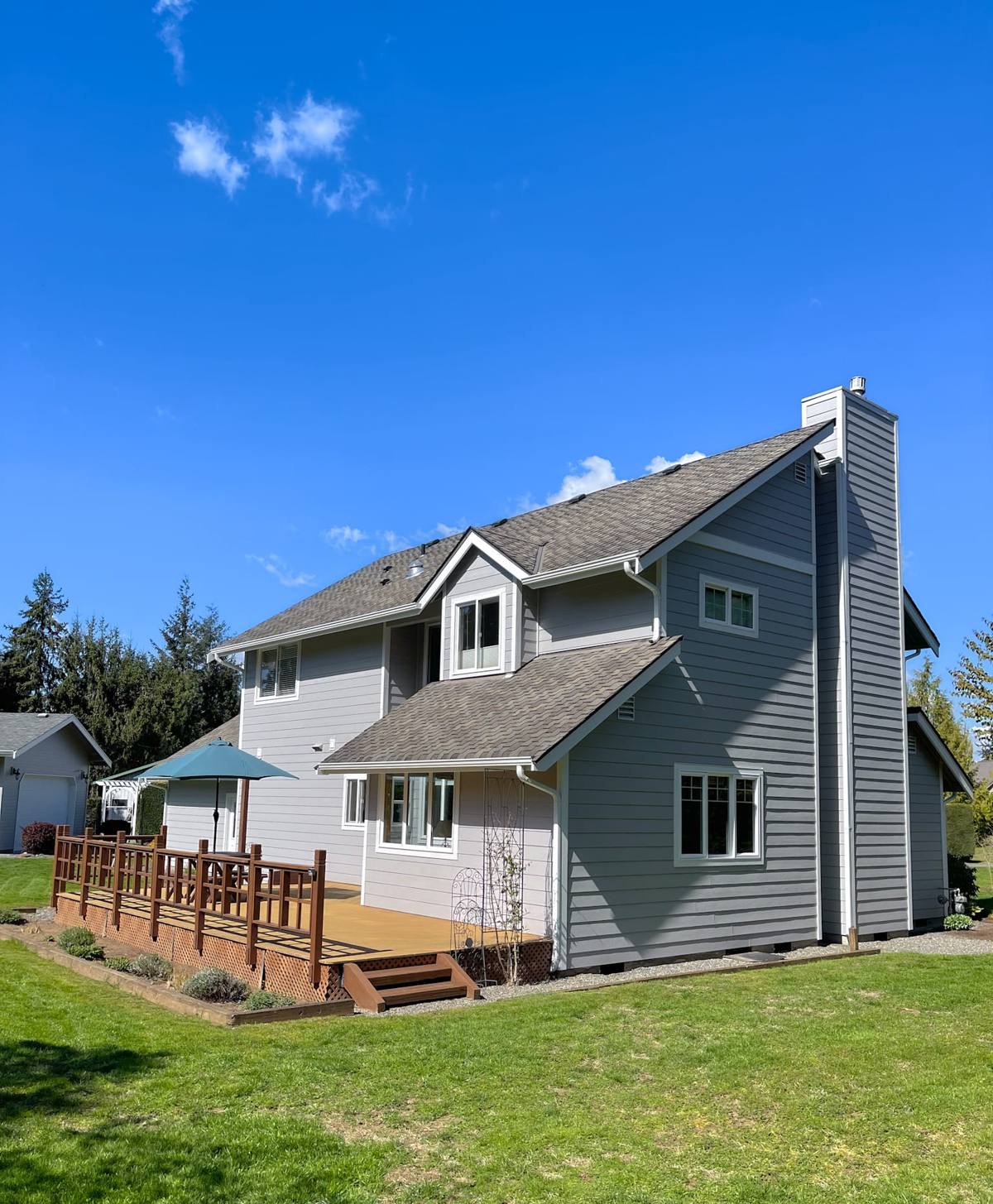
What This Climate Actually Demands From a Siding System
Before talking about any specific product, it helps to be clear on what Sumas siding actually has to survive year after year:
- Extended dampness — long grey stretches where siding stays wet for days, not hours, giving moss, algae, and rot fungus time to establish
- Driving rain — wind-driven storms that push water sideways into laps, joints, and trim intersections, not just straight down the face of the wall
- Salt-influenced air — corrosive to unprotected fasteners and hard on painted finishes that aren't formulated to hold up under it
- Freeze-thaw swings — winter cold snaps that stress any material holding trapped moisture
- Shade and tree cover — common on Whatcom County lots, which slows drying time and extends the moss season even further
A siding material and installation that can't handle all five of those, together, is going to underperform here regardless of what it costs going in.
Why We Install Only James Hardie Fiber Cement
We standardized this company on James Hardie siding exclusively. We don't install LP SmartSide, vinyl, Cemplank, Allura, primed spruce, or cedar — not because those products have no merit anywhere, but because we've made a professional judgment that they carry real trade-offs in a climate like ours: moisture-sensitive cores, maintenance burdens that creep up fast, or factory finishes that don't hold color and adhesion the way we want to stand behind for years after the install.
James Hardie fiber cement is non-combustible, dimensionally stable when it gets wet, and available in HZ formulations specifically engineered for climate zones like the Pacific Northwest. It doesn't swell, and it doesn't rot. Paired with a factory-baked ColorPlus finish, it holds its color and its bond far longer than field-applied paint on wood or composite substrates typically does. That combination — a stable substrate plus a finish that isn't fighting our rain and UV cycle from day one — is why it's the only product we put on a Sumas home.
How James Hardie Handles the Specific Problems Sumas Sees
| Local Problem | How Hardie Fiber Cement Responds |
|---|---|
| Extended dampness / moss growth | Won't rot or swell when wet; ColorPlus finish resists mildew staining better than field-painted surfaces |
| Driving, wind-blown rain | Rigid board holds its shape at laps and joints, reducing gaps that let water track behind the cladding |
| Salt-influenced air | Non-combustible, non-organic core isn't susceptible to the corrosion and biological growth that affects wood |
| Freeze-thaw cycling | Dimensionally stable material doesn't expand/contract the way wood or some composites do when saturated then frozen |
| Shaded, slow-drying lots | Factory finish and fiber-cement core tolerate longer wet cycles without the finish failing early |
What a Correct Hardie Installation Actually Involves
Hardie siding's long-term performance depends almost entirely on installation quality — this is a product that rewards care and punishes shortcuts. A correct install in a wet climate like Sumas includes several things that are easy to skip and hard to spot once the siding is up:
Weather-Resistive Barrier and Drainage Plane
Behind every board, there needs to be a properly lapped weather-resistive barrier and a drainage gap that lets any incidental moisture that does get behind the siding find its way back out instead of sitting against the sheathing. On a house taking regular driving rain, this drainage plane is doing real work, not just satisfying a checklist.
Flashing at Every Penetration
Windows, doors, hose bibs, light fixtures, deck ledgers — every penetration through the siding plane needs proper flashing that directs water outward and downward, never into the wall assembly. This is where most siding failures in this region actually originate, and it's invisible once the trim is on.
Fastening and Clearances to Hardie's Spec
James Hardie publishes specific fastener types, spacing, and minimum clearances from grade, roof lines, and decks. Cutting corners here — using the wrong fastener, nailing too close to a board edge, or leaving insufficient ground clearance — voids warranty coverage and creates the exact wicking points that let moisture into the assembly in a climate that doesn't forgive that mistake.
Caulking and Joint Treatment
Butt joints, corners, and trim intersections need to be treated correctly — some sealed, some designed to shed water without sealant at all, depending on the detail. Over-caulking is as much of a problem as under-caulking; it can trap moisture instead of letting it drain.
Our Process for a Sumas Siding Project
- On-site assessment — we walk the exterior, check for existing moisture damage, moss buildup, and trim condition, and look at how the house is actually oriented to prevailing wind and rain
- Scope and product selection — HardiePlank lap, HardiePanel, or a mix with HardieTrim, matched to the home's exposure and style, in the appropriate HZ formulation
- Tear-off and substrate check — removing existing siding gives us a look at the sheathing and framing underneath; any rot or damage gets addressed before anything new goes up
- Weather barrier and drainage plane installation — done to manufacturer spec, not shortcut for speed
- Flashing at all penetrations — windows, doors, and any wall-mounted fixtures
- Siding installation to Hardie's fastening and clearance requirements
- Trim, caulking, and paint touch-up — finishing details that determine how clean the job looks and how well it sheds water at the joints
- Final walkthrough — reviewing the finished work with the homeowner before we consider the job done
Product Lines and Color Considerations
James Hardie's HZ5 and HZ10 formulations are engineered for different climate zone demands; for Whatcom County's damp, moderate climate, we select the formulation and product line that matches the specific exposure of the home rather than defaulting to one option across every project. ColorPlus finishes are factory-applied and baked on, which matters more here than in a drier climate — a field-painted finish has to fight our rain and humidity cycle from day one, while ColorPlus is cured and ready to perform before it ever reaches the site.
Lighter, warmer color tones tend to show streaking and staining less than very dark, matte finishes in a climate with this much organic growth potential, though the right choice always depends on the home's design and the homeowner's preference. We'll talk through the trade-offs honestly rather than just pushing whatever's easiest to install.
Cost Factors on a Sumas Project
We don't publish blanket per-square-foot pricing because it depends heavily on the specifics of the house, but these are the variables that actually move the number:
| Factor | Why It Affects Cost |
|---|---|
| Existing siding removal | Tear-off, disposal, and any substrate repair found underneath add labor and material |
| Wall complexity | Dormers, multiple gables, and cut-up elevations take more time than flat, simple wall planes |
| Product selection | Lap siding, panel siding, and shingle-style profiles carry different material and labor costs |
| Trim scope | Full HardieTrim window and corner treatments cost more than minimal trim packages |
| Access and site conditions | Tree cover, tight lot lines, and staging access affect labor time on a project |
| Moisture or rot repair | Any sheathing or framing damage found during tear-off is addressed before new siding goes on |
Maintaining Hardie Siding in a Sumas Climate
James Hardie siding is genuinely low-maintenance compared to wood or composite alternatives, but "low-maintenance" isn't "no-maintenance" in a climate that grows moss on everything. A simple annual routine keeps it performing and looking right:
- Rinse the siding down once a year, especially north- and west-facing walls that stay shaded and damp longest
- Keep gutters clear so overflow isn't running down the face of the siding
- Trim back vegetation and tree limbs that hold moisture against the wall or block airflow
- Check caulking at trim joints and penetrations periodically for cracking or separation
- Address any impact damage or chipping promptly so the substrate underneath stays protected
Why It Matters That We Already Work in Sumas
A crew that's installed siding on other Whatcom County homes already understands how this specific climate behaves — where the wind-driven rain hits hardest on a typical lot orientation, how much moss pressure to expect on a shaded north wall, and which flashing details actually matter versus which ones are boilerplate in a drier region's install manual. That local knowledge shows up in decisions that don't get written on the estimate: where to add extra flashing attention, which product line makes sense for a particular exposure, how to sequence the job around the wet season.
It also means warranty support and any follow-up questions come from a crew that's still local and still reachable, not a company that did one job in the area and moved on.
If you're weighing a siding replacement in Sumas, we're happy to take a look at your home and walk you through what a James Hardie installation would involve — no pressure, no obligation. Use the form below to request a free estimate.